







How does this happen?

Road Master
Joined: Feb 2011
Posts: 1,120
Likes: 4

There is a ways two determine if a bolt sheared off due to over torquing or due to side load issues. If the bolts failed due to shear only you will be able to see a planer grain failure, if they failed due to over torquing you will be able to see a circular pattern in the ductile material. The problem is getting a high power view of the failure area of the bolt. BTW I have never remove mine to change the rear tire (Fatboy).......I have not had to change the rear on my SG yet.

Seasoned HDF Member


Joined: Jul 2011
Posts: 27,096
Likes: 4,673
From: Frozelandia, Minnysota
I'm getting suspect of Harley parts, so many from China, and not all bolts are grade 8, either. I get grade 8 bolts elsewhere, and hope when they claim American made, they aren't lying. But actually, I'd go with the loose or over torqued theory, too, that's common; a lot of mechanics have "calibrated" arms and don't use torque wrenches. I'm not one of them.
Removing pulley - that can depend on the tire changer, too. You can see in the pic that mine needs either the pulley or the disk removed to use the bar. Since this one was off a used bike, I removed the pulley so I could be sure it was put on with red loctite and the correct torque, but removing the disk is easier; no need to remove both on mine. Not all changers are the same, though. I've used spoons before, and removed both disk and pulley to avoid damage, though if you're really careful you could do it without removing them.
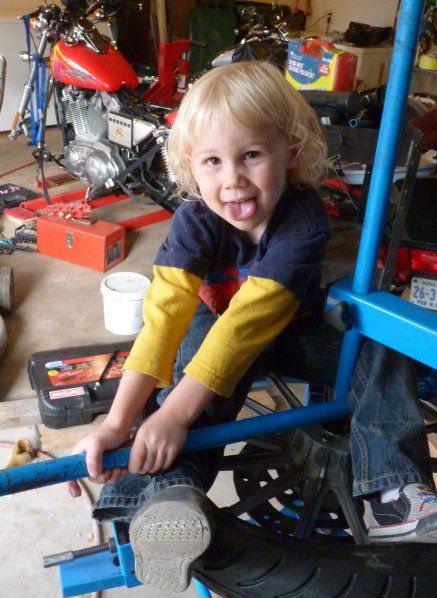
Removing pulley - that can depend on the tire changer, too. You can see in the pic that mine needs either the pulley or the disk removed to use the bar. Since this one was off a used bike, I removed the pulley so I could be sure it was put on with red loctite and the correct torque, but removing the disk is easier; no need to remove both on mine. Not all changers are the same, though. I've used spoons before, and removed both disk and pulley to avoid damage, though if you're really careful you could do it without removing them.

Last edited by Imold; Sep 8, 2014 at 07:54 AM.
Outstanding HDF Member
Joined: Feb 2007
Posts: 2,976
Likes: 49
From: Northern California
I have reused the factory pulley and brake disk bolts and as of yet not a failure. I do use loctite and a torque wrench. Removal of these items for tire removal depends on the installer and machine.
I have a pulley with 900 miles from a 2007 or 2008 Ultra for sale if needed.
I have a pulley with 900 miles from a 2007 or 2008 Ultra for sale if needed.

Road Master
Joined: Oct 2006
Posts: 832
Likes: 6
From: Vermont
Was your '07 retrofitted with IDS? Some of the first generation IDS installations in '07 experienced the bolt shearing problem. The failures occurred fairly soon after installing though, not years after like yours.

Former Sponsor
Joined: Aug 2005
Posts: 10,968
Likes: 54
No red loctite and not torqued properly with new bolts. Red loc tite new bolts torque to 65-75 ft lbs. I see this all the time. Pulley's do not usually need to come off for a tire install but it depends on who is doing it and what tire machine they are using.
Seasoned HDF Member

Joined: Jun 2006
Posts: 30,875
Likes: 32,934
From: King George, VA
Any damage to the swing arm?
HD Forum Stories
The Best of Harley-Davidson for Lifelong Riders

7 Surprising Harley-Davidson Products that Are Not Motorcycles
Verdad Gallardo
8 Best Harley-Davidson Motorcycles Ever
Pouria Savadkouei
10 Worst Harley-Davidson Motorcycles Ever
Pouria Savadkouei
Killer Custom's Jail Break Is The Breakout That Refused to Blend In
Verdad Gallardo
Crazy Bunderbike Build Looks Amazing, But Is It Impossible to Ride?
Verdad Gallardo
Harley-Davidson Reveals Super Cool Cafe Racer Concept
Verdad Gallardo
Engraved Rebellion: Inside Bundnerbike's Glam Rock II
Verdad Gallardo
10 Motorcycles You Should Never Buy
Joe Kucinski
10 Things Harley-Davidson Needs to Fix in 2026
Verdad Gallardo
Thread Starter
|
Stage III
Joined: Aug 2014
Posts: 3
Likes: 0
From: Huntley
Thanks for the comments guys. I'm still floored that this happened. I'm going to see about removing the rear wheel this weekend. I haven't been able to get a good view on the inside of the swing arm. Hopefully I am not going to have to replace the swing arm or the rear wheel.

Thread
Thread Starter
Forum
Replies
Last Post