




problems with new pipe

Thread Starter
|
Stage II
Joined: May 2010
Posts: 2
Likes: 0
 problems with new pipe
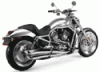
i have a 2004 v rod and just had thunderheader pipes put on. before this my bike ran great but the day that i brought my bike home, the power was not there and it died on me four times and smelled like gas. the next day i took it back which the bike died three more times and the power still was not there. during the work on the bike, the employees at C n A harley davidson, they are now telling me that there is something wrong with the cylinders and that they had done what they needed to while putting the new pipes on. to me, this does not make sense that my bike ran great before the new pipes and now it barley runs. anyone have any ides?

Road Captain
Joined: Aug 2009
Posts: 520
Likes: 1
From: Newark OH
Did they retune it also? If not this is needed to be done. With the gas smell it sounds like its running rich, however with new pipes it should be running leaner. Have you pulled the spark plug and read it?
Also you don't say where you are located. Is this the C n a in ohio you are referring to?
MH
Also you don't say where you are located. Is this the C n a in ohio you are referring to?
MH

Road Captain
Joined: Feb 2010
Posts: 560
Likes: 10
From: Livermore, CA
It could be that the new Thunder Header doesn't have ports for the O2 sensors and the installer just took them out of the circuit. Without a tune and with no oxygen sensors would put the computer in limp mode. Limp mode will let the bike run but in a way so that it won't harm itself (way rich and with very little ignition advance).

Stage III
Joined: May 2010
Posts: 3
Likes: 0
From: Pocono Mountains, Pennsylvania
Eric is totally correct.............
The Revolution motor is nothing like any air cooled HD motor. Not only do they need proper tuning like a Power Commander 3 or one with Auto Tune, they need back pressure. Many guys have found that when they tune there super loud pipes on their V Rods so that they run smooth, they were actually making less horsepower but the funny thing is that many of them don't care because they like the sound that much. The Revolution motor was made to be hammered and bolt on modifications are available by the truck loads. Just remember one thing, we all love the sound of overly loud pipes when they're first put on the bike but try taking a ride to the shore or any long ride on the highway, believe me they can get old really quick. Mine has D&D slip ons and everyone tells me they need to be louder and I reply, BS, they're plenty loud enough and the bike pulls like a rocket right up to the point that I'm not sure I can hold onto the handlebars any longer. I've only done it once and backed off at 140 mph and it wasn't at red line either. Believe me, I will never ride that fast again no matter how smooth and solid it felt. They top out at around 146 stock for the 1130's and maybe a few mph's faster for the 1250's but again, keep in mind that it's a cruiser bike, not a Daytona Track Racer.
Ed
Ed

Elite HDF Member
Joined: Sep 2007
Posts: 4,541
Likes: 1
From: Nuevo México, Los Estados Unidos de América
Your bike needs to be tuned. Thunderheaders are easy to tune. Depending on which tuner you get, you can probably find a decent map online (1130cc.com) if you can't afford a custom tune right now.
As far as loud pipes: remember the bike gets louder as you rev. So an air-head that idles nicely will never get that loud since they redline at 5.5k and most airheads rarely take it above 3k just driving around. On the other hand, the Revo will be running over 5k all the time, and I bring mine up to 10k on the stip... that's some real noise.
Back Pressure: you don't need back-pressure.
You get the most power with the highest velocity exhaust. Think about water in a pipe coming down from a water tower. If the tower is large (high volume) the pipe that will carry the water to the sink at the highest velocity will be large. If the pipe is too small the water will clog, and the velocity will be sub-optimal. If the pipe is to wide, the pressure will be too low, and the velocity will be sub-optimal. The same big pipe on a large water tower, on a small water tower will be sub-optimal, there will be no pressure, and thus a lower velocity.
An engine is like the water tower in the analogy. There is an ideal sized pipe (length, and diameter) for every engine/power-output out there. You only need back pressure if you're trying to quit the engine down, or you've selected a pipe that is too "large" (like short cut drag pipes) for your engine. Also, there is an ideal pipe for every every engine at every single engine speed: a shorter, more open pipe (larger) will be more ideal for higher RPMs, while a longer, narrower (smaller) exhaust will work better at lower RPMs.
As far as loud pipes: remember the bike gets louder as you rev. So an air-head that idles nicely will never get that loud since they redline at 5.5k and most airheads rarely take it above 3k just driving around. On the other hand, the Revo will be running over 5k all the time, and I bring mine up to 10k on the stip... that's some real noise.
Back Pressure: you don't need back-pressure.
You get the most power with the highest velocity exhaust. Think about water in a pipe coming down from a water tower. If the tower is large (high volume) the pipe that will carry the water to the sink at the highest velocity will be large. If the pipe is too small the water will clog, and the velocity will be sub-optimal. If the pipe is to wide, the pressure will be too low, and the velocity will be sub-optimal. The same big pipe on a large water tower, on a small water tower will be sub-optimal, there will be no pressure, and thus a lower velocity.
An engine is like the water tower in the analogy. There is an ideal sized pipe (length, and diameter) for every engine/power-output out there. You only need back pressure if you're trying to quit the engine down, or you've selected a pipe that is too "large" (like short cut drag pipes) for your engine. Also, there is an ideal pipe for every every engine at every single engine speed: a shorter, more open pipe (larger) will be more ideal for higher RPMs, while a longer, narrower (smaller) exhaust will work better at lower RPMs.
Trending Topics

Intermediate
Joined: Apr 2010
Posts: 28
Likes: 0
From: Buffalo,NY
PCV with autotune works great....There are lots of maps on the internet you can use and adjust as you need
HD Forum Stories
The Best of Harley-Davidson for Lifelong Riders

Jason Momoa Is Turning Classic Harleys Into PHEVs
Verdad Gallardo
Harley-Davidson Fat Boy Becomes a Dark, Decepticon-Inspired Custom
Verdad Gallardo
6 Weirdest Harley-Davidsons Ever Sold to the Public
Verdad Gallardo
7 Times Harley-Davidson Chucked Tradition Out the Window
Verdad Gallardo
7 Surprising Harley-Davidson Products that Are Not Motorcycles
Verdad Gallardo
8 Best Harley-Davidson Motorcycles Ever
Pouria Savadkouei
10 Worst Harley-Davidson Motorcycles Ever
Pouria Savadkouei
Killer Custom's Jail Break Is The Breakout That Refused to Blend In
Verdad Gallardo
Crazy Bunderbike Build Looks Amazing, But Is It Impossible to Ride?
Verdad Gallardo


Thread
Thread Starter
Forum
Replies
Last Post
