


Rear Wheel Alignment

Thread Starter
|
Road Master
Joined: Aug 2018
Posts: 766
Likes: 651
From: Reno, NV
 Rear Wheel Alignment
Shop manual says to measure the alignment before removing the rear wheel using an official fancy dancy rear wheel alignment tool...or to make your own home made tool from a coat hanger (I think the manual specifically calls for a welding rod...but yeah). Saw a video of a guy that used a dial micrometer. I have one of those in my reloading bench. I marked the distance between the wheel axle and the axle mounting tab on both sides. When I put the new tire back on I made sure the measurement was the same on both sides. Went for a little test ride and noticed my handlebars are turned slightly to the right. So then I used a straight edge on the wheel long enough to line up with the frame of the bike. The tire seems to be canted to the right. So I adjusted it so the rear tire is now in line with the bike's frame. Took another test run and the front handle bars are fairly close to center now.
Seems odd that the factory service manual is basically telling you to put the wheel on the same way it came off. This assumes the wheel is aligned correctly to begin with. But has absolutely no mention of how to check if it is properly aligned.
Is it just not that important to align it? Do tire shops have fancy laser light equipment to properly align the wheel? Am I going to wear this tire out prematurely? How do you guys do it?
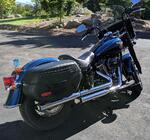
For reference...2018 Heritage.
Seems odd that the factory service manual is basically telling you to put the wheel on the same way it came off. This assumes the wheel is aligned correctly to begin with. But has absolutely no mention of how to check if it is properly aligned.
Is it just not that important to align it? Do tire shops have fancy laser light equipment to properly align the wheel? Am I going to wear this tire out prematurely? How do you guys do it?
For reference...2018 Heritage.
Last edited by Sierra Nate; Jun 20, 2023 at 12:46 PM.


Club Member


Joined: Mar 2009
Posts: 66,115
Likes: 51,405
From: Niles Canyon Ca.
I use the straight edge method still, got in that habit back in the long bike days with choppers. Tried the cute wire gauge tool from the pivot to the axle and never been happy with it. Suspect you are as **** about setup and stuff being correct as I am, the little stuff add's up.

Thread Starter
|
Road Master
Joined: Aug 2018
Posts: 766
Likes: 651
From: Reno, NV
So here's what I learned. Still not convinced I got it right, but it's better.
First...as stated I aligned it to where it was when I took the wheel off. Using a caliper I measured the distance from the tang to the inner axle. That really just gets the alignment close. After riding it a few miles I noticed a sound I can only describe as a groan coming from the drive belt when I slow down or come to a stop.
I jacked the back end up and used a straight edge to align with the frame. Then the sound got worse.
I jacked it up again and this time started with setting the belt deflection using the left adjuster, and then turned the right adjuster as I was spinning the rear tire...adjusted the right until the belt tracked in the center of the rear sprocket while spinning the tire. Tightened everything up and the belt was no longer tracking in the center. Loosened it a bit, adjusted the adjuster screw again and tightened it up again and now the belt is riding in the center like it should.
Took the bike for a ride and no more noise coming from the drive belt. Front bars track straight as an arrow while cruising at 70 MPH on a long straight stretch. Pulled over to check the drive belt again and noticed it is no longer tracking in the center, but it is not making the noise so I feel good about this setup.
140 miles in combo of straight highway and twists yesterday. Bike was smooth as a baby's butt (not that I run around rubbing babies butts...not a pedo here).
First...as stated I aligned it to where it was when I took the wheel off. Using a caliper I measured the distance from the tang to the inner axle. That really just gets the alignment close. After riding it a few miles I noticed a sound I can only describe as a groan coming from the drive belt when I slow down or come to a stop.
I jacked the back end up and used a straight edge to align with the frame. Then the sound got worse.
I jacked it up again and this time started with setting the belt deflection using the left adjuster, and then turned the right adjuster as I was spinning the rear tire...adjusted the right until the belt tracked in the center of the rear sprocket while spinning the tire. Tightened everything up and the belt was no longer tracking in the center. Loosened it a bit, adjusted the adjuster screw again and tightened it up again and now the belt is riding in the center like it should.
Took the bike for a ride and no more noise coming from the drive belt. Front bars track straight as an arrow while cruising at 70 MPH on a long straight stretch. Pulled over to check the drive belt again and noticed it is no longer tracking in the center, but it is not making the noise so I feel good about this setup.
140 miles in combo of straight highway and twists yesterday. Bike was smooth as a baby's butt (not that I run around rubbing babies butts...not a pedo here).

Thread
Thread Starter
Forum
Replies
Last Post









