


Shift Points


Outstanding HDF Member
Joined: Aug 2012
Posts: 3,217
Likes: 90
From: Detroit

So your wheels have connecting rods which basically go up and down? I though that the connecting rods (which are scissor type) need some help from the flywheel to keep rotating when they get to the bottom and a higher rotational speed will help keep those conn rods from trying to push out the bottom.
But maybe I'm full of it and lugging your engine is good for it. From listening to a very few here maybe I should lug it and then I won't have to worry about pesky things like good brakes...
Chonk
But maybe I'm full of it and lugging your engine is good for it. From listening to a very few here maybe I should lug it and then I won't have to worry about pesky things like good brakes...
Chonk
The other type of forces, rotational and reciprocating forces (like the force required to change the direction of the rods and pistons) increase as rpms go up. So the bottom line is that your engine is getting "hammered" hardest at high rpm, combined with high throttle opening.
Things were a little different in the old days, before electronic engine controls became really good at controlling detonation. Detonation produced huge spikes in cylinder pressure and heat, which could indeed put a hammering on parts, and destroy engines. A lot of the lore about "lugging" is left over from those days.

Seasoned HDF Member


Joined: Sep 2013
Posts: 6,175
Likes: 1,966
From: Great State of Canada
I too like running in the 3000ish range with my 103 TC and 204 cam. With a 204, it seems you're not really on the cam till at least 2800 rpm anyway.
I'm wondering though, how keeping the revs up squares with running cams like the 255. These seem to be designed to provide higher torque at lower rpm's. I'm not very savvy when it comes to cams so maybe I'm easily confused, but would running a 255 cam somehow better equip an engine for low rpm upshifting & operation?
I'm certainly sticking with my 204 cam and 3000 + shift pattern but I'm nonetheless curious about this presumptive rpm / cam relationship.
Thanx & sorry for the hijack.
I'm wondering though, how keeping the revs up squares with running cams like the 255. These seem to be designed to provide higher torque at lower rpm's. I'm not very savvy when it comes to cams so maybe I'm easily confused, but would running a 255 cam somehow better equip an engine for low rpm upshifting & operation?
I'm certainly sticking with my 204 cam and 3000 + shift pattern but I'm nonetheless curious about this presumptive rpm / cam relationship.
Thanx & sorry for the hijack.

Cruiser
Joined: Feb 2016
Posts: 149
Likes: 27
From: Quiet end of Silicon Valley
Unless the engine is detonating, forces on the bottom end from combustion pressure are highest around the torque peak (around 3000-3500 rpm on a stock engine). The torque peak is an indication of the rpm where the engine is producing the biggest bang.
The other type of forces, rotational and reciprocating forces (like the force required to change the direction of the rods and pistons) increase as rpms go up. So the bottom line is that your engine is getting "hammered" hardest at high rpm, combined with high throttle opening.
Things were a little different in the old days, before electronic engine controls became really good at controlling detonation. Detonation produced huge spikes in cylinder pressure and heat, which could indeed put a hammering on parts, and destroy engines. A lot of the lore about "lugging" is left over from those days.
The other type of forces, rotational and reciprocating forces (like the force required to change the direction of the rods and pistons) increase as rpms go up. So the bottom line is that your engine is getting "hammered" hardest at high rpm, combined with high throttle opening.
Things were a little different in the old days, before electronic engine controls became really good at controlling detonation. Detonation produced huge spikes in cylinder pressure and heat, which could indeed put a hammering on parts, and destroy engines. A lot of the lore about "lugging" is left over from those days.
You are apparently old school, which I get because I am too to a certain extent, but I have not been assimilated by the MoCo collective.
Just my $.02 worth.
Chonk
Outstanding HDF Member
Joined: Aug 2012
Posts: 3,217
Likes: 90
From: Detroit
Perhaps you'll explain why, in terms of the loads and forces involved, and why you think they are higher at low rpm.
Road Captain
Joined: Jan 2016
Posts: 518
Likes: 244
From: Tucson Arizona
 Another new guy...
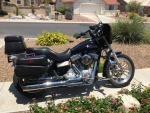
I have just a little over 5,000 miles on my 2010 SG with the 96 CI twin cam. The Torque curve I have seen shows max torque comes on at just over 2500 and the curve remains relatively flat/static all the way up to 4,300 where it beings to drop off. I usually "lazy cruise" at 2200 to 2500 on the flats doing the legal limit or a reasonable facsimile thereof. When I want more speed or power a simple down shift {or two}, works wonders as from 2500 to 4500 it pulls like a runaway train .
Coming off of a light/stop sign I roll out to 3,500 to 4,000 through first, second and third for accelerations sake. Not much need to go past 4,000 in any gear through I have and would not hesitate to do so knowing it won't hurt a thing.
The manual says don't shift to 6th until you are at 50 or better but that feels way to slow. I never hit 6th until at least 60-65 especially since 5th easily takes me to 80 and beyond without complaint {ya gotta let the big dog run every once in a while}.
Driving as I do (hey I'm 64 for Pete's sake), I have far more power on tap in any gear then I am likely to ever need. Better still, solo on the two lanes I consistently get 50 mpg and manage 45 - 47 with two up.
Works for me.
Coming off of a light/stop sign I roll out to 3,500 to 4,000 through first, second and third for accelerations sake. Not much need to go past 4,000 in any gear through I have and would not hesitate to do so knowing it won't hurt a thing.
The manual says don't shift to 6th until you are at 50 or better but that feels way to slow. I never hit 6th until at least 60-65 especially since 5th easily takes me to 80 and beyond without complaint {ya gotta let the big dog run every once in a while}.
Driving as I do (hey I'm 64 for Pete's sake), I have far more power on tap in any gear then I am likely to ever need. Better still, solo on the two lanes I consistently get 50 mpg and manage 45 - 47 with two up.
Works for me.

Thread
Thread Starter
Forum
Replies
Last Post











