When you click on links to various merchants on this site and make a purchase, this can result in this site earning a commission. Affiliate programs and affiliations include, but are not limited to, the eBay Partner Network.
Dyna Glide ModelsSuper Glide, Super Glide Sport, Super Glide Custom, Dyna Glide Convertible, Super Glide T-Sport, Dyna Glide Police, Dyna Switchback, Low Rider, Street Bob, Fat Bob and Wide Glide.
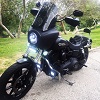
It is unfortunate that the FXDX/FXDXT are no longer in production. If one wants such a machine, you go buy one used, or you pick a Dyna platform and start emptying your wallet. We have seems many fellow forum members here build some very nice dynas to resemble the FXDX/FXDXT is terms of asthetics and performance. I sought to do the same. I own a 2015 FXDL and prior to that, I owned a 2014 FXDB. After being ran over on my streetbob, I wanted to continue to achieve my goal of building a bike as close as possible to the FXDX/FXDXT and at the advice of a few friends, went with the Lowrider. My question is that between the FXDB and FXDL, which one is closer to the FXDX/FXDXT in terms of measurements(rake and trail, ground clearance) and makes for a better platform to build upon. Thank you.
street bob=29 degree rake
LR, LRS=30.5 degree rake
WG=34 degree rake
You could swap to Street bob trees fairly easy, fairly cheap if you think 1.5 degree rake makes much difference in handleing. Then you'd have dual front disc like FXDX and same rake.
street bob=29 degree rake
LR, LRS=30.5 degree rake
WG=34 degree rake
You could swap to Street bob trees fairly easy, fairly cheap if you think 1.5 degree rake makes much difference in handleing. Then you'd have dual front disc like FXDX and same rake.
Is the rake even in the trees? Wouldn't it be in the neck of the frame? I know you can get raked triple trees but I figured they were all different frames. I could have sworn I read in one of these threads there's a guy some where that takes the rake out of the Low Rider frames but I can't remember where it was at. I want to say it was in Cali somewhere.
Factory rake on the FXDX(narrow glide) was 28 degrees. Street bob(mid glide) is 29. On a street bob you can increase the turning ability by keeping front stock rake/tube length and increase the length of the rear shocks to 13.5" and still have good handling. 13.5" rear shocks were the stock length on an FXDX. As for ground clearance, on my FXDB I've personally gone to 13.5" rear shocks with wide glide tubes which are ~2.4" over stock and I haven't really scraped a peg since but it doesn't turn as well. I might choke up on the tubes 1/2" or so to see if I can get it to turn better. You could switch the trees out on your FXDL and get the stock rake of an FXDB.
I like the extra Rake on the Lowrider. The The older FXDX frames turned too quick and were more prone to high-speed wobble's. Right now I have one of each, fxdl & fxdx. The main thing is to stiffen up the pathetically soft Harley suspension.
The dual brake is the only thing left in my FXDB->FXDXT conversion. might not do it because of the cost
So I guess my answer will be FXDL just because of that
7 Surprising Harley-Davidson Products that Are Not Motorcycles
Slideshow: The bar-and-shield logo shows up on far more than motorcycles, some of the company's most unexpected products have nothing to do with riding.
Slideshow: From the troubled AMF years to modern misfires, these bikes earned reputations for reliability issues, questionable engineering, or disappointing performance.
Crazy Bunderbike Build Looks Amazing, But Is It Impossible to Ride?
Slideshow: The Swiss custom shop has taken a Harley Softail and stretched it into something so long and low that it looks closer to a rolling sculpture than a conventional motorcycle.
Engraved Rebellion: Inside Bundnerbike's Glam Rock II
Slideshow: A standard cruiser becomes an intricate metal canvas in the hands of a Swiss custom house known for pushing Harley-Davidson platforms far beyond their factory brief.
Slideshow: Harley-Davidson's challenges aren't abstract; they show up in dropping shipments, shrinking dealer traffic, and strategic decisions that aren't yet translating into growth.







 "FXDX" build question