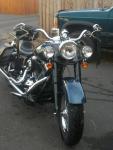






dynas more power then softies?

Ultimate HDF Member
Joined: Oct 2007
Posts: 7,562
Likes: 11
From: Palm Harbor fl.

some softails are lighter than some dynas...(like a nighttrain vs fatbob). rider weight may have as much a factor as the small difference in bike weight as well. I wonder if one can really tell the difference in a couple horsepower or ft-lbs of torque.
Dynas do have higher published torque than the softail. does this torque get lost in our rubber mounting system vs the rigid mount on the softail?
I don't believe H-D publishes the rear wheel torque.
Dynas do have higher published torque than the softail. does this torque get lost in our rubber mounting system vs the rigid mount on the softail?
I don't believe H-D publishes the rear wheel torque.
Last edited by rounder; Jan 26, 2009 at 07:08 PM.

Road Warrior
Joined: Dec 2008
Posts: 1,530
Likes: 1
From: Upstate, SC
The balance shaft in the B engine is a counter-rotating weighted shaft that negates the engine's natural imbalance and thus smooths it out some. I don't think there is any way to retrofit one to an A engine. The crankcases are different.

Road Warrior
Joined: Nov 2008
Posts: 1,789
Likes: 9
From: Double Oak, Texas
some softails are lighter than some dynas...(like a nighttrain vs fatbob). rider weight may have as much a factor as the small difference in bike weight as well. I wonder if one can really tell the difference in a couple horsepower or ft-lbs of torque.
Dynas do have higher published torque than the softail. does this torque get lost in our rubber mounting system vs the rigid mount on the softail?
I don't believe H-D publishes the rear wheel torque.
Dynas do have higher published torque than the softail. does this torque get lost in our rubber mounting system vs the rigid mount on the softail?
I don't believe H-D publishes the rear wheel torque.
http://www.harley-davidson.com/wcm/C...p?locale=en_US
Stock 96" Twin Cam values at the rear wheel are a max of 78FtLbs @ 3,500RPM and max RWHP of 63 @ 5,000RPM

Club Member
Joined: May 2006
Posts: 14,564
Likes: 9,225
From: the 50s & the 60s

rook, the answer to your first question is - of course.
Any serious modification package will include flywheel balancing,
as well as the rest of the associated moving components.
Second question - no.
mud

Cruiser
Joined: Oct 2007
Posts: 213
Likes: 1
From: Southeast New York
When I changed from the steel flywheel to an steel insert aluminum one on one of my '71 Dodge Hemi cars, if I were in a lower gear and took my foot off the gas, the compression of the 11.5 ratio pistons would nearly lock up the back wheels. Great for drag racing, but sucked for just driving around. And gas milage went from 6.5 mpg to 4, but with 645 HP, who cares about that.
Same physics apply to the TC "A" and "B" engines. "A" lighter flywheel = better acceleration, rougher . "B" Heavier flywheel = better streetability, smoother. But does not change actual HP, if all things are equal, just feels like it.
Road Warrior
Joined: Dec 2008
Posts: 1,530
Likes: 1
From: Upstate, SC
I don't think that's correct. The B and A engines have the same flywheels, it's just that the B engines have an additional counter-rotating weighted shaft in the crankcase that is driven off the crankshaft. The extra HP it takes to constantly turn this big hunk of steel does reduce the available HP and TQ at the rear wheel.
HD Forum Stories
The Best of Harley-Davidson for Lifelong Riders

7 Times Harley-Davidson Chucked Tradition Out the Window
Verdad Gallardo
7 Surprising Harley-Davidson Products that Are Not Motorcycles
Verdad Gallardo
8 Best Harley-Davidson Motorcycles Ever
Pouria Savadkouei
10 Worst Harley-Davidson Motorcycles Ever
Pouria Savadkouei
Killer Custom's Jail Break Is The Breakout That Refused to Blend In
Verdad Gallardo
Crazy Bunderbike Build Looks Amazing, But Is It Impossible to Ride?
Verdad Gallardo
Harley-Davidson Reveals Super Cool Cafe Racer Concept
Verdad Gallardo
Engraved Rebellion: Inside Bundnerbike's Glam Rock II
Verdad Gallardo
10 Motorcycles You Should Never Buy
Joe Kucinski
Cruiser
Joined: Oct 2007
Posts: 213
Likes: 1
From: Southeast New York
I don't think that's correct. The B and A engines have the same flywheels, it's just that the B engines have an additional counter-rotating weighted shaft in the crankcase that is driven off the crankshaft. The extra HP it takes to constantly turn this big hunk of steel does reduce the available HP and TQ at the rear wheel.
All I was saying was that the engines are basically the same, but the added mass presented advantages (smoother operation) as well as presenting disadvantages (horsepower available to the rear wheels).