




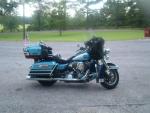

Need some tire info.
Dirt don't hurt


Joined: Jan 2011
Posts: 21,065
Likes: 4,561
From: Haslet Texas

I have a friend of mine who put a car tire on his bike. It took the indy 3 days to get the tire to pop onto the rim. (he couldn't get it to work at all)
He told me it took the road vibration out due to the thinner sidewall. I will find out if it really works when he gets back from his trip in September.
Don't get me wrong I have no intention of actually trying this I just put it out there for information purposes.
He told me it took the road vibration out due to the thinner sidewall. I will find out if it really works when he gets back from his trip in September.
Don't get me wrong I have no intention of actually trying this I just put it out there for information purposes.

Seasoned HDF Member


Joined: Nov 2010
Posts: 17,548
Likes: 7,197
From: Oxford, Nc
Commuting 20,000 miles a year, ( thats replacing one front tire and two rears every year,) I understand the thinking re: using a car tire. Any savings on fuel cost gets sucked up by tires and 5000 mile maintenances, which I do myself.
Fortunately, thanks to the forum, I tried Dunlop E-3's and at 6 months, ( when I should be replacing my first rear tire,) I've got 50% left on the tread.
There's no reason to even try and justify using a car tire. IMO
Fortunately, thanks to the forum, I tried Dunlop E-3's and at 6 months, ( when I should be replacing my first rear tire,) I've got 50% left on the tread.
There's no reason to even try and justify using a car tire. IMO
Grand HDF Member
Joined: Mar 2007
Posts: 4,923
Likes: 266
From: Deep in the heart of New Jersey
I don't know what movie you guys were watching, but it sure looked to me that there was more then enough tire in contact with the road at all times. Even when running straight take a look how much of the tire is making contact with the road. That has to equate to more stopping power. Car tire are designed to handle more weight then motorcycle tires, so handling might feel different. Just like when you make any changes to stock suspension parts. That 2000 cc Vulcan puts out more power then a Harley in stock form, but didn't seem to have any unpredicted handling quirks. From what I have read about this subject there are several car tires that perform better then others. Different compounds with different sidewall strength. I find it funny how people nowadays are quick to shoot down bike modifications, when not that many years ago guys were riding around with 30 inch longer then stock Springer front ends that were real "death machines" that would never work.,,
Seasoned HDF Member
Joined: Nov 2010
Posts: 17,548
Likes: 7,197
From: Oxford, Nc
And as for that "fat contact patch," I'll take pounds per square inch over too much contact patch anyday, I like stopping...but then I never rode a 30" over Paughco Springer either...

Last edited by Stiggy; Aug 13, 2011 at 10:05 AM.
Grand HDF Member
Joined: Mar 2007
Posts: 4,923
Likes: 266
From: Deep in the heart of New Jersey
And as for that "fat contact patch," I'll take pounds per square inch over too much contact patch anyday, I like stopping...but then I never rode a 30" over Paughco Springer either...[/QUOTE]
Really, pounds per square inch over too much contact patch? In case nobody ever told you, your tires contact patch is the only thing on your bike that grabs the road no matter what the situation is. If you bother to watch the videos, you will notice neither of the bikes shown had any difficulty handling the bikes going straight, or into left and right hand turns. So where's all the predicted gloom, doom and fiery crashes? Also extended front ends are nothing new , but new riders probably haven't been in the bike scene long enough to have known about them.,,
[/QUOTE]Really, pounds per square inch over too much contact patch? In case nobody ever told you, your tires contact patch is the only thing on your bike that grabs the road no matter what the situation is. If you bother to watch the videos, you will notice neither of the bikes shown had any difficulty handling the bikes going straight, or into left and right hand turns. So where's all the predicted gloom, doom and fiery crashes? Also extended front ends are nothing new , but new riders probably haven't been in the bike scene long enough to have known about them.,,
Seasoned HDF Member
Joined: Nov 2010
Posts: 17,548
Likes: 7,197
From: Oxford, Nc
You sound as old as I am!
Back in the 70's my Norton 850 Interstate was the only " handling" motorcycle I ever owned. And the Kaw, HD FX and even the GoldWing that followed after that really couldn't corner like anything today. I suppose a car tire wouldn't have made that much of a difference.
Guess I just miss the point. Surely no one argues that the car tire handles BETTER than a bike tire. There are really high milage bike tires out there now. So where's the benefit of the car tire?
Just cause you can do it doesn't mean you should...
As for the importance of the size of the contact patch, ever run a car with fat tires in the snow? Same principle applies to bikes in the rain.
Back in the 70's my Norton 850 Interstate was the only " handling" motorcycle I ever owned. And the Kaw, HD FX and even the GoldWing that followed after that really couldn't corner like anything today. I suppose a car tire wouldn't have made that much of a difference.
Guess I just miss the point. Surely no one argues that the car tire handles BETTER than a bike tire. There are really high milage bike tires out there now. So where's the benefit of the car tire?
Just cause you can do it doesn't mean you should...
As for the importance of the size of the contact patch, ever run a car with fat tires in the snow? Same principle applies to bikes in the rain.
HD Forum Stories
The Best of Harley-Davidson for Lifelong Riders

7 Surprising Harley-Davidson Products that Are Not Motorcycles
Verdad Gallardo
8 Best Harley-Davidson Motorcycles Ever
Pouria Savadkouei
10 Worst Harley-Davidson Motorcycles Ever
Pouria Savadkouei
Killer Custom's Jail Break Is The Breakout That Refused to Blend In
Verdad Gallardo
Crazy Bunderbike Build Looks Amazing, But Is It Impossible to Ride?
Verdad Gallardo
Harley-Davidson Reveals Super Cool Cafe Racer Concept
Verdad Gallardo
Engraved Rebellion: Inside Bundnerbike's Glam Rock II
Verdad Gallardo
10 Motorcycles You Should Never Buy
Joe Kucinski
10 Things Harley-Davidson Needs to Fix in 2026
Verdad Gallardo
Ultimate HDF Member
Joined: Jun 2007
Posts: 9,193
Likes: 494
From: Richmond, VA
There are really high milage bike tires out there now. So where's the benefit of the car tire?
Just cause you can do it doesn't mean you should...
As for the importance of the size of the contact patch, ever run a car with fat tires in the snow? Same principle applies to bikes in the rain.
Just cause you can do it doesn't mean you should...
As for the importance of the size of the contact patch, ever run a car with fat tires in the snow? Same principle applies to bikes in the rain.
Again, I am not advocating them, just discussing them.

______________________________
Last edited by bikerlaw; Aug 13, 2011 at 11:59 AM.
Seasoned HDF Member
Joined: Nov 2010
Posts: 17,548
Likes: 7,197
From: Oxford, Nc
I appreciate the conversation too bikerlaw...Here's my thinking:
Sure, a bald tire (slick) is best on dry pavement. On water however, which is incompressible, everything lifts to a degree. ( Look at the warnings about driving anything through even a couple of inches of water.)
So if I'm going to push that water towards a rain groove in the tire, I want weight per inch. And on my bike in the dusty environment where I work, I can see that my tires contact patch is about 1 1/2" wide, not 4 or 5 as in a non rounded car tire.
On wet roads, I gotta think I'll stop quicker on a bike tire. A car tire is going to want to float IMO.
Sure, a bald tire (slick) is best on dry pavement. On water however, which is incompressible, everything lifts to a degree. ( Look at the warnings about driving anything through even a couple of inches of water.)
So if I'm going to push that water towards a rain groove in the tire, I want weight per inch. And on my bike in the dusty environment where I work, I can see that my tires contact patch is about 1 1/2" wide, not 4 or 5 as in a non rounded car tire.
On wet roads, I gotta think I'll stop quicker on a bike tire. A car tire is going to want to float IMO.