


 drive belt adjustment?


drive belt adjustment?

Seasoned HDF Member


Joined: Nov 2010
Posts: 17,548
Likes: 7,197
From: Oxford, Nc

About 10 lbs of upward pressure in the middle of the lower belt should deflect the belt no more than about 3/8". Close enough. (I've never owned a belt gauge and my first belt lasted 119,600 miles, so that method certainly works for me.)

Cruiser
Joined: Sep 2007
Posts: 242
Likes: 0
Check it with the bike on the side stand and no rider. Push firmly up on the belt with your finger. That will approximate 10 lbs. Another method preferred by many people is to grab the middle of the belt with two fingers and twist it. If you can twist it 45 degrees before it gets tight it is just about right. If you cannot twist it 45 degrees it is too tight. More than 45 degrees it is too loose. I use both methods as a double check. Only takes a minute to check. If you need to adjust it be aware that it takes very little adjustment. About a half flat on the bolt heads.
Last edited by martin1; Jun 8, 2014 at 06:02 AM.
Seasoned HDF Member
Joined: Nov 2010
Posts: 17,548
Likes: 7,197
From: Oxford, Nc
Rear Belt Drive Adjustment
Performance and Technical information on the rear belt drive for Harley-Davidson motorcycles. Belt Drive Adjustment for Big Twins
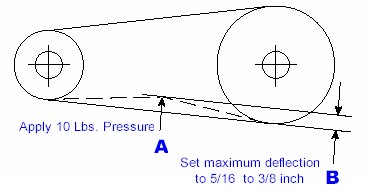
 Set belt tension a the tightest rotational point on the sprockets. The adjustments should be done when the bike is cold. The adjustments should be made with the weight of a rider on the bike. 1. At the lower strand, position "A", mid-way between transmission sprocket and rear wheel sprocket, apply 10 Ibs. of upward force on lower span of rear belt. Harley-Davidson has a BELT TENSION GAUGE (Part No. HD-35381) to help.
2. Measure belt deflection "B" several times, each time with belt moved (by rotating rear wheel) to a different position on sprockets. With sprockets rotated to tightest belt posi-tion, belt deflection "B" (measured at position "A") should be 5/16-3/8 in.
(copied off nightrider.com. I believe the the earlier bikes ('99 Softail,) recommended the weight of the rider added on when adjusting the belt.)
Performance and Technical information on the rear belt drive for Harley-Davidson motorcycles. Belt Drive Adjustment for Big Twins
Set belt tension a the tightest rotational point on the sprockets. The adjustments should be done when the bike is cold. The adjustments should be made with the weight of a rider on the bike. 1. At the lower strand, position "A", mid-way between transmission sprocket and rear wheel sprocket, apply 10 Ibs. of upward force on lower span of rear belt. Harley-Davidson has a BELT TENSION GAUGE (Part No. HD-35381) to help.2. Measure belt deflection "B" several times, each time with belt moved (by rotating rear wheel) to a different position on sprockets. With sprockets rotated to tightest belt posi-tion, belt deflection "B" (measured at position "A") should be 5/16-3/8 in.
(copied off nightrider.com. I believe the the earlier bikes ('99 Softail,) recommended the weight of the rider added on when adjusting the belt.)
Last edited by Stiggy; Jun 8, 2014 at 06:08 AM.
Trending Topics
Seasoned HDF Member

Joined: Jun 2006
Posts: 30,881
Likes: 32,991
From: King George, VA
Check it with the bike on the side stand and no rider. Push firmly up on the belt with your finger. That will approximate 10 lbs. Another method preferred by many people is to grab the middle of the belt with two fingers and twist it. If you can twist it 45 degrees before it gets tight it is just about right. If you cannot twist it 45 degrees it is too tight. More than 45 degrees it is too loose. I use both methods as a double check. Only takes a minute to check. If you need to adjust it be aware that it takes very little adjustment. About a half flat on the bolt heads.
This is why they make the calibrated tool to do this adjustment.
HD Forum Stories
The Best of Harley-Davidson for Lifelong Riders

7 Surprising Harley-Davidson Products that Are Not Motorcycles
Verdad Gallardo
8 Best Harley-Davidson Motorcycles Ever
Pouria Savadkouei
10 Worst Harley-Davidson Motorcycles Ever
Pouria Savadkouei
Killer Custom's Jail Break Is The Breakout That Refused to Blend In
Verdad Gallardo
Crazy Bunderbike Build Looks Amazing, But Is It Impossible to Ride?
Verdad Gallardo
Harley-Davidson Reveals Super Cool Cafe Racer Concept
Verdad Gallardo
Engraved Rebellion: Inside Bundnerbike's Glam Rock II
Verdad Gallardo
10 Motorcycles You Should Never Buy
Joe Kucinski
10 Things Harley-Davidson Needs to Fix in 2026
Verdad Gallardo
Seasoned HDF Member
Joined: Nov 2010
Posts: 17,548
Likes: 7,197
From: Oxford, Nc
So how much twisting torque should ya use when twisting the belt? Bubba the gorrila fingers should have no problem twisting the belt a couple rotations while Sherman the key board commando has trouble twisting the same belt 10 degrees from flat. You noted to twist it until it gets tight. What is the definition of tight?
This is why they make the calibrated tool to do this adjustment.
This is why they make the calibrated tool to do this adjustment.
The definition of tight is At the lower strand, position "A", mid-way between transmission sprocket and rear wheel sprocket, apply 10 Ibs. of upward force on lower span of rear belt.
(Seems clear to me.)
Last edited by Stiggy; Jun 8, 2014 at 06:24 AM.
lol thanks for your guys help. Stiggy i did it the way the info you suplied me said and then checked it the 45* way and if someone was half smart that way is correct just cant be stuppid about it and when i check it pushing up i just feels like its right