




Ironhead rear motor mount stud

Thread Starter
|
Intermediate
Joined: Apr 2011
Posts: 32
Likes: 0
 Ironhead rear motor mount stud
Hey everyone this is my first of many posts on here so bare with me if I am a little short. I'm rebuilding my 1000cc Ironhead and I noticed that my rear motor mount was cracked. I am replacing it when the new one once it gets here. What I can't figure out is if the top stud on the lower T part is screwed into the block or if it is stamped or pressed???? Can anyone help me with this question?
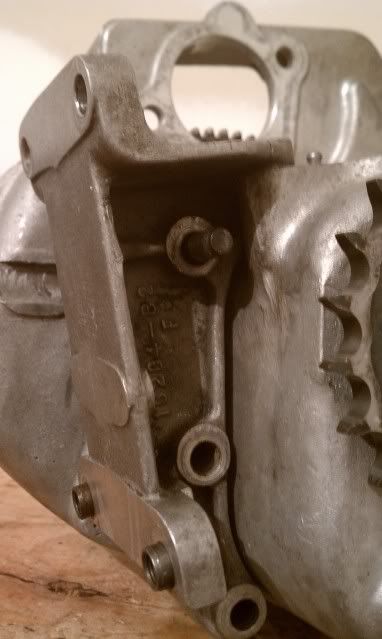

What year is your bike? On my 1978 that is a bolt, not a stud.
The parts catalog 99451-78B and the service manual 99484-78 would be helpful to you; your two most important tools.
The parts catalog 99451-78B and the service manual 99484-78 would be helpful to you; your two most important tools.
Thread Starter
|
Intermediate
Joined: Apr 2011
Posts: 32
Likes: 0
Mick,
I couldn't agree with you more about the service manual and the parts catalog. I just ordered the parts catalog yesterday and my service manual is on the way as well. I can't believe I forgot to say what year the bike was! It's a 1983 1000cc Sporty XLX. You are the second person to tell me now that the top hole is a bolt...I wonder why mine is a stud then??? So, if it is a stud do you think it's screwed into the casing then? I need to get the stud out in order to remove the mount because there is no way in God's creation that it will come out if the stud is still in. I love my old Ironhead but this setup (if this stud is stock) was designed poorly. I have already double nutted the stud to try to back the stud out (no success), I tried it again with minor heat applied to the casing (no success). This stud is IN THERE. What other ideas do you have to get the stubborn guy out? I may have to weld a nut on the end and crank her out that way but I NEED to make sure that it is screwed in before I really start cranking on it. Thanks.
I couldn't agree with you more about the service manual and the parts catalog. I just ordered the parts catalog yesterday and my service manual is on the way as well. I can't believe I forgot to say what year the bike was! It's a 1983 1000cc Sporty XLX. You are the second person to tell me now that the top hole is a bolt...I wonder why mine is a stud then??? So, if it is a stud do you think it's screwed into the casing then? I need to get the stud out in order to remove the mount because there is no way in God's creation that it will come out if the stud is still in. I love my old Ironhead but this setup (if this stud is stock) was designed poorly. I have already double nutted the stud to try to back the stud out (no success), I tried it again with minor heat applied to the casing (no success). This stud is IN THERE. What other ideas do you have to get the stubborn guy out? I may have to weld a nut on the end and crank her out that way but I NEED to make sure that it is screwed in before I really start cranking on it. Thanks.
Have you found any other anomalies with the bike that would suggest that a PO has mucked up something and installed this as a bandaid? Or is the whole bike pretty well stock?
I have always had success with the double nut technique on studs.
Is there ant sign of red locktite? But the heat should have taken care of that anyway.
That bolt/stud and the two below it do hold together the two case halves. I am unable to think of a good reason for it to have been replaced by a stud.
Post this at this other IronHead Forum There are some more guys there who will be helpful on this.
I have always had success with the double nut technique on studs.
Is there ant sign of red locktite? But the heat should have taken care of that anyway.
That bolt/stud and the two below it do hold together the two case halves. I am unable to think of a good reason for it to have been replaced by a stud.
Post this at this other IronHead Forum There are some more guys there who will be helpful on this.
Last edited by IronMick; Apr 19, 2011 at 05:46 PM.

Stellar HDF Member

Joined: Feb 2006
Posts: 3,035
Likes: 17
From: Houston Texas
Mick,
I couldn't agree with you more about the service manual and the parts catalog. I just ordered the parts catalog yesterday and my service manual is on the way as well. I can't believe I forgot to say what year the bike was! It's a 1983 1000cc Sporty XLX. You are the second person to tell me now that the top hole is a bolt...I wonder why mine is a stud then??? So, if it is a stud do you think it's screwed into the casing then? I need to get the stud out in order to remove the mount because there is no way in God's creation that it will come out if the stud is still in. I love my old Ironhead but this setup (if this stud is stock) was designed poorly. I have already double nutted the stud to try to back the stud out (no success), I tried it again with minor heat applied to the casing (no success). This stud is IN THERE. What other ideas do you have to get the stubborn guy out? I may have to weld a nut on the end and crank her out that way but I NEED to make sure that it is screwed in before I really start cranking on it. Thanks.
I couldn't agree with you more about the service manual and the parts catalog. I just ordered the parts catalog yesterday and my service manual is on the way as well. I can't believe I forgot to say what year the bike was! It's a 1983 1000cc Sporty XLX. You are the second person to tell me now that the top hole is a bolt...I wonder why mine is a stud then??? So, if it is a stud do you think it's screwed into the casing then? I need to get the stud out in order to remove the mount because there is no way in God's creation that it will come out if the stud is still in. I love my old Ironhead but this setup (if this stud is stock) was designed poorly. I have already double nutted the stud to try to back the stud out (no success), I tried it again with minor heat applied to the casing (no success). This stud is IN THERE. What other ideas do you have to get the stubborn guy out? I may have to weld a nut on the end and crank her out that way but I NEED to make sure that it is screwed in before I really start cranking on it. Thanks.
These studs were threaded into the left half crankcase and were installed TIGHTLY!
To the point that removing the studs for a motor mount replacement was never done as a general practice.
The crankcase halves were split to replace a broken mount.
Now I have heard of a few times the studs were removed successfully, but I am thinking you are going to have to weld a nut on the end like you said to get it out.
Be sure to have a replacement stud in hand before doing this though.
pg
Thread Starter
|
Intermediate
Joined: Apr 2011
Posts: 32
Likes: 0
According to Harley's stock I got 1 of the 3 rear motor mounts left in inventory (I know there is scrap yards though). I have had the sporty since I was 16 when I saved up enough of my own money. That was back in 2002. My dad and I knew the previous owner so we have seen the bike in the pack for a long time and nothing that I know of points to why the mount is cracked. I had to split the case to get the stud out, well it’s still in but it's ready to be pulled. I went to Ray Price's Harley shop today and there is a mechanic there that owns a few Ironheads and seems like he knew what he was talking about. He actually told me what I did to try to get it out without me telling him lol. You’re going to have to split it he says, but man was I trying to inch my way around other options but he shot down each alternative because he has tried them all before.
I can't remember what he said what years had the top as a stud but he was defiantly for sure my year had the top as a stud.
Why would they ever be designed like this?
Thanks guys for the help, I really do enjoy the comradery on this site! I’m glad to be a new member
I can't remember what he said what years had the top as a stud but he was defiantly for sure my year had the top as a stud.
Why would they ever be designed like this?
Thanks guys for the help, I really do enjoy the comradery on this site! I’m glad to be a new member
Stellar HDF Member
Joined: Feb 2006
Posts: 3,035
Likes: 17
From: Houston Texas
IHEd,
Maybe no one has told you yet (I am one of those) but a cracked rear motor mount is a very common thing on an ironhead.
All of them that crack are the mounts made of aluminum.
The first aluminum mount had 4 bolts in the top. Later the mounts had only 2 bolts. A cost cutter I assume.
Originally this mount was made of steel and had 4 bolts in the top.
Later it was made of aluminum (to save money I assume) and the aluminum was prone to cracking. The steel mount will never crack.
When I rebuilt my 1971 in 1995-2000 I had an aluminum mount that had been cracked for years.
Since I was splitting the cases to rebuild the engine I began looking for a replacement mount.
I found a mechanic at San Diego Harley who had a steel mount and he wanted $50 for it. I scooped it up! These are very rare today.
Here is the point of this post.........
Aluminum mounts are going to crack.
If you have a brand new replacement mount in hand right now...... it will crack. Guaranteed! Should your mount be a steel one, then it is worth installing..........BUT,
The cracks do not present a problem though.
That is the good news.
I ran mine with the cracked mount for years as I said and only replaced it because:
1) I was rebuilding the engine
2) I found a steel mount to replace the aluminum.
So I do not know how far along you are with this project but I would leave the cracked mount alone and save a lot of money and time, unless you have other reasons to tear the engine down.
Just remember, sooner or later an aluminum replacement mount is going to crack again .
pg
Maybe no one has told you yet (I am one of those) but a cracked rear motor mount is a very common thing on an ironhead.
All of them that crack are the mounts made of aluminum.
The first aluminum mount had 4 bolts in the top. Later the mounts had only 2 bolts. A cost cutter I assume.
Originally this mount was made of steel and had 4 bolts in the top.
Later it was made of aluminum (to save money I assume) and the aluminum was prone to cracking. The steel mount will never crack.
When I rebuilt my 1971 in 1995-2000 I had an aluminum mount that had been cracked for years.
Since I was splitting the cases to rebuild the engine I began looking for a replacement mount.
I found a mechanic at San Diego Harley who had a steel mount and he wanted $50 for it. I scooped it up! These are very rare today.
Here is the point of this post.........
Aluminum mounts are going to crack.
If you have a brand new replacement mount in hand right now...... it will crack. Guaranteed! Should your mount be a steel one, then it is worth installing..........BUT,
The cracks do not present a problem though.
That is the good news.
I ran mine with the cracked mount for years as I said and only replaced it because:
1) I was rebuilding the engine
2) I found a steel mount to replace the aluminum.
So I do not know how far along you are with this project but I would leave the cracked mount alone and save a lot of money and time, unless you have other reasons to tear the engine down.
Just remember, sooner or later an aluminum replacement mount is going to crack again .
pg
Trending Topics
Thread Starter
|
Intermediate
Joined: Apr 2011
Posts: 32
Likes: 0
Thanks for all the help here guys!!! This is a huge knowledge bank here, I can tell, so I thank all of you. Unfortunately I am not able to find a steel motor mount but I have an ally one on the way. If it cracks again, so be it, it cracks...but at least I know I replaced it lol. The engine was already disassembled completely (minus from splitting the case) so It wasn’t a big deal to split it. I am pulling this pesky stud and replacing it with a bolt just like the other two are. Do you guys see a problem that could arise in the future from doing this?
HD Forum Stories
The Best of Harley-Davidson for Lifelong Riders

7 Surprising Harley-Davidson Products that Are Not Motorcycles
Verdad Gallardo
8 Best Harley-Davidson Motorcycles Ever
Pouria Savadkouei
10 Worst Harley-Davidson Motorcycles Ever
Pouria Savadkouei
Killer Custom's Jail Break Is The Breakout That Refused to Blend In
Verdad Gallardo
Crazy Bunderbike Build Looks Amazing, But Is It Impossible to Ride?
Verdad Gallardo
Harley-Davidson Reveals Super Cool Cafe Racer Concept
Verdad Gallardo
Engraved Rebellion: Inside Bundnerbike's Glam Rock II
Verdad Gallardo
10 Motorcycles You Should Never Buy
Joe Kucinski
10 Things Harley-Davidson Needs to Fix in 2026
Verdad Gallardo
Stellar HDF Member
Joined: Feb 2006
Posts: 3,035
Likes: 17
From: Houston Texas
Thanks for all the help here guys!!! This is a huge knowledge bank here, I can tell, so I thank all of you. Unfortunately I am not able to find a steel motor mount but I have an ally one on the way. If it cracks again, so be it, it cracks...but at least I know I replaced it lol. The engine was already disassembled completely (minus from splitting the case) so It wasn’t a big deal to split it. I am pulling this pesky stud and replacing it with a bolt just like the other two are. Do you guys see a problem that could arise in the future from doing this?
This stud (or bolt) is threaded into an aluminum casting (the case) which is not noted for having great strength.
So the wise move is to use a stud threaded into the case using red Locktite.
The reason is because this is the only time the case threads get disturbed again.
Keep in mind the question..... Just why did the factory do this?
They did it because there is good engineering reason to use a stud over a bolt.
When you tighten a nut on the stud the nut takes all of the beating and stress as it compresses against the motor mount, not the aluminum case.
If you want to use a bolt (and I cannot understand why you do) then you should have a Heli-Coil installed in the case first.
And again I have to ask...... Why are you having to install a new stud? Did you weld a nut to the end of the existing stud? If so, did you remove the original stud yet?
If you have not removed it I urge you to leave well enough alone.
pg
Last edited by piniongear; Apr 20, 2011 at 04:33 PM.
Thread Starter
|
Intermediate
Joined: Apr 2011
Posts: 32
Likes: 0
If I were to put a bolt in I would put a Heli-coil in first though. I am a Mechanical Engineer so I fully understand why studs are used over bolts but at the same time the other two fastening points (on the side) on the mount uses bolts. It's just odd to me. It's in my nature to analyze things when it seems as if a design takes a funny turn is all. If HD has a reason behind as to why they use this one stud at this particular location I want to fully know why this is. In practice, I have had to scrap designs before right at the last moment because of one particular thing was not conducive to the desired outcome. I'm definitely not saying Ironheads are poor designs by far (I'll stand behind this engine until the day I die), but sometimes Irritation of a design gets under my skin more than most. If they put the stud there for compression/tensile load reasons then I will put a new stud in its place. The stud needs to be replaced because when I double nutted the stud to pull it I tightened the nuts so hard together (because they kept rotating) that it marred up the threads beyond use. I will be using a stud puller to pull the old one to replace it.
Like I said before, I'm sure there is a reason as to why HD used a stud here, but I would love to sit down with the design team to see what other ideas they had before going with this one and why the others were not as good.
Like I said before, I'm sure there is a reason as to why HD used a stud here, but I would love to sit down with the design team to see what other ideas they had before going with this one and why the others were not as good.