





Solid Lifter Noise

Thread Starter
|
Road Warrior
Joined: Sep 2007
Posts: 1,252
Likes: 142
 Solid Lifter Noise
I have been an ironhead man for many years and the noise coming from the valve train from one of those babies when hot sounds like a typewriter. My shovel also gets somewhat like that as it has solid lifters as well. Diss-similar metals, ie iron and aluminum expand due to heat at different rates and even though when cold everything seems snug, when the cylinders heat up and expand they basically get taller thereby making the aluminum pushrods sloppy since they don't expand nearly as fast or as great. So my question is why don't we use pushrods with similar makeup in composition as the iron cylinders to compensate for some of this expansion? Yes the shovel with aluminum heads will expand at a different rate, but for anyone who understands the concept of geometric tolerance and dimensioning, the "stack-up" for worst case should in theory be greatly reduced. In other words if the cylinder expands a certain distance when hot at a defined rate, would it not make sense for the pushrods to be made of a material that matches the same expansion rate as the cylinder? Has anyone ever tried this?
Just a thought.
randy
Just a thought.
randy

Seasoned HDF Member


Joined: Nov 2006
Posts: 12,878
Likes: 5,449
From: la la land jerzey
if you hold a empty gallon container in one hand and a full one in the other
then pick them up and down the full length of your reach
the empty jug is an alloy pushrod and the full jug is an iron pushrod
and the valve springs notice this BTW
then pick them up and down the full length of your reach
the empty jug is an alloy pushrod and the full jug is an iron pushrod
and the valve springs notice this BTW

Club Member


Joined: Mar 2009
Posts: 66,145
Likes: 51,484
From: Niles Canyon Ca.
Nicely done.
Thread Starter
|
Road Warrior
Joined: Sep 2007
Posts: 1,252
Likes: 142
It what you are saying that the steel rods would be too heavy? I don't think that would be that big of a difference and since steel chrome molly pushrods exist although lightweight I would expect there expansion due to heat would be a lot closer to that of the iron rather than the aluminum which dissipates heat quite effectively. And for argument stake what would the valve springs have issue with given when they close the pushrods are going downward, if anything they would in theory close faster if this extra weight came into play.
Just wondering guys..
randy
randy
Just wondering guys..
randy
randy
Seasoned HDF Member
Joined: Nov 2006
Posts: 12,878
Likes: 5,449
From: la la land jerzey
OK look at it this away -- for get the temp thing its a non issue
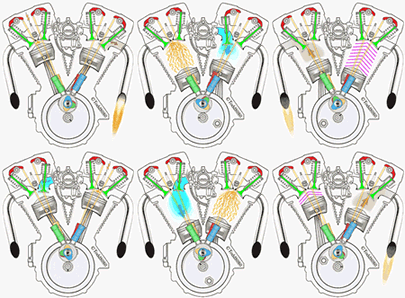
if the valve train is light the ability of the valve spring has just so many up and downs till it floats < well that is what they say = it does not float well maybe -- it slinkies and when it slinkies it does not have the ability to go up and down --- straight -- hence -> its doing the slinkie thing
so the heavier the valve train parts are the less RPMs the spring can handle and its a lot to take on the parts -- push rod /// alloy material verses steel verses titainum all have an RPM play no matter what the lift - but the more lift the greater RPM the tighter spring, the spring needs to be and the valve train weight is at play at all times -
the correct term is the speed of torque - the heavier all of it is the slower it can make power and the weight absorbs the speed of torque, so your machine is much slower then mine so to speak
if the valve train is light the ability of the valve spring has just so many up and downs till it floats < well that is what they say = it does not float well maybe -- it slinkies and when it slinkies it does not have the ability to go up and down --- straight -- hence -> its doing the slinkie thing
so the heavier the valve train parts are the less RPMs the spring can handle and its a lot to take on the parts -- push rod /// alloy material verses steel verses titainum all have an RPM play no matter what the lift - but the more lift the greater RPM the tighter spring, the spring needs to be and the valve train weight is at play at all times -
the correct term is the speed of torque - the heavier all of it is the slower it can make power and the weight absorbs the speed of torque, so your machine is much slower then mine so to speak
Road Warrior
Joined: Mar 2010
Posts: 1,290
Likes: 7
From: D/FW Texas
now that makes a world of sense; thanks John
Trending Topics
Club Member
Joined: Mar 2009
Posts: 66,145
Likes: 51,484
From: Niles Canyon Ca.
About the aluminium pushrods , check them. The most common are a set of pinky finger sized fat cheapies that tend to rub the upper inside of the pushrod tubes plus most are warped to some degree which makes them rattle a lot. The good ones are Andrews or another similar make about pencil sized in diameter.
HD Forum Stories
The Best of Harley-Davidson for Lifelong Riders

Jason Momoa Is Turning Classic Harleys Into PHEVs
Verdad Gallardo
Harley-Davidson Fat Boy Becomes a Dark, Decepticon-Inspired Custom
Verdad Gallardo
6 Weirdest Harley-Davidsons Ever Sold to the Public
Verdad Gallardo
7 Times Harley-Davidson Chucked Tradition Out the Window
Verdad Gallardo
7 Surprising Harley-Davidson Products that Are Not Motorcycles
Verdad Gallardo
8 Best Harley-Davidson Motorcycles Ever
Pouria Savadkouei
10 Worst Harley-Davidson Motorcycles Ever
Pouria Savadkouei
Killer Custom's Jail Break Is The Breakout That Refused to Blend In
Verdad Gallardo
Crazy Bunderbike Build Looks Amazing, But Is It Impossible to Ride?
Verdad Gallardo

Sponsor
Joined: Dec 2007
Posts: 12,084
Likes: 829
If you adjust a solid lifter Shovel with aluminum pushrods to a "snug turn", warm, it will not start when it cools off.
I tried this back in the '70's, when I thought I knew everything about bikes, and women..........I was wrong on both counts....
Scott
I tried this back in the '70's, when I thought I knew everything about bikes, and women..........I was wrong on both counts....
Scott