When you click on links to various merchants on this site and make a purchase, this can result in this site earning a commission. Affiliate programs and affiliations include, but are not limited to, the eBay Partner Network.
Difference or charts anywhere for Screaming Eagle 575 vs 585 cam/ change Lifter(tappets)?
i don't know what i'm doing
I was a the dealer happily about to order pistons, studs, and cams. the folks at the parts counter are matching board tracker prices... all going good... then they threw monkey wrenches in the plan:
Monkey wrench 1:
i had been going back and forth over the se-536 and the se-575 (25740-50) because i saw that the se-585 (25400125) was not listed for use in 13 and down sportys. the sales folks told me that a few people have installed the se-585 and the stage iv 92500042 kit (that i'm cobbling together) pre-2014 sportsters. so the se-575 is now in the mix. decided to back-off and go see if i'm leaving anything on the table since they all will cost $224.99. i know the 536 and 575 put the power where i want it.
any charts or other good stuff out there on the se-585?
i don't know what i'm doing
Monkey wrench 2:
{i don't know what i'm doing} they said i needed lifters, i don't see that anywhere in the installation goods - https://serviceinfo.harley-davidson....document/76617 . again i know nothing here. should i look at lifters? they were recommending head quarters black ops @$160 (4 ct). worth doing? or stick with stock . i am using s&s adjustable push rods so i can get in there at any point and change them.
again, open to all knowledge, training and experience....i don't know what i'm doing
So this is for your 2007?
And it's an 883/1200 conversion?
What kind of heads on it? 883 or 1200? Stock or modified?
With what kind of pistons?
All of these things are critical to take into consideration for cam selection
So this is for your 2007?
And it's an 883/1200 conversion?
What kind of heads on it? 883 or 1200? Stock or modified?
With what kind of pistons?
All of these things are critical to take into consideration for cam selection
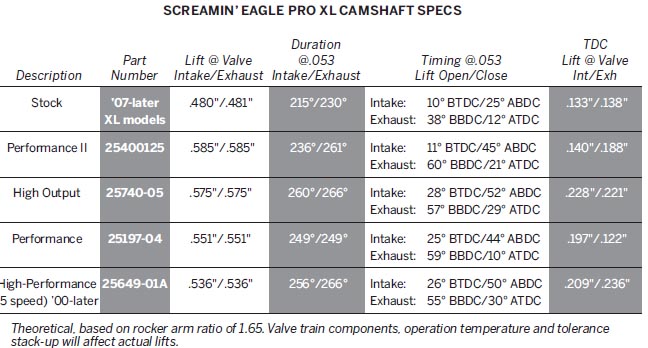
One of the first things I always look at is the intake close timing. The later the intake closes, the less of the compression stroke is used for compression, and therefore the less compression you get from a given compression ratio. Knowing your CR is going to be 10.5:1, you can run the numbers ... I'll use my own compression calculator ...
585's: 45 degree intake close point at 10.5:1 comes out to 202.6psi
536's: 50 degree intake close point at 10.5:1 comes out to 195.8psi
575's: 52 degree intake close point at 10.5:1 comes out to 192.9psi
This just comes down to how hard you want to push it, and how good of gas you can get. None of these numbers is really pushing things hard though, for an EFI bike. They're all manageable.
Later intake close points work best at higher rpm's, too, so keep that in mind. Your stock "W" cams for example have a 25 degree intake close point as you can see on the top line, the earliest of any XL cams on the market. It's really well optimized for bottom end and mid range.
Another number I pay a lot of attention to is the overlap, which is the sum of the intake open and exhaust close points. More overlap gives the exhaust more influence over the intake flow, which gives it a lot of control of the powerband. A motor with a lot of overlap will make a bunch of torque (and thus power) at any rpm where the exhaust pulls hard. It'll also run like crap at any rpm where the pipe is pushing back. But it's a huge, huge opportunity to make power. It can make a motor act like it has much bigger valves than it actually has, it's great for undervalved motors, and these motors are pretty badly undervalved.
585's: 11+21 = 33 degrees of overlap - this is fairly mild to middle of the road
536's: 26+30 = 56 degrees of overlap - that's a good hot street grind
575's: 28+29 = 57 degrees of overlap - that's a good hot street grind
Also I look at intake duration as it relates to exhaust duration. Cams that have longer exhaust lobes are called "dual pattern". This is done largely to help overcome pumping losses associated with restrictive exhausts.
The 585's are 236 intake and 261 exhaust - a whopping 25 degrees dual patterned. That's a lot. In fact, I'm not aware of any other cams on the market that come close to that.
The 536's are 256 intake and 266 exhaust - 10 degrees dual patterned, which is more or less a typical number on a hot street grind
The 575's are 260 intake and 266 exhaust - 6 degrees dual patterned, again not unusual on a hot street grind
Lift is another key number. Ideally you look at the lift as it relates to the head flow data. All ports have a nose-over point, where opening the valve more doesn't cause more flow to occur, because the valve is far enough out of the way that it's no longer relevant. The bigger the valve diameter, the higher the lift at which this occurs. A person can actually look at the flow data and run some numbers and come up with some reasonable relative values from different cams in terms of the airflow capability with a given set of heads. I don't have the flow data on the SE CNC heads in front of me however. But from memory and just speaking in broad generalities, I think they can take good advantage of the higher lift numbers you're looking at here. The 536's aren't going to get everything out of them that they have for you.
Bottom line is that the 585's are fairly mild, not a lot of overlap, and made for a more restrictive exhaust. Note that they're an emissions legal grind, too. That doesn't surprise me, looking at their specs.
The 536's and 575's on the other hand are really very typical hot street types of grinds, with the 575's having slightly hotter timing and some additional lift that the SE CNC heads can make use of. Neither is a really super hot cam, but they'll work well for what you're doing. The 575's will likely work a little better.
I had to read that a few times. I really appreciate you taking the time to break that all down. I was having a hard time trying to digest all this at once. I will go with the 575.
Again, I really appreciate the help and I'm certain your post will help others who probably wouldn't ask.
575, lifters aren't needed imho, and adjustables are also not needed. Possibility of pushrods coming loose and the collapsible tubes have more seals to possibly leak. To me, that's not worth the risk or $$$. The 575 is my favorite chicken cam, I ran it for year and it worked good.
Yeah, I agree, the 575's really are the best hot-rod grind that HD offers, especially for big valve heads. My only reservation about them is they tend to be a little rattly. But not overly so.
I, too, am not a fan of adjustable pushrods. They're more expensive, they introduce a new point of potential failure, they're weaker at a given weight, and the collapsible tube kits are both expensive and introduce another potential point of failure. Give me a high quality, heat treated chrome moly .065 wall pushrod with Mae West ends, and the stock tubes. Simpler and stronger and more reliable and lower cost. The stock lifters are self adjusting. Why in the world would you introduce a manual adjuster and bring along all the drawbacks that go with it? It's a solution looking for a problem, IMO.
575, lifters aren't needed imho, and adjustables are also not needed. Possibility of pushrods coming loose and the collapsible tubes have more seals to possibly leak. To me, that's not worth the risk or $$$.
Originally Posted by aswracing
....
I, too, am not a fan of adjustable pushrods. They're more expensive, they introduce a new point of potential failure, they're weaker at a given weight, and the collapsible tube kits are both expensive and introduce another potential point of failure. Give me a high quality, heat treated chrome moly .065 wall pushrod with Mae West ends, and the stock tubes. Simpler and stronger and more reliable and lower cost. The stock lifters are self adjusting. Why in the world would you introduce a manual adjuster and bring along all the drawbacks that go with it? It's a solution looking for a problem, IMO.
sounds reasonable. I also noticed that last year, the stage 4 kit said perfect fit push rods were required but, this year:
Bizzare how the same group of parts require different things from year to year.
7 Surprising Harley-Davidson Products that Are Not Motorcycles
Slideshow: The bar-and-shield logo shows up on far more than motorcycles, some of the company's most unexpected products have nothing to do with riding.
Slideshow: From the troubled AMF years to modern misfires, these bikes earned reputations for reliability issues, questionable engineering, or disappointing performance.
Crazy Bunderbike Build Looks Amazing, But Is It Impossible to Ride?
Slideshow: The Swiss custom shop has taken a Harley Softail and stretched it into something so long and low that it looks closer to a rolling sculpture than a conventional motorcycle.
Engraved Rebellion: Inside Bundnerbike's Glam Rock II
Slideshow: A standard cruiser becomes an intricate metal canvas in the hands of a Swiss custom house known for pushing Harley-Davidson platforms far beyond their factory brief.
Slideshow: Harley-Davidson's challenges aren't abstract; they show up in dropping shipments, shrinking dealer traffic, and strategic decisions that aren't yet translating into growth.









 Difference or charts anywhere for Screaming Eagle 575 vs 585 cam/ change Lifter(tappets)?