








Screaming Eagle 585 Cam kit for Sportster

Thread Starter
|
Stage IV
Joined: Mar 2018
Posts: 4
Likes: 0
From: Seattle, WA
 Screaming Eagle 585 Cam kit for Sportster
I have a 2015 Sportster Iron 883 that I have upgraded with the SE 1200 kit. I added a Cobra El Diablo 2 into 1 pipe and a Cobra high flow air intake. I am now thinking of putting a cam kit on my Sporty to achieve greater low end torque. I am looking at the SE 585 cam kit. Any feedback as to pros and cons of this cam kit would be appreciated. Thank you for your input.

Road Captain


Joined: Mar 2009
Posts: 654
Likes: 734
The primary driver of the rpm range of the cams is the intake valve close point (IVC).
At 25 degrees IVC, the stock "W" cams make more low end than any cams you can buy.
At 45 degrees IVC, I think you can expect the SE 585's to shift the power up the rpm scale at the expense of low end, pretty significantly in fact.
At 25 degrees IVC, the stock "W" cams make more low end than any cams you can buy.
At 45 degrees IVC, I think you can expect the SE 585's to shift the power up the rpm scale at the expense of low end, pretty significantly in fact.
Thread Starter
|
Stage IV
Joined: Mar 2018
Posts: 4
Likes: 0
From: Seattle, WA
How would you suggest I get more low end torque out of my bike? The guys at my local Harley shop recommended the SE 585 and you are telling me I can't buy a cam that will give me more torque. Very confusing and I know nothing of the mechanics of how torque is achieved. I just know when it feels right. My bike is much faster than it was as an 883, but I feel it is not using it's HP efficiently at low rpm's. Any suggestions?

Club Member
Joined: Jun 2007
Posts: 45,429
Likes: 2,898
From: Bedford UK

The only SE-585 cam kit I know of is for the big twins, so won't fit a Sporty. There are limits to how much we can improve low down torque with our Sporties - they are not big twins and have a different torque profile. There are bound to be ways of yet further increasing performance of your bike, but that will mostly be in the upper rev range, not low down. It might be worth talking to Hammer Performance, who are probably the most experienced Sporty tuners out there.
Road Warrior
Joined: Sep 2017
Posts: 1,609
Likes: 694
From: over the mountain
Yeah there is a 585 cam for Sportsters but the power gain is in the higher RPMs. To get more low torque you need to get more cubit inches.
http://www.hammerperf.com/xlvalvetrain.shtml
http://www.hammerperf.com/xlvalvetrain.shtml
Last edited by apache snow; Mar 20, 2018 at 06:18 AM.
How would you suggest I get more low end torque out of my bike? The guys at my local Harley shop recommended the SE 585 and you are telling me I can't buy a cam that will give me more torque. Very confusing and I know nothing of the mechanics of how torque is achieved. I just know when it feels right. My bike is much faster than it was as an 883, but I feel it is not using it's HP efficiently at low rpm's. Any suggestions?

graph below lifted from the stage 4 kit which uses the 585 cam(which is where you are headed, lol)

compare that to what you already have with the 883-1200 stage 1 kit (yours probably looks better withe the 2-1 and 883 gearing)

if you want arm ripping monster low end torque, trade in you bike for a big twin or m8....they cross 100 ft/lb with ease
 or open that wallet to hammer and let the spending begin. most of the sporty builds i've seen never cross 100 ft/lb of torque, especially not below 5K rpm. 60-80ft/lb maybe and 90+ above 5k.
like already mentioned, the stock cam is you best bet. the 585 moves things up a bit higher in the rpm range. most of the HD cams do. i can't speak on on aftermarket ones. you are new and probably don't know that the first response you got was from a magical performance wizard, Aaron / aswracing. He knows his stuff.
i had similar questions a while ago and Aaron broke out the textbooks:
from - https://www.hdforums.com/forum/sport...l#post15965006
OK so now look at the cam specs:
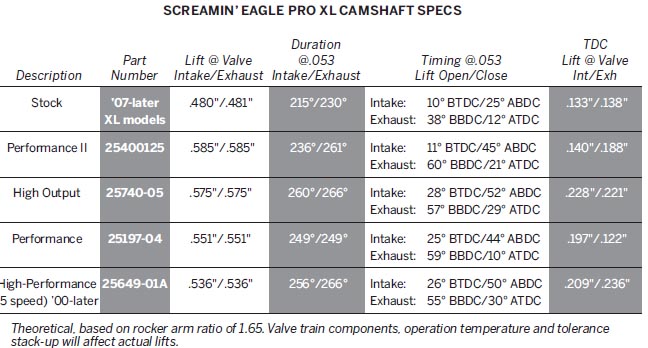
One of the first things I always look at is the intake close timing. The later the intake closes, the less of the compression stroke is used for compression, and therefore the less compression you get from a given compression ratio. Knowing your CR is going to be 10.5:1, you can run the numbers ... I'll use my own compression calculator ...
585's: 45 degree intake close point at 10.5:1 comes out to 202.6psi
536's: 50 degree intake close point at 10.5:1 comes out to 195.8psi
575's: 52 degree intake close point at 10.5:1 comes out to 192.9psi
This just comes down to how hard you want to push it, and how good of gas you can get. None of these numbers is really pushing things hard though, for an EFI bike. They're all manageable.
Later intake close points work best at higher rpm's, too, so keep that in mind. Your stock "W" cams for example have a 25 degree intake close point as you can see on the top line, the earliest of any XL cams on the market. It's really well optimized for bottom end and mid range.
Another number I pay a lot of attention to is the overlap, which is the sum of the intake open and exhaust close points. More overlap gives the exhaust more influence over the intake flow, which gives it a lot of control of the powerband. A motor with a lot of overlap will make a bunch of torque (and thus power) at any rpm where the exhaust pulls hard. It'll also run like crap at any rpm where the pipe is pushing back. But it's a huge, huge opportunity to make power. It can make a motor act like it has much bigger valves than it actually has, it's great for undervalved motors, and these motors are pretty badly undervalved.
585's: 11+21 = 33 degrees of overlap - this is fairly mild to middle of the road
536's: 26+30 = 56 degrees of overlap - that's a good hot street grind
575's: 28+29 = 57 degrees of overlap - that's a good hot street grind
Also I look at intake duration as it relates to exhaust duration. Cams that have longer exhaust lobes are called "dual pattern". This is done largely to help overcome pumping losses associated with restrictive exhausts.
The 585's are 236 intake and 261 exhaust - a whopping 25 degrees dual patterned. That's a lot. In fact, I'm not aware of any other cams on the market that come close to that.
The 536's are 256 intake and 266 exhaust - 10 degrees dual patterned, which is more or less a typical number on a hot street grind
The 575's are 260 intake and 266 exhaust - 6 degrees dual patterned, again not unusual on a hot street grind
Lift is another key number. Ideally you look at the lift as it relates to the head flow data. All ports have a nose-over point, where opening the valve more doesn't cause more flow to occur, because the valve is far enough out of the way that it's no longer relevant. The bigger the valve diameter, the higher the lift at which this occurs. A person can actually look at the flow data and run some numbers and come up with some reasonable relative values from different cams in terms of the airflow capability with a given set of heads. I don't have the flow data on the SE CNC heads in front of me however. But from memory and just speaking in broad generalities, I think they can take good advantage of the higher lift numbers you're looking at here. The 536's aren't going to get everything out of them that they have for you.
Bottom line is that the 585's are fairly mild, not a lot of overlap, and made for a more restrictive exhaust. Note that they're an emissions legal grind, too. That doesn't surprise me, looking at their specs.
The 536's and 575's on the other hand are really very typical hot street types of grinds, with the 575's having slightly hotter timing and some additional lift that the SE CNC heads can make use of. Neither is a really super hot cam, but they'll work well for what you're doing. The 575's will likely work a little better.
One of the first things I always look at is the intake close timing. The later the intake closes, the less of the compression stroke is used for compression, and therefore the less compression you get from a given compression ratio. Knowing your CR is going to be 10.5:1, you can run the numbers ... I'll use my own compression calculator ...
585's: 45 degree intake close point at 10.5:1 comes out to 202.6psi
536's: 50 degree intake close point at 10.5:1 comes out to 195.8psi
575's: 52 degree intake close point at 10.5:1 comes out to 192.9psi
This just comes down to how hard you want to push it, and how good of gas you can get. None of these numbers is really pushing things hard though, for an EFI bike. They're all manageable.
Later intake close points work best at higher rpm's, too, so keep that in mind. Your stock "W" cams for example have a 25 degree intake close point as you can see on the top line, the earliest of any XL cams on the market. It's really well optimized for bottom end and mid range.
Another number I pay a lot of attention to is the overlap, which is the sum of the intake open and exhaust close points. More overlap gives the exhaust more influence over the intake flow, which gives it a lot of control of the powerband. A motor with a lot of overlap will make a bunch of torque (and thus power) at any rpm where the exhaust pulls hard. It'll also run like crap at any rpm where the pipe is pushing back. But it's a huge, huge opportunity to make power. It can make a motor act like it has much bigger valves than it actually has, it's great for undervalved motors, and these motors are pretty badly undervalved.
585's: 11+21 = 33 degrees of overlap - this is fairly mild to middle of the road
536's: 26+30 = 56 degrees of overlap - that's a good hot street grind
575's: 28+29 = 57 degrees of overlap - that's a good hot street grind
Also I look at intake duration as it relates to exhaust duration. Cams that have longer exhaust lobes are called "dual pattern". This is done largely to help overcome pumping losses associated with restrictive exhausts.
The 585's are 236 intake and 261 exhaust - a whopping 25 degrees dual patterned. That's a lot. In fact, I'm not aware of any other cams on the market that come close to that.
The 536's are 256 intake and 266 exhaust - 10 degrees dual patterned, which is more or less a typical number on a hot street grind
The 575's are 260 intake and 266 exhaust - 6 degrees dual patterned, again not unusual on a hot street grind
Lift is another key number. Ideally you look at the lift as it relates to the head flow data. All ports have a nose-over point, where opening the valve more doesn't cause more flow to occur, because the valve is far enough out of the way that it's no longer relevant. The bigger the valve diameter, the higher the lift at which this occurs. A person can actually look at the flow data and run some numbers and come up with some reasonable relative values from different cams in terms of the airflow capability with a given set of heads. I don't have the flow data on the SE CNC heads in front of me however. But from memory and just speaking in broad generalities, I think they can take good advantage of the higher lift numbers you're looking at here. The 536's aren't going to get everything out of them that they have for you.
Bottom line is that the 585's are fairly mild, not a lot of overlap, and made for a more restrictive exhaust. Note that they're an emissions legal grind, too. That doesn't surprise me, looking at their specs.
The 536's and 575's on the other hand are really very typical hot street types of grinds, with the 575's having slightly hotter timing and some additional lift that the SE CNC heads can make use of. Neither is a really super hot cam, but they'll work well for what you're doing. The 575's will likely work a little better.
maybe Aaron and the hammer folks can get you straightened out. give them a call. (208) 696-1250
Last edited by cvaria; Mar 20, 2018 at 09:34 AM.
Trending Topics
Thread Starter
|
Stage IV
Joined: Mar 2018
Posts: 4
Likes: 0
From: Seattle, WA
HD Forum Stories
The Best of Harley-Davidson for Lifelong Riders

7 Surprising Harley-Davidson Products that Are Not Motorcycles
Verdad Gallardo
8 Best Harley-Davidson Motorcycles Ever
Pouria Savadkouei
10 Worst Harley-Davidson Motorcycles Ever
Pouria Savadkouei
Killer Custom's Jail Break Is The Breakout That Refused to Blend In
Verdad Gallardo
Crazy Bunderbike Build Looks Amazing, But Is It Impossible to Ride?
Verdad Gallardo
Harley-Davidson Reveals Super Cool Cafe Racer Concept
Verdad Gallardo
Engraved Rebellion: Inside Bundnerbike's Glam Rock II
Verdad Gallardo
10 Motorcycles You Should Never Buy
Joe Kucinski
10 Things Harley-Davidson Needs to Fix in 2026
Verdad Gallardo


Thread
Thread Starter
Forum
Replies
Last Post