



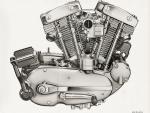

Fuel economy - 883 vs 1200 conversion

Thread Starter
|
Road Captain
Joined: May 2017
Posts: 590
Likes: 201
From: Southern Ontario
 Fuel economy - 883 vs 1200 conversion
I just found this peculiar and who else to talk about it to other than a forum of Sportster junkies.
I put about 7,000 miles on my 2017 Iron as an 883 with Stage 1(all aftermarket companies), dealer flashed but no dyno. I then converted it to a 1200, dynoed it, and have put on another 20,000 miles. My fuel economy decreased by 1/5 and that obviously makes sense given the bigger motor. 25 km/L before, 20 km/L after (using round numbers).
I recently went on a 2,000 mile US road trip with a friend (we're Canadian, not that it matters) who has a 2013 Iron 883, Screaming Eagle exhaust, dealer flashed, no other performance modifications, same mileage as mine. We would yell out how many gallons at every gas station during the trip. He was always 0.1 or 0.2 gallons less than me. If I put 2.3xx gallons of fuel in, he put 2.1xx gallons. If I put in 1.7xx gallons, he was at 1.6xx gallons.
The first thing I said to him was that he must be running really rich, but he said no and that his spark plugs are never black when he checks them.
How does that make any sense? To me, it doesn't if he's burning the same amount of fuel as a 1200.
Cheers
I put about 7,000 miles on my 2017 Iron as an 883 with Stage 1(all aftermarket companies), dealer flashed but no dyno. I then converted it to a 1200, dynoed it, and have put on another 20,000 miles. My fuel economy decreased by 1/5 and that obviously makes sense given the bigger motor. 25 km/L before, 20 km/L after (using round numbers).
I recently went on a 2,000 mile US road trip with a friend (we're Canadian, not that it matters) who has a 2013 Iron 883, Screaming Eagle exhaust, dealer flashed, no other performance modifications, same mileage as mine. We would yell out how many gallons at every gas station during the trip. He was always 0.1 or 0.2 gallons less than me. If I put 2.3xx gallons of fuel in, he put 2.1xx gallons. If I put in 1.7xx gallons, he was at 1.6xx gallons.
The first thing I said to him was that he must be running really rich, but he said no and that his spark plugs are never black when he checks them.
How does that make any sense? To me, it doesn't if he's burning the same amount of fuel as a 1200.
Cheers
Last edited by TimmyPage; Aug 16, 2019 at 08:20 AM.

Road Captain


Joined: Mar 2009
Posts: 654
Likes: 734
In reality, a conversion should make the motor more efficient, not less, because there's almost always a compression increase associated with the conversion.

Grand HDF Member


Joined: Nov 2018
Posts: 4,607
Likes: 3,311
From: Virginia
Real simple explanation.
When you put the 1200 kit in your bike you enjoyed the larger engine and used the throttle more. When you were riding with your buddy on the 883 you both were riding very similar riding style, speed, weight, luggage, ect... so your 1200 got very similar mileage to his 883.
When you put the 1200 kit in your bike you enjoyed the larger engine and used the throttle more. When you were riding with your buddy on the 883 you both were riding very similar riding style, speed, weight, luggage, ect... so your 1200 got very similar mileage to his 883.

Club Member
Joined: Jun 2007
Posts: 45,429
Likes: 2,897
From: Bedford UK

My Buell Firebolt 1200 is much more economical than my XL883. My old 80" Glide started out as a new bike and has been developed through Stage 1 to 89" stroker and now has an S&S 107" engine. Fuel consumption hasn't changed much at all, even though it now gives over 100HP. Riding above 80mph increases consumption a lot, but always has. Don't get too wound up in these things - logic doesn't always seem to make sense!
Grand HDF Member
Joined: Nov 2018
Posts: 4,607
Likes: 3,311
From: Virginia
My Buell Firebolt 1200 is much more economical than my XL883. My old 80" Glide started out as a new bike and has been developed through Stage 1 to 89" stroker and now has an S&S 107" engine. Fuel consumption hasn't changed much at all, even though it now gives over 100HP. Riding above 80mph increases consumption a lot, but always has. Don't get too wound up in these things - logic doesn't always seem to make sense!
I don't know about the Buell's, but the Harley Sportster 1200's are geared higher than the 883's. So it's possible to get better mileage with a 1200. But the OP said he had an 883 Converted to 1200. If he didn't change his drive pulleys then he still has the 883 gearing.
Thread Starter
|
Road Captain
Joined: May 2017
Posts: 590
Likes: 201
From: Southern Ontario
Cheers guys.
Those numbers I posted (20km/L and 25 km/L) are from a fuel app I have used since the beginning. Bigger engines just burn more gas.
Not exactly. I rode the same as I always do a lot of the time, especially windier roads, and we weren't always riding side-by-side. I would often take off on him and wait at a gas station ~50 miles up the road. Weight might be a factor. I am around 70 lbs lighter than he and only have a side solo bag. His Sporty is like a mini tourer. Saddle bags and tour pack.
I'm not wound up and I think you're right that the logic doesn't always add up. Again, I just figured to share with a bunch of Sportster junkies. It's not like my wife wants to hear this stuff. LOL
Correct. 883 gearing. Both our bikes were at the same RPM for the same speed.
Those numbers I posted (20km/L and 25 km/L) are from a fuel app I have used since the beginning. Bigger engines just burn more gas.
When you put the 1200 kit in your bike you enjoyed the larger engine and used the throttle more. When you were riding with your buddy on the 883 you both were riding very similar riding style, speed, weight, luggage, ect... so your 1200 got very similar mileage to his 883.
Correct. 883 gearing. Both our bikes were at the same RPM for the same speed.

Seasoned HDF Member


Joined: Sep 2018
Posts: 6,038
Likes: 1,812
From: Kalifornia
Well I would disagree with you one one big point. Bigger engines do NOT always use more gas. A motor vehicle take X amount of horsepower to travel down the road at say 65 miles per hour. It does not matter if said engine only produces 20 or 60, it only needs X which lats say 17hp. The engine producing 20hp will require far more throttle to achieve 17hp, than thr engine that produces 60.
So less throttle will equal less fuel. As far as getting to 65, then it comes down to how quick you want to get there. If you always drive "just like you did when it was an 883" then why bother upgrading to more power? When we make more power, we tend to use it, even subconsciously, I guarantee it.
As was pointed out, when riding with a bike of lesser power, you ride like he does. Your engine, that produces MORE power, takes less throttle to do the same work, thus you are more efficient than you normally are.
So less throttle will equal less fuel. As far as getting to 65, then it comes down to how quick you want to get there. If you always drive "just like you did when it was an 883" then why bother upgrading to more power? When we make more power, we tend to use it, even subconsciously, I guarantee it.
As was pointed out, when riding with a bike of lesser power, you ride like he does. Your engine, that produces MORE power, takes less throttle to do the same work, thus you are more efficient than you normally are.
Trending Topics
Thread Starter
|
Road Captain
Joined: May 2017
Posts: 590
Likes: 201
From: Southern Ontario
I do a lot of freeway riding and it's always at the same speed (120 km/h - 75 mph) and at the same RPM (a hair just under 4,000 RPM whether it was an 883 or 1200). My gas light used to come on like clockwork at about 125 miles as an 883, whereas now it comes on at 100 miles as a 1200. I used to be able to make it from my driveway to Kingston's city limits (on fumes) as an 883, whereas now the tank is bone dry by Belleville as a 1200. Please explain that to me. Again, same speed, same RPM, same road, same time of day. I ride this route many, many times over the summer for work.
I don't mean to come across as a jerk (if it comes through that way) but I'm the one who puts gas in this thing. I'm the one who has tracked its fuel expenses with the same app since the beginning that uses the same mathematical formulas. Fuel economy dropped by 20% after I converted it. That's just the way it is. Maybe dyno-ing it was the reason, because it's not running factory lean anymore, I don't know. I just know my fuel economy dropped by 20%. Cheers
(2 Princess is not my address. It's the hotel I stay at.)

Last edited by TimmyPage; Aug 17, 2019 at 07:38 AM.
HD Forum Stories
The Best of Harley-Davidson for Lifelong Riders

8 Best Harley-Davidson Motorcycles Ever
Pouria Savadkouei
10 Worst Harley-Davidson Motorcycles Ever
Pouria Savadkouei
Killer Custom's Jail Break Is The Breakout That Refused to Blend In
Verdad Gallardo
Crazy Bunderbike Build Looks Amazing, But Is It Impossible to Ride?
Verdad Gallardo
Harley-Davidson Reveals Super Cool Cafe Racer Concept
Verdad Gallardo
Engraved Rebellion: Inside Bundnerbike's Glam Rock II
Verdad Gallardo
10 Motorcycles You Should Never Buy
Joe Kucinski
10 Things Harley-Davidson Needs to Fix in 2026
Verdad Gallardo
Southpaw Super Glide: A Left-Hand-Drive 1979 Harley FXE Built to Fit the Rider
Verdad Gallardo
Road Captain
Joined: Mar 2009
Posts: 654
Likes: 734
handrifle is absolutely correct. The power required to move the bike doesn't change. And the bigger engine is not necessarily less efficient at turning fuel into power. In fact, if there was an increase in compression as part of the conversion (and there almost always is), the converted motor should make the engine more efficient, not less.
Now sure, frictional losses are a part of the equation, and to the extent making a motor bigger creates more frictional losses, it loses efficiency. But that's in the noise compared the efficiency gains you get from raising compression.
I'm not doubting for a second that you carefully measure fuel efficiency and made no other changes besides the conversion and saw a reduction in efficiency. I'm just saying the conversion didn't likely cause it.
I suspect that Apache Snow is exactly correct, that it has more to do with the tune than the conversion. The bike was retuned for the conversion and that's a much more likely cause.
There's another possibility as well, too, and that's the exhaust. Changing the size of the motor can really change the way an exhaust behaves, because they work on reflected pressure waves, and the timing of those waves is affected by the volume of exhaust being expelled by the engine. If, for example, the motor size change caused a reversion in the exhaust, at an rpm where you cruise, well, that'll hurt efficiency. The shape of the torque curve can tell you a lot about how the exhaust behaves. Anywhere you've got a torque dip, you've likely got the exhaust pushing back right there.
Now sure, frictional losses are a part of the equation, and to the extent making a motor bigger creates more frictional losses, it loses efficiency. But that's in the noise compared the efficiency gains you get from raising compression.
I'm not doubting for a second that you carefully measure fuel efficiency and made no other changes besides the conversion and saw a reduction in efficiency. I'm just saying the conversion didn't likely cause it.
I suspect that Apache Snow is exactly correct, that it has more to do with the tune than the conversion. The bike was retuned for the conversion and that's a much more likely cause.
There's another possibility as well, too, and that's the exhaust. Changing the size of the motor can really change the way an exhaust behaves, because they work on reflected pressure waves, and the timing of those waves is affected by the volume of exhaust being expelled by the engine. If, for example, the motor size change caused a reversion in the exhaust, at an rpm where you cruise, well, that'll hurt efficiency. The shape of the torque curve can tell you a lot about how the exhaust behaves. Anywhere you've got a torque dip, you've likely got the exhaust pushing back right there.
Last edited by aswracing; Aug 17, 2019 at 09:13 AM.