When you click on links to various merchants on this site and make a purchase, this can result in this site earning a commission. Affiliate programs and affiliations include, but are not limited to, the eBay Partner Network.
Has anyone heard of Big Bear Choppers? Looks like the make a custom raked tree to correct steering geometry and also make a inverted fork kit. Anyone heard of these? https://youtu.be/i4dmkCNHaqg
Has anyone heard of Big Bear Choppers? Looks like the make a custom raked tree to correct steering geometry and also make a inverted fork kit. Anyone heard of these? https://youtu.be/i4dmkCNHaqg
Big Bear choppers been around awhile they went under after the chopper craze crashed, Was bought out and new owner kept Kevin around.
Looks like a nice setup, Kraus motor co has a nice setup also.
I find it interesting the way they change the rake in the trees to adjust trail. I haven't heard of others doing this. They claim it really makes a difference in handling and stability.
Big Bear choppers been around awhile they went under after the chopper craze crashed, Was bought out and new owner kept Kevin around.
Looks like a nice setup, Kraus motor co has a nice setup also.
Do some research.......their demise had nothing to do with the end of a fad. Big bear choppers ripped off quite a few people for a lot of $$$$. They're scumbags........
IIRC Howard of HDF sponsor Motorcycle Metal does upside down forks for us. Inevitably they will need new trees, as they are a lot fatter than our stock forks.
Thanks Grahm. I have been doing inverted forks in HD's for about 10 years. I offer two types. I make a steering stem behind the forks for those who wish performance. There are no performance bikes that have a steering stem in front of forks. Anyone who believes that reducing the rake and/or trail on a set of triple trees that have a steering stem in front of forks will be "a (positive) difference in stability" needs to use your common sense. The bike would turn slightly quicker but the reason why you purchased a touring bike in the beginning is for the bike not to be responsive and enjoying a relaxed ride over a long time in the saddle. If you wanted a responsive bike for touring, ride a late model FXD (Dyna) with saddle bags that already has a steering stem in front of the forks. We all know that a Dyna, yes, a very good bike, is no where as comfortable for touring as a HD Touring model for long trips/rides. Does anyone here actually believe that Harley Davidson can not design the best geometry for a particular application with rows of engineers that work for them? Granted that the parts made are not the best but the cheapest to manufacture (Sand Cast Mild Steel)
For anyone to make a statement that they have a "custom raked tree to correct (HD touring) steering geometry" is ludicrous. Reduce the trail, the bike will turn better (in retrospect) but will be less stable than the original 7.6" to the M-8 with 6.8" of trail. The reason why the steering stem is in front of the forks is: The friction of the tire will always push the forks thus push the fork/tire straight requiring much less feedback mile after mile. If you wanted handling to where this effect is non-existent than a steering stem behind the forks is your only design choice. The steering is much lighter and turning is effortless V/S a very heavy steering that requires a lot of effort and input. That is what makes the steering stem in front of forks such a good high millage touring design. The longer rake helps the bike to track straight, look at any long forked, poorly designed chopper. Goes down the road straight and effortlessly, however you need two (2) flagman to stop traffic in the parking lot so the chopper can leave bike night.
Use your search on the internet and you will find that the many Big Bear choppers had their neck crack and fall off and BBC did nothing to warranty their street legal, registered, and plated bikes they sold to the general public. So much for Kevin's suspension skills. Standing by their product with actual engineering is non-existent. Google is your friend, read than talk. Neither companies, using the same machine shop have actual engineers or metallurgists working for them like HD does in their design.
There are many factors to consider when thinking of installing an inverted fork on a high raked bike which are all HD's. An inverted fork may or may not have great internal components. Inverted forks are far from equal from one brand to another. The next is the bushings and replacement of them. If you have a good fork such as the KYB style which has captivated bushings that requires specialized tools and a trained technician to replace them. I personally know of no one in S. Fla who does this other than myself. I do not know everything, however prior to purchase, get to know your guy. All touring bikes and Dyna's require the fork bushings to be replaced every 10K miles. Anyone who disputes this needs to actually take your fork apart if you have 20K miles and inspect your fork tubes for shinny spots where your Teflon coating on the bushings have worn off and the steel/brass carriers (bushings) have worn through the hard chrome into the softer steel fork tubes. Replace your bushings or replace your fork tubes, your choice. This means is if you want performance there is maintenance involved.
Fast pictures:
Unlike a Showa design the bushings are captivated inside of the slider and the micro polished fork tube slides up and down on the bushings. Much less resistance than sliding up and down an aluminum slider and far more precise.
My inverted set of triple trees that is made of: Bottom 17-4 PH Stainless Steel and top 7071 T6. These are the same trees that I use on my 49mm W/ Ohlins NIX 30mm fully adjustable forks. My trees fit on all models including the Road King Nacelle. This model tree is designed for 1986 ~ 2013. The 2014~Current requires a different bottom triple tree and steering stem.
This is what a steering stem in front of your fork looks like on your 1986~Current design.
This is my Steering stem behind the forks with 4" of trail. This is a 10 year old proven design. More steering input is required but handles corners much better than the OEM Steering Stem in fornt of the forks. This comes down to what do you want to use your bike for?
Howard, this is such a great summary amd write up (you tood me in person and reading it I actuallyhear you how would you say it LOL) that you should link it (copy it) into your website.
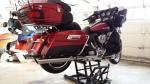
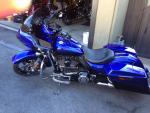
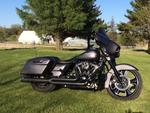
Finally got my inverted frontend done, Took a little longer than I thought with work and everything and waiting on paint but it turned out good.
Still have to put my Trac swingarm and rear brake setup on but it has been in the rack long enough, Time to ride.
7 Surprising Harley-Davidson Products that Are Not Motorcycles
Slideshow: The bar-and-shield logo shows up on far more than motorcycles, some of the company's most unexpected products have nothing to do with riding.
Slideshow: From the troubled AMF years to modern misfires, these bikes earned reputations for reliability issues, questionable engineering, or disappointing performance.
Crazy Bunderbike Build Looks Amazing, But Is It Impossible to Ride?
Slideshow: The Swiss custom shop has taken a Harley Softail and stretched it into something so long and low that it looks closer to a rolling sculpture than a conventional motorcycle.
Engraved Rebellion: Inside Bundnerbike's Glam Rock II
Slideshow: A standard cruiser becomes an intricate metal canvas in the hands of a Swiss custom house known for pushing Harley-Davidson platforms far beyond their factory brief.





 Raked Trees and Inverted Forks