



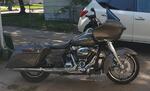



Turns left easy, right not as easy
Road Master


Joined: Feb 2021
Posts: 1,081
Likes: 478
From: Phoenix Arizona

Get bike on lift, and get engine alignment tool on rear swing arm so you have the swing arm in line with the frame center line, then check rear tire axle to front of swing are pivot distances.
Get frame level with alignment tool still on bike, the get string line down the front and rear tires to get the front tire aligned with the rear tire that is aligned with the frame, then put an angle gauge on both the front rotor and the back rotors, and make sure both front and back rotors at reading 90 degrees on the money.
If front rotor is not reading 90 with it straight down the frame line, then you have a problem with either bent fork, head tube not welded true, or triple clamp is bent instead.
On the back end, it's a frame thing, and just need to use the motor top turnbuckle once you remove the alignment tool to get the rear tire/ swiing arm 90 to the frame (leave the front turn buckle alone, since the alignment tool already set that correctly to begin with).
As for the whole level the frame, then angle gauge on the front tire to get it to 90 for string line use, does not tell you if the front wheel is actual pointing down the frame center line to begin with or not. And if not, then your going to be pulling the rear end way the hell out of frame center line to get it on the same line as the front tire isntead.
From here, check all your brake calipers to make sure that they are kicking back freely, and not bound up to hold the pads tight to one side of the rotor.
Note, do not use a petroleum base grease on the brake parts, since it will swell the rubber parts up on them to cause the caliber/pistons/guide rods to bind.
Get frame level with alignment tool still on bike, the get string line down the front and rear tires to get the front tire aligned with the rear tire that is aligned with the frame, then put an angle gauge on both the front rotor and the back rotors, and make sure both front and back rotors at reading 90 degrees on the money.
If front rotor is not reading 90 with it straight down the frame line, then you have a problem with either bent fork, head tube not welded true, or triple clamp is bent instead.
On the back end, it's a frame thing, and just need to use the motor top turnbuckle once you remove the alignment tool to get the rear tire/ swiing arm 90 to the frame (leave the front turn buckle alone, since the alignment tool already set that correctly to begin with).
As for the whole level the frame, then angle gauge on the front tire to get it to 90 for string line use, does not tell you if the front wheel is actual pointing down the frame center line to begin with or not. And if not, then your going to be pulling the rear end way the hell out of frame center line to get it on the same line as the front tire isntead.
From here, check all your brake calipers to make sure that they are kicking back freely, and not bound up to hold the pads tight to one side of the rotor.
Note, do not use a petroleum base grease on the brake parts, since it will swell the rubber parts up on them to cause the caliber/pistons/guide rods to bind.

Grand HDF Member


Joined: Jan 2012
Posts: 4,459
Likes: 2,892
From: Oklahoma
An absolute WILD GUESS. How many miles on your tires? If the roads where you ride are crowned, the flat area in the center of the tread will be a bit more worn on the left side. Turning to the right requires over powering the slight shoulder on the right side of the flat area but the left turn has less of a shoulder to overcome. Never noticed any difference on my bikes, just use whatever "muscle" is needed for the desired results.

Road Master


Joined: May 2012
Posts: 1,001
Likes: 107
From: Houston
I’m right handed and can turn left on a dime…my rights need more work and I’ve been riding a while…I’m a “North American” lol
Cruiser

Joined: Sep 2023
Posts: 189
Likes: 123
From: Ottawa
Lol, I'm just messin' around. Although as a North American my right u-turns are a little rusty.

HDF Community Team


Joined: Dec 2005
Posts: 5,419
Likes: 2,621
From: NC USA
OK, here's what I'm talking about. I'm going down the road , say 75 or 80, I have the same amount of beer in each bag. I come to a left sweeper and I just have to think about the turn and around she goes. Then down the road a little ways a right sweeper, but on this one I have to give the right bar a little more push. not much, but more than the left.
Doesn't matter about difference in saddlebag weights and for a cable be causing any such issue, it'd have to be too tight to let the thing steer when sitting still.
Too may people try to align the rear tire by getting the belt to run dead center of rear pulley. That seldom works out well.
HD Forum Stories
The Best of Harley-Davidson for Lifelong Riders

7 Surprising Harley-Davidson Products that Are Not Motorcycles
Verdad Gallardo
8 Best Harley-Davidson Motorcycles Ever
Pouria Savadkouei
10 Worst Harley-Davidson Motorcycles Ever
Pouria Savadkouei
Killer Custom's Jail Break Is The Breakout That Refused to Blend In
Verdad Gallardo
Crazy Bunderbike Build Looks Amazing, But Is It Impossible to Ride?
Verdad Gallardo
Harley-Davidson Reveals Super Cool Cafe Racer Concept
Verdad Gallardo
Engraved Rebellion: Inside Bundnerbike's Glam Rock II
Verdad Gallardo
10 Motorcycles You Should Never Buy
Joe Kucinski
10 Things Harley-Davidson Needs to Fix in 2026
Verdad Gallardo



Thread
Thread Starter
Forum
Replies
Last Post
Gitarded
Tri Glide, RG3 & Freewheeler Models
18
Oct 13, 2017 09:41 PM
BrianDamage
General Harley Davidson Chat
26
Apr 27, 2007 04:01 AM