




Handlebar improves handling

HDF Community Team


Joined: Nov 2012
Posts: 6,189
Likes: 2,419
From: USA


You steer a bicycle, you don't steer a motorcycle at speed.
Push right handlebar grip on bicycle, go left.
Push right handlebar grip on motorcycle, go right.
The bars provide the leverage for the 'steering head' geometry! More leverage, more response.
You ride a bike with drag bars, and it feels tighter. You put apes on it, and it feels looser.
Push right handlebar grip on bicycle, go left.
Push right handlebar grip on motorcycle, go right.
The bars provide the leverage for the 'steering head' geometry! More leverage, more response.
You ride a bike with drag bars, and it feels tighter. You put apes on it, and it feels looser.
 That I usually use counter steering at speed is true, but that is still steering.
A longer lever arm gives better control and increased torque, but reduces response. I already explained the geometry of this previously. This is why little steering wheels are “quick”, but twitchy, compared to big steering wheels, which are sluggish, but stable. The same geometry applies to wide va narrow handlebars.
With the exact same width, a drag bar will often be more solidly affixed than an ape, because of the mounts and rise of the apes tubes. In which case not only do the drag bars feel more solid, they are.
The riders body position and resulting geometry also comes into play, with generally better strength and control when leaning slightly forward and down as opposed to upright and ahead.
This can easily be exceeded, resulting in a negative impact. Overhead apes, or the drop type bicycle bars for example. As well extremely skinny bars, where one cannot control deflection well. Or extremely wide bars, where dramatic body core motion is needed to retain grip while moving the bars. These extremes adversely affect control.

Stellar HDF Member
Joined: Jul 2017
Posts: 2,327
Likes: 2,404
From: Jackson, OH
There's a point where wider bars obviously become ridiculously wide, but in general they offer a couple known benefits:
Greater width = greater leverage = reduced input forces needed to achieve movement. This is more easily apparent at slower speeds and especially so with very low speed maneuvers. It's the same effect as using a 'cheater' bar on a wrench.
Greater width = more precise control of bars and wheel. This is just a function of the bar ends requiring more movement (vs narrower bars) to affect steering. It sounds counter-intuitive but the more the bar ends must move, the more precise control you'll experience. A set of very narrow bars would result in much more front wheel movement per degree of hand movement. 'Twitchy' is often used to describe the effect.
Greater width = greater leverage = reduced input forces needed to achieve movement. This is more easily apparent at slower speeds and especially so with very low speed maneuvers. It's the same effect as using a 'cheater' bar on a wrench.
Greater width = more precise control of bars and wheel. This is just a function of the bar ends requiring more movement (vs narrower bars) to affect steering. It sounds counter-intuitive but the more the bar ends must move, the more precise control you'll experience. A set of very narrow bars would result in much more front wheel movement per degree of hand movement. 'Twitchy' is often used to describe the effect.
Road Warrior


Joined: Jun 2014
Posts: 1,934
Likes: 722
From: Ontario, Canada
Hola,
Take a look at Khrome Werks website for their bars. They show all the dimensions for their bars, inclusive of pitch angle. I'm on my 2nd set (1st set got bent from an accident) of their mini apes. They have a 30.4 degree pitch angle for where your hand contacts the bars. Aside from T bars / drag bars, these have a relatively flat angle compared to something like beach bars. I find the flatter pitch angle allows better leverage.

Take a look at Khrome Werks website for their bars. They show all the dimensions for their bars, inclusive of pitch angle. I'm on my 2nd set (1st set got bent from an accident) of their mini apes. They have a 30.4 degree pitch angle for where your hand contacts the bars. Aside from T bars / drag bars, these have a relatively flat angle compared to something like beach bars. I find the flatter pitch angle allows better leverage.
This flatter wrist angle is what drove me to my current bars on my Road Glide. I have KST Pioneers. They are part of the KST Vanguard collection. These allow the uprights to be adjusted for pullback/wrist angle. Unfortunately I don't think they have them for batwings...just Road Glides & Road Kings.
Stellar HDF Member

Joined: Apr 2007
Posts: 2,339
Likes: 486
From: Nor Cal
There's a point where wider bars obviously become ridiculously wide, but in general they offer a couple known benefits:
Greater width = greater leverage = reduced input forces needed to achieve movement. This is more easily apparent at slower speeds and especially so with very low speed maneuvers. It's the same effect as using a 'cheater' bar on a wrench.
Greater width = more precise control of bars and wheel. This is just a function of the bar ends requiring more movement (vs narrower bars) to affect steering. It sounds counter-intuitive but the more the bar ends must move, the more precise control you'll experience. A set of very narrow bars would result in much more front wheel movement per degree of hand movement. 'Twitchy' is often used to describe the effect.
Greater width = greater leverage = reduced input forces needed to achieve movement. This is more easily apparent at slower speeds and especially so with very low speed maneuvers. It's the same effect as using a 'cheater' bar on a wrench.
Greater width = more precise control of bars and wheel. This is just a function of the bar ends requiring more movement (vs narrower bars) to affect steering. It sounds counter-intuitive but the more the bar ends must move, the more precise control you'll experience. A set of very narrow bars would result in much more front wheel movement per degree of hand movement. 'Twitchy' is often used to describe the effect.
Grand HDF Member

Joined: Sep 2017
Posts: 3,835
Likes: 988
From: Southern Virginia
I'm 6'2" and loved the stock bars of my 2010 Ultra Classic from the get go. I look at it like this. When I am sitting in my recliner I don't have my arms elevated to shoulder height, they are down lower either on the armrests of the chair or in my lap. The stock bars sort of felt that way to me. Low speed handling of the bike was never an issue to me due t the inverted triple trees of the Harley glides (admittedly my muscle memory was still tuned to my Shovelhead chopper).
Now when I got a different seat that sat a little lower and farther back I felt that something needed to change. All I had to do was loosen the clamp on the stock bar and adjust it to where I felt comfortable again and then tightened it down.
As always everyone has their preferences, but I have never liked high bars on batwing bikes. I ride year round and like the wind protection given by the fairing where the stock handlebars have my hands placed. Add in some head grips and I never get cold hands even in the dead of winter.
OP you may find that just a little adjustment of the bars you have or a change to a nicer seat might be all you need to do to get the feeling you want.
Now when I got a different seat that sat a little lower and farther back I felt that something needed to change. All I had to do was loosen the clamp on the stock bar and adjust it to where I felt comfortable again and then tightened it down.
As always everyone has their preferences, but I have never liked high bars on batwing bikes. I ride year round and like the wind protection given by the fairing where the stock handlebars have my hands placed. Add in some head grips and I never get cold hands even in the dead of winter.
OP you may find that just a little adjustment of the bars you have or a change to a nicer seat might be all you need to do to get the feeling you want.
Road Warrior
Joined: Jun 2014
Posts: 1,934
Likes: 722
From: Ontario, Canada
As always everyone has their preferences, but I have never liked high bars on batwing bikes. I ride year round and like the wind protection given by the fairing where the stock handlebars have my hands placed. Add in some head grips and I never get cold hands even in the dead of winter.
 Seriously though, I completely agree with you on this. It's why at 6'3" ish myself, I chose to go with their 10" version. I wanted to keep my hands below/behind the batwing more or less. And yes, added the heated grips at the same time and I could quite comfortably ride in our cold northern spring & fall.
Outstanding HDF Member
Joined: Jan 2020
Posts: 2,333
Likes: 628
From: the South
Normally I would say t bars for handling in my opinion but thats kind of strange on a bagger to me. 10 inch ape hangars usually do nice. I always recommend folks take a look at wild 1 chubbys for bars. good Luck brother!
HD Forum Stories
The Best of Harley-Davidson for Lifelong Riders

7 Surprising Harley-Davidson Products that Are Not Motorcycles
Verdad Gallardo
8 Best Harley-Davidson Motorcycles Ever
Pouria Savadkouei
10 Worst Harley-Davidson Motorcycles Ever
Pouria Savadkouei
Killer Custom's Jail Break Is The Breakout That Refused to Blend In
Verdad Gallardo
Crazy Bunderbike Build Looks Amazing, But Is It Impossible to Ride?
Verdad Gallardo
Harley-Davidson Reveals Super Cool Cafe Racer Concept
Verdad Gallardo
Engraved Rebellion: Inside Bundnerbike's Glam Rock II
Verdad Gallardo
10 Motorcycles You Should Never Buy
Joe Kucinski
10 Things Harley-Davidson Needs to Fix in 2026
Verdad Gallardo
Road Master
Joined: Jan 2020
Posts: 934
Likes: 1,050
From: So Calif
I can’t speak for you, but personally, I’ve always steered my motorcycle. That I usually use counter steering at speed is true, but that is still steering.
A longer lever arm gives better control and increased torque, but reduces response. I already explained the geometry of this previously. This is why little steering wheels are “quick”, but twitchy, compared to big steering wheels, which are sluggish, but stable. The same geometry applies to wide va narrow handlebars.
With the exact same width, a drag bar will often be more solidly affixed than an ape, because of the mounts and rise of the apes tubes. In which case not only do the drag bars feel more solid, they are.
The riders body position and resulting geometry also comes into play, with generally better strength and control when leaning slightly forward and down as opposed to upright and ahead.
This can easily be exceeded, resulting in a negative impact. Overhead apes, or the drop type bicycle bars for example. As well extremely skinny bars, where one cannot control deflection well. Or extremely wide bars, where dramatic body core motion is needed to retain grip while moving the bars. These extremes adversely affect control.
That I usually use counter steering at speed is true, but that is still steering.A longer lever arm gives better control and increased torque, but reduces response. I already explained the geometry of this previously. This is why little steering wheels are “quick”, but twitchy, compared to big steering wheels, which are sluggish, but stable. The same geometry applies to wide va narrow handlebars.
With the exact same width, a drag bar will often be more solidly affixed than an ape, because of the mounts and rise of the apes tubes. In which case not only do the drag bars feel more solid, they are.
The riders body position and resulting geometry also comes into play, with generally better strength and control when leaning slightly forward and down as opposed to upright and ahead.
This can easily be exceeded, resulting in a negative impact. Overhead apes, or the drop type bicycle bars for example. As well extremely skinny bars, where one cannot control deflection well. Or extremely wide bars, where dramatic body core motion is needed to retain grip while moving the bars. These extremes adversely affect control.
I understand what you are saying, and it is valid at parking lot speed, and for trikes. A narrow bar will turn the wheel more, with less movement than a wider bar (it will be harder to turn though). But, on the highway, on two wheels, things change. Lets say you are going 60mph, and you apply, for arguments sake, 1lb of pressure to your right grip. The bike veers right. You did not actually turn the wheel, or move the bars, it happened because of frame (steering head) geometry.
Now, you do this with narrow bars, and you get the reaction, but do this with wider bars and the reaction is greater (from the same input pressure). You did not move the bar, or turn the wheel, you get more frame dip, hence more reaction. This is why I say the wider bar feels 'looser', or more sensitive, because every slight input from your hand has more of an effect.
To put it another way, if you need 1lb pressure on a wide bar to change lanes, you need 2lb of pressure on a narrow bar to change lanes.
Just grab your bars closer to the center and feel how it is to 'steer' your bike.
Bottom line, they all do the same thing, you buy them for comfort and feel.
Grand HDF Member
Joined: Sep 2017
Posts: 3,835
Likes: 988
From: Southern Virginia
I'll try to type a little with my cold fingers (it dropped below 80 today John).
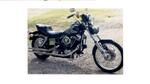
I've seen some folks mention T bars and it made me think back to when I had them on my 2003 FXDWG. When I bought the bike they were already on there so I left them for a few years. I liked the low speed handling but the highway comfort wasn't the greatest. After a while I got a proper set of risers which put the wider bar I purchased a little lower. So the end result was I wound up with a wider bar that had a more natural curve for the grips and levers that was sitting a little lower.
After the switch I noticed two things. One was the bike felt a whole lot less twitchy when hitting bumps at high speed. Another thing was it felt a lot more stable banging it around the backroads where I live. Also I noticed less back strain after long periods of time on the highway.
I ain't saying T bars are bad, but just for discussions' sake I thought I'd throw that out there in case anyone was curious.
I've seen some folks mention T bars and it made me think back to when I had them on my 2003 FXDWG. When I bought the bike they were already on there so I left them for a few years. I liked the low speed handling but the highway comfort wasn't the greatest. After a while I got a proper set of risers which put the wider bar I purchased a little lower. So the end result was I wound up with a wider bar that had a more natural curve for the grips and levers that was sitting a little lower.
After the switch I noticed two things. One was the bike felt a whole lot less twitchy when hitting bumps at high speed. Another thing was it felt a lot more stable banging it around the backroads where I live. Also I noticed less back strain after long periods of time on the highway.
I ain't saying T bars are bad, but just for discussions' sake I thought I'd throw that out there in case anyone was curious.