




Handlebar improves handling
Road Warrior


Joined: Jun 2014
Posts: 1,934
Likes: 722
From: Ontario, Canada

 Sheesh...80º!! We haven't seen that since last September. Honestly I envy you guys that live south and can ride year round.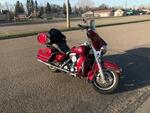
Tourer
Joined: Sep 2014
Posts: 461
Likes: 119
From: North Dakota
I understand what you are saying, and it is valid at parking lot speed, and for trikes. A narrow bar will turn the wheel more, with less movement than a wider bar (it will be harder to turn though). But, on the highway, on two wheels, things change. Lets say you are going 60mph, and you apply, for arguments sake, 1lb of pressure to your right grip. The bike veers right. You did not actually turn the wheel, or move the bars, it happened because of frame (steering head) geometry.
Now, you do this with narrow bars, and you get the reaction, but do this with wider bars and the reaction is greater (from the same input pressure). You did not move the bar, or turn the wheel, you get more frame dip, hence more reaction. This is why I say the wider bar feels 'looser', or more sensitive, because every slight input from your hand has more of an effect.
To put it another way, if you need 1lb pressure on a wide bar to change lanes, you need 2lb of pressure on a narrow bar to change lanes.
Just grab your bars closer to the center and feel how it is to 'steer' your bike.
Bottom line, they all do the same thing, you buy them for comfort and feel.
Now, you do this with narrow bars, and you get the reaction, but do this with wider bars and the reaction is greater (from the same input pressure). You did not move the bar, or turn the wheel, you get more frame dip, hence more reaction. This is why I say the wider bar feels 'looser', or more sensitive, because every slight input from your hand has more of an effect.
To put it another way, if you need 1lb pressure on a wide bar to change lanes, you need 2lb of pressure on a narrow bar to change lanes.
Just grab your bars closer to the center and feel how it is to 'steer' your bike.
Bottom line, they all do the same thing, you buy them for comfort and feel.
Road Master

Joined: Jan 2020
Posts: 934
Likes: 1,050
From: So Calif
Not wrong.
Forget the parking lot, and forget trikes. If what you believe it true, when you push your right grip, you would turn left! But you don't, do you? You go right. You can steer your bike without even touching the bars, just by leaning. Why . .
When you are at speed, your bike stays up because of the centrifugal force of the wheels spinning. The bike wants to go straight. The wheels 'resist' turning (steering). Because of this resistance, when you push the bars, the wheel resists, and because of the frame geometry (the rake angle), the frame dips, and you turn because the bike leaned over, and you are on the tire edge, causing the direction change. If you (could) actually turn the front wheel at speed, you would go down on your face!
Now I may not be explaining this in a way for you to understand, but what I say is not conjecture, it is absolute fact. You can research it, and you can prove it to yourself.
Sorry OP for getting off topic.
Forget the parking lot, and forget trikes. If what you believe it true, when you push your right grip, you would turn left! But you don't, do you? You go right. You can steer your bike without even touching the bars, just by leaning. Why . .
When you are at speed, your bike stays up because of the centrifugal force of the wheels spinning. The bike wants to go straight. The wheels 'resist' turning (steering). Because of this resistance, when you push the bars, the wheel resists, and because of the frame geometry (the rake angle), the frame dips, and you turn because the bike leaned over, and you are on the tire edge, causing the direction change. If you (could) actually turn the front wheel at speed, you would go down on your face!
Now I may not be explaining this in a way for you to understand, but what I say is not conjecture, it is absolute fact. You can research it, and you can prove it to yourself.
Sorry OP for getting off topic.

HDF Community Team


Joined: Nov 2012
Posts: 6,189
Likes: 2,419
From: USA

As you ride by pressure on your palms, I can see how wider bars would be more unstable to you. I ride by gross motion, and in fact often cannot feel my hands. The longer lever arm reduces the effect of my gross motions, so for me, it is the narrower bar that is more unstable.
The brute strength of the wide bars leverage also gives me psychological comfort, as well occasionally actually helping on rough, rutted or loose surfaces.
To your comment about not actually moving the handlebars, that I disagree with. If the front wheel wasn’t turned side to side around the steering head, the bike wouldn’t turn. That is the action that brings the geometry into play. The motion is slight, especially as speed increases. But the motion is there.
Oh, and OP, for low speed stability and maneuvering, scooting forward on your seat often helps. I don’t think any of us mentioned that. It’s often instruction #1 in low speed courses.
Last edited by foxtrapper; May 2, 2021 at 10:49 AM.
Road Master
Joined: Jan 2020
Posts: 934
Likes: 1,050
From: So Calif
It always amazes me how people can see the exact same thing, each from a completely different perspective! So each to his own!
Of course there are so many other factors to consider, such as type of bike, weight, purpose, seating position, speeds, etc., so there really is not one answer. I have raced bikes (and cars), and for me, on a dirt bike, a wider bar provides more control, but on a fast drag bike or track bike, a narrow bar provides more stability.
On the street, on my Road Glide, I changed from a 36" wide bar, to a 32" wide bar, because in a high speed (80 mph) sweeper, the wide bar was to 'touchy', or sensitive to any physical movement from my hand (like when hitting a bump). The narrow one is a little more stable feeling.
Thanks for the debate!
Of course there are so many other factors to consider, such as type of bike, weight, purpose, seating position, speeds, etc., so there really is not one answer. I have raced bikes (and cars), and for me, on a dirt bike, a wider bar provides more control, but on a fast drag bike or track bike, a narrow bar provides more stability.
On the street, on my Road Glide, I changed from a 36" wide bar, to a 32" wide bar, because in a high speed (80 mph) sweeper, the wide bar was to 'touchy', or sensitive to any physical movement from my hand (like when hitting a bump). The narrow one is a little more stable feeling.
Thanks for the debate!
Grand HDF Member
Joined: Sep 2017
Posts: 3,829
Likes: 984
From: Southern Virginia
Not wrong.
Forget the parking lot, and forget trikes. If what you believe it true, when you push your right grip, you would turn left! But you don't, do you? You go right. You can steer your bike without even touching the bars, just by leaning. Why . .
When you are at speed, your bike stays up because of the centrifugal force of the wheels spinning. The bike wants to go straight. The wheels 'resist' turning (steering). Because of this resistance, when you push the bars, the wheel resists, and because of the frame geometry (the rake angle), the frame dips, and you turn because the bike leaned over, and you are on the tire edge, causing the direction change. If you (could) actually turn the front wheel at speed, you would go down on your face!
Now I may not be explaining this in a way for you to understand, but what I say is not conjecture, it is absolute fact. You can research it, and you can prove it to yourself.
Sorry OP for getting off topic.
Forget the parking lot, and forget trikes. If what you believe it true, when you push your right grip, you would turn left! But you don't, do you? You go right. You can steer your bike without even touching the bars, just by leaning. Why . .
When you are at speed, your bike stays up because of the centrifugal force of the wheels spinning. The bike wants to go straight. The wheels 'resist' turning (steering). Because of this resistance, when you push the bars, the wheel resists, and because of the frame geometry (the rake angle), the frame dips, and you turn because the bike leaned over, and you are on the tire edge, causing the direction change. If you (could) actually turn the front wheel at speed, you would go down on your face!
Now I may not be explaining this in a way for you to understand, but what I say is not conjecture, it is absolute fact. You can research it, and you can prove it to yourself.
Sorry OP for getting off topic.
Many years ago when my late Wife got a bike I tried to teach her the basics in a parking lot but you know the saying familiarity breeds contempt. I quickly found out she would be best off taking a riding course taught by a professional. I agreed to take the course with her. When she got the study guide it taught just the way Mike described. I thought they were crazy, especially since at the time I rode a Shovelhead chopper with a hefty rake and drag bars. That bike definitely didn't build skills in me worthy of passing along to anyone.
Long story short my Wife learned just fine with that teaching method and I didn't get yelled at anymore.

Stellar HDF Member
Joined: Jul 2017
Posts: 2,327
Likes: 2,404
From: Jackson, OH
I won't speak for anyone else but myself.
Riding a thousand pound bike into a strong curve on a state route at...say...50 mph; I'm not steering or directing the bike by leaning primarily. Adjusting the bike's direction of travel by leaning (only) would have me wrecking quickly...mainly due to the heavy bike's sluggish reaction to control by physical body weight and leaning. I'm definitely NOT pulling on either bar end. I'm noticeably pushing the right bar to 'steer' right and vice versa. Nothing new here to most folks who comprehend counter-steering. I've never researched the physics of why counter-steering does what it does with a motorcycle. Trying to explain it to a new rider is like convincing a monkey to eat a banana sideways...it seems impossible.
Anyway: Bars which provide (me) more leverage and power (typically wider, with hands closer to shoulder height) require less felt effort to push (or pull) depending upon the bike's speed and maneuvers. Wider bars (for me) provide a feeling of greater control with more precision, while narrow bars feel faster to react while offering less-precise control of a very heavy bike.
Riding a thousand pound bike into a strong curve on a state route at...say...50 mph; I'm not steering or directing the bike by leaning primarily. Adjusting the bike's direction of travel by leaning (only) would have me wrecking quickly...mainly due to the heavy bike's sluggish reaction to control by physical body weight and leaning. I'm definitely NOT pulling on either bar end. I'm noticeably pushing the right bar to 'steer' right and vice versa. Nothing new here to most folks who comprehend counter-steering. I've never researched the physics of why counter-steering does what it does with a motorcycle. Trying to explain it to a new rider is like convincing a monkey to eat a banana sideways...it seems impossible.
Anyway: Bars which provide (me) more leverage and power (typically wider, with hands closer to shoulder height) require less felt effort to push (or pull) depending upon the bike's speed and maneuvers. Wider bars (for me) provide a feeling of greater control with more precision, while narrow bars feel faster to react while offering less-precise control of a very heavy bike.
HD Forum Stories
The Best of Harley-Davidson for Lifelong Riders

7 Surprising Harley-Davidson Products that Are Not Motorcycles
Verdad Gallardo
8 Best Harley-Davidson Motorcycles Ever
Pouria Savadkouei
10 Worst Harley-Davidson Motorcycles Ever
Pouria Savadkouei
Killer Custom's Jail Break Is The Breakout That Refused to Blend In
Verdad Gallardo
Crazy Bunderbike Build Looks Amazing, But Is It Impossible to Ride?
Verdad Gallardo
Harley-Davidson Reveals Super Cool Cafe Racer Concept
Verdad Gallardo
Engraved Rebellion: Inside Bundnerbike's Glam Rock II
Verdad Gallardo
10 Motorcycles You Should Never Buy
Joe Kucinski
10 Things Harley-Davidson Needs to Fix in 2026
Verdad Gallardo
Stellar HDF Member

Joined: Apr 2007
Posts: 2,339
Likes: 486
From: Nor Cal
I won't speak for anyone else but myself.
Riding a thousand pound bike into a strong curve on a state route at...say...50 mph; I'm not steering or directing the bike by leaning primarily. Adjusting the bike's direction of travel by leaning (only) would have me wrecking quickly...mainly due to the heavy bike's sluggish reaction to control by physical body weight and leaning. I'm definitely NOT pulling on either bar end. I'm noticeably pushing the right bar to 'steer' right and vice versa. Nothing new here to most folks who comprehend counter-steering. I've never researched the physics of why counter-steering does what it does with a motorcycle. Trying to explain it to a new rider is like convincing a monkey to eat a banana sideways...it seems impossible.
Anyway: Bars which provide (me) more leverage and power (typically wider, with hands closer to shoulder height) require less felt effort to push (or pull) depending upon the bike's speed and maneuvers. Wider bars (for me) provide a feeling of greater control with more precision, while narrow bars feel faster to react while offering less-precise control of a very heavy bike.
Riding a thousand pound bike into a strong curve on a state route at...say...50 mph; I'm not steering or directing the bike by leaning primarily. Adjusting the bike's direction of travel by leaning (only) would have me wrecking quickly...mainly due to the heavy bike's sluggish reaction to control by physical body weight and leaning. I'm definitely NOT pulling on either bar end. I'm noticeably pushing the right bar to 'steer' right and vice versa. Nothing new here to most folks who comprehend counter-steering. I've never researched the physics of why counter-steering does what it does with a motorcycle. Trying to explain it to a new rider is like convincing a monkey to eat a banana sideways...it seems impossible.
Anyway: Bars which provide (me) more leverage and power (typically wider, with hands closer to shoulder height) require less felt effort to push (or pull) depending upon the bike's speed and maneuvers. Wider bars (for me) provide a feeling of greater control with more precision, while narrow bars feel faster to react while offering less-precise control of a very heavy bike.
Tourer
Joined: Sep 2014
Posts: 461
Likes: 119
From: North Dakota
Just to be clear, I know and understand countersteer. My father taught me about it when he taught me to ride 30 years ago. It was the comment that one doesn’t move the front wheel when pushing the bars on the highway that I was pointing out as wrong.