



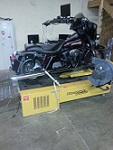

Truth in dyno
Outstanding HDF Member
Joined: Jul 2006
Posts: 2,876
Likes: 3
From: Washington State

Just a quick question: What should one expect from a "proficient tuner" as far as time on the Dyno and a ballpark price as to what we should be getting charged? I will be taking mine in the near future to be tuned with my SERT. My only mods are BUB 7's w/crossover and the S/E ventilator A/C.
After asking a few people on here "in the know" I myself have done the standard download with the SERT/laptop and maxed out the CLB's. Bike runs fine, starts fine, but has a slight amount of decel pop. That's it.
Thanks and great info.
After asking a few people on here "in the know" I myself have done the standard download with the SERT/laptop and maxed out the CLB's. Bike runs fine, starts fine, but has a slight amount of decel pop. That's it.
Thanks and great info.

Road Warrior
Joined: Jan 2006
Posts: 1,808
Likes: 0
From: Waynesville, NC
That's the problem with the majority of tuners, they only know how to tune power. With a proper tune you can get both, power and econpmy/rideability. A tune is done with throttle positions and RPM ranges. A bike can be tuned for perfomance in the 60%, 80% and 100% (wide open throttle) ranges throughout the RPM range. It can be tuned for economy at the other throttle positions. To put it in lamens terms, when you are cruising at 55 MPH in 5th gear, you are running at about 7 - 15% throttle position at around 2300 to 2500 RPM. A tuner can set that particualar area up for fuel efficiency, I/E/ a little leaner. but if you are cruising at 55 MPH in 5th gear at 2300 RPM and want to pass someone, you twist the grip and are at 80% to 100% throttle at the same RPM range, a tuner can set that up more on the performance side. In other words, a good tune will give you the best of both worlds.
so what your saying is an afr of 13.2 is a good way to go for those of us that use an autune like the thundermax which is an auto tune unit and by default they set the auto tune to 13.0 ? also if i may ask this is on a different subject it has to do with rpm's what is a good rpm for the 96 to cruise at for example i can run 55mph in 4th gear at 2900rpm or 55mph in 5th gear at say 2300 rpm which is best on the motor both feel fine no lugging as far as i can tell so in your opinion what is a good rpm to cruise on these 96.(flat ground cruising) any info would be greatly appreciated.
[quote=ATC2;4805415]
A/F is the air fuel ratio. We calibrate the bikes computer to 13.2:1 A/F, which means 13.2 parts of air to 1 part of fuel. Harley has set values of A/F for throttle positions and RPM ranges. For instance, newer Harleys cruising ranges are set to 14.6:1. When we tune a bike, we change Harley's setting to 13.2:1, that makes the computers target area to 13.2:1, we then make a dyno passes to see where your bike is running in it's configuration, (pipes, A/C, etc.), we make changes to the computer (ECM) to make it as to close to our goal 13.2:1 as possible, once we get it there the ECM is calibrated to the engine, we then set the ECM AFR back to what Harley wants or close to it.
Being a dyno tuner it troubles me to see some of your The other thing that bugs me is some of the A/F lines I see, or lack of. Bottom line is, if they can't read your A/F then they CANNOT perform a full tune, if they don't have a 250 dyno, they CANNOT perform a full tune. If they give you a "full tune" and don't show you the A/F calibration then they are hiding something. If you do have the A/F on your printout, it should be relatively a straight line, at around 13.2 : 1. Anything below that line is rich and anything above it is lean. That's NOT where your bike is running, (when you get it back) that is just where it is calibrated. Your Dyno lines should be smooth, when they get real wavy, usually at higher RPM's then your timing is probably off.
What exactly is the A/F line? What does it stand for?
What exactly is the A/F line? What does it stand for?
Just a quick question: What should one expect from a "proficient tuner" as far as time on the Dyno and a ballpark price as to what we should be getting charged? I will be taking mine in the near future to be tuned with my SERT. My only mods are BUB 7's w/crossover and the S/E ventilator A/C.
After asking a few people on here "in the know" I myself have done the standard download with the SERT/laptop and maxed out the CLB's. Bike runs fine, starts fine, but has a slight amount of decel pop. That's it.
Thanks and great info.
After asking a few people on here "in the know" I myself have done the standard download with the SERT/laptop and maxed out the CLB's. Bike runs fine, starts fine, but has a slight amount of decel pop. That's it.
Thanks and great info.
You have to realize that when we tune a bike we are really just calibrating it. The ECM is targeting a certain A/F value at differn't throttle positions and RMP ranges. For instance, the stock bike is seeking a 14.6:1 AFR at 15% throttle and 2500 RPM (cruising speed), a stock bike will be running around that. BUT, if you add a high flow air filter, your bike might actually be getting say 15.8:1 AFR, (lean). That's why the bike need to be calibrated (tuned) to the new filter. So we (tuners) set the computers whole AFR range to 13.2:1 so it's consistant across the board. The we "teach" the computer what 13.3:1 AFR is on your bike. Once that is done, we set the ECM back to Harley's specs and your bike is tunes, well for the most part. After I do the AFR I usually make some timing adjustments and so on.
You bet man. It just irks me to see good people get taken advantage of by some of the "tuners" out there. They give all of us a bad name.
HD Forum Stories
The Best of Harley-Davidson for Lifelong Riders

7 Surprising Harley-Davidson Products that Are Not Motorcycles
Verdad Gallardo
8 Best Harley-Davidson Motorcycles Ever
Pouria Savadkouei
10 Worst Harley-Davidson Motorcycles Ever
Pouria Savadkouei
Killer Custom's Jail Break Is The Breakout That Refused to Blend In
Verdad Gallardo
Crazy Bunderbike Build Looks Amazing, But Is It Impossible to Ride?
Verdad Gallardo
Harley-Davidson Reveals Super Cool Cafe Racer Concept
Verdad Gallardo
Engraved Rebellion: Inside Bundnerbike's Glam Rock II
Verdad Gallardo
10 Motorcycles You Should Never Buy
Joe Kucinski
10 Things Harley-Davidson Needs to Fix in 2026
Verdad Gallardo
Stage II
Joined: Dec 2008
Posts: 2
Likes: 0
From: rural NW ILL
Harleytuner, great info broke down so all can understand. I get how a hi flow air cleaner creates a higher air to fuel ratio creating a leaner running bike. How do tru dual headpipes with certain slip-ons affect all this? Thanks again.

Road Warrior


Joined: May 2006
Posts: 1,650
Likes: 539
From: BHC, Arizona
Is the DJ software setup to show the AFR at all throttle positions vs. rpm? Is the AFR line on the printout a true representation of the previous question or is it an avg. of all the WOT positions vs. rpm?
Do you use the DJ tunelink option, if so or not do you feel it is a viable tuning aid and why or why not? Also how much of your tuning process is devoted to timing? Do you utilize heat soak and drum loading in your process?
AP
Do you use the DJ tunelink option, if so or not do you feel it is a viable tuning aid and why or why not? Also how much of your tuning process is devoted to timing? Do you utilize heat soak and drum loading in your process?
AP
Last edited by Apendejo; Apr 2, 2009 at 10:26 PM.