






Does weight play a role in acceleration? Who wins??

Club Member


Joined: Jun 2007
Posts: 45,429
Likes: 2,898
From: Bedford UK

Hey guys, many years ago I was curious about the same thing and used real world data accumulated by car and driver magazine to graph lbs/torque vs 1/4 mile times. it was very linear using data from a couple of hundred makes and models. sure there are some minor variables between riders and tires, but basically it is all about lbs/torque. after 1/4 mile, as speed increases, then HP kicks in as the mass is already accelerated a lot, rpms are up and wind resistance becomes a huge factor...which has everything to do with the color of the bike....ha

Thread Starter
|
Road Master
Joined: Jun 2010
Posts: 757
Likes: 4

Using this 1/4 mile ET calculator http://robrobinette.com/et.htm My rodded 50hp 300lb drz400 will do the same 12.5 1/4 as my 700lb 90hp 103 EG. I added my 200# to each and it is for cars but the math is the same if maybe not correct for bikes? My old 400# 130hp ninja comes out at 9.7 So I've really stepped down in my old age. Pisses me off too! I will also like to call BS on a 400# fxr???
Pretty cool.
Club Member
Joined: Jun 2007
Posts: 45,429
Likes: 2,898
From: Bedford UK

As for that calculator, it is frankly misleading to use it here on this subject. To start with it is torque not power that gets you off the line, as already stated. In addition, a high torque figure at low rpm will give better results on one of our touring bikes compared with the same number at the top of the rev range.
If you have looked at dyno curves in HDF recently, there are some excellent ones with very high torque in the low/mid rev range, with a lower HP number than TQ. Despite that they will give the best butt-gauge acceleration.

Outstanding HDF Member
Joined: Feb 2007
Posts: 2,710
Likes: 6
From: Spokane, WA.
Ah Ha!
My friend is 6-2 275#- not really fat, but just a big strong guy.
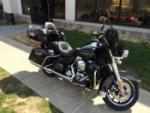
He has a 2008 CVO RK, Vance and Hines true duals and V&H slash cut mufflers.Ventilator A/C with K&N.
I am 6-0 and 170 2011 RKC, SE 255 cams, V&H power duals and V&H monster rounds sane A/C unit with K&N.
We rode 1500 miles together last August, to California, he could always pull away from me.
My friend is 6-2 275#- not really fat, but just a big strong guy.
He has a 2008 CVO RK, Vance and Hines true duals and V&H slash cut mufflers.Ventilator A/C with K&N.
I am 6-0 and 170 2011 RKC, SE 255 cams, V&H power duals and V&H monster rounds sane A/C unit with K&N.
We rode 1500 miles together last August, to California, he could always pull away from me.
Outstanding HDF Member
Joined: Sep 2007
Posts: 3,074
Likes: 12
From:
That is the correct answer in theory but rider weight, height, ambient temp, wind speed,aerodynamics (Fairings), shift points, race duration will all make contributions to the outcome

Elite HDF Member
Joined: Apr 2007
Posts: 3,766
Likes: 16
From: Roseville, CA
Don't forget gearing and torque, including under the curve.
For instance, tuned 6.1 SRT-8s could trap 113/114mph and run mid/high 12s.
However heavier, stock 6.4 SRT-8s, same horsepower, more torque all over the powerband trap the same mph, but can run low 12s.
That is totally false when comparing street tires in a straight line and any difference isn't even measurable unless there is obviously slippage.
Aero and gearing will come into play LONG before rolling resistance.
Personally, if my SG runs 12s I'd be happy.
For instance, tuned 6.1 SRT-8s could trap 113/114mph and run mid/high 12s.
However heavier, stock 6.4 SRT-8s, same horsepower, more torque all over the powerband trap the same mph, but can run low 12s.
we can only change the friction coefficient between the driving wheel and pavement assuming we have enough power in reserve. Slicks, all weather and rain tires were developed for adapting to the terrain. So if you have the proper tires on a heavy CVO and perhaps the same model of tires on a lighter RK the weight ratio doesn't really apply because the deformation of both rear tires will be different during acceleration and the grip of the rubber material onto the pavement will also differ.
Road rally conditions "in my younger days" showed there was a gain of 5 seconds per mile between each type of tire of a same manufacturer.
Road rally conditions "in my younger days" showed there was a gain of 5 seconds per mile between each type of tire of a same manufacturer.
Personally, if my SG runs 12s I'd be happy.
Last edited by Deuuuce; Jun 21, 2012 at 12:43 PM.
HD Forum Stories
The Best of Harley-Davidson for Lifelong Riders

7 Surprising Harley-Davidson Products that Are Not Motorcycles
Verdad Gallardo
8 Best Harley-Davidson Motorcycles Ever
Pouria Savadkouei
10 Worst Harley-Davidson Motorcycles Ever
Pouria Savadkouei
Killer Custom's Jail Break Is The Breakout That Refused to Blend In
Verdad Gallardo
Crazy Bunderbike Build Looks Amazing, But Is It Impossible to Ride?
Verdad Gallardo
Harley-Davidson Reveals Super Cool Cafe Racer Concept
Verdad Gallardo
Engraved Rebellion: Inside Bundnerbike's Glam Rock II
Verdad Gallardo
10 Motorcycles You Should Never Buy
Joe Kucinski
10 Things Harley-Davidson Needs to Fix in 2026
Verdad Gallardo
Road Captain
Joined: Jan 2009
Posts: 739
Likes: 2
From: St. Louis
I've read the whole post and didn't see where anybody had mentioned rotating mass. If you put lighter wheels and tires on a vehicle, there's less rotating mass to accelerate. As far as automobiles go, for every 1 pound of rotating mass you add/remove from the wheel/tire assembly is equal to adding or removing 7 pounds from the total weight of the vehicle. ie: If you put a new lighter wheel and tire assembly on the vehicle that weighs 10 pounds less, it's like removing 70 pounds of static mass (weight) from the vehicle. It could add up quickly, too. 10 lbs. per wheel (which is very easy to do) x 4 wheels = 40 lbs. of rotating mass, 40 lbs. of rotating mass x 7 lbs. of static mass is the equivalent of removing 280 lbs. from the vehicle. This also applies to rotating mass in the engine (lighter crank, rods, pistons, etc.) Even items such as the driveshaft weight (again it is rotating mass) can be reduced to help out. Lightweight braking components, lug nuts (titanium) lighter harmonic balancers, the list goes on and on. Bear in mind, on some items where the mass is located closer to the center of rotation (lug nuts, for example) you won't see the same results as if the weight were located more towards the outer diameter of the rotating assembly. This could (obviously) be applied to your bike, but on a smaller scale. Just bear in mind, every little bit helps.
Last edited by Gearhead3; Jun 21, 2012 at 08:17 PM.

Road Master
Joined: Jun 2010
Posts: 1,221
Likes: 4
From: Annemasse (border of Geneva-Switzerland) facing Mt-Blanc.
http://www.michelin-power.com/
MICHELIN Power Cup A,
MICHELIN Power Cup B,
MICHELIN Power Cup C,
MICHELIN Power Slick,
MICHELIN Power Rain.
They've assessed this topic before.