






Do Carb'd bikes run cooler than Efi??
Thread Starter
|
Tourer
Joined: Mar 2010
Posts: 354
Likes: 24
From: near dayton ohio
 Do Carb'd bikes run cooler than Efi??
I was doing some searching on here for info on my efi to carb switch that I am about to do and found a post where someone said that carb'd bikes run with a 20-30 degree coller oil temps? I not know if this is true, but wondering if I will notice less heat while riding after I have switched to a carb. My bike is a 99 RK with the 88 twinkie, but I would imagine that it would have the same efect on an evo as well.
anyone know if there is any truth in this?
anyone know if there is any truth in this?

Extreme HDF Member
Joined: Sep 2010
Posts: 14,744
Likes: 402
From: Phoenix '53, '88, '09 Big Twins
hmmm.
I have both.
I think the bigger the motor- the more heat. (103 vs 96 vs 88 vs 80).
AND the evo motor cylinder is taller, maybe better fin exposure.... although the TC has oil jets spraying at the bottoms of the pistons to cool them (remove heat)... no models before the TC had that.
so maybe a high oil temp shows better removal of heat from the motor internals...? that has to be considered.
so that's the physical differences.
on the earlier models ignition timing could be more easily adjusted, lower temps may be achieved by retarding timing, but MPG would be affected and under some conditions performance. the earlier systems used a VOES to retard timing under low vacuum conditions ( such as acceleration,)
likewise a carb is easier to "adjust" but even the best tuned carb ( and the Keihin CV carb is one of the best) is very coarse in terms of atomization of the fuel and air/fuel ratio matching rpm and loading
and running overly rich is bad for performance...mpg and can damage the motor.
so a couple of ways of looking at it.
With all my years on Harleys, the current EFI is pretty darn good. I am way happy with the motor compared to the others ( 53, 53, 63, 88, 95)--- now i stayed away from the efi until the 09 model as I did not think the efi was as accurate as it could have been.
and I do a fair amount of hot weather riding, the twin cam and the evo feel equally hot on a 108º day.
Mike
I have both.
I think the bigger the motor- the more heat. (103 vs 96 vs 88 vs 80).
AND the evo motor cylinder is taller, maybe better fin exposure.... although the TC has oil jets spraying at the bottoms of the pistons to cool them (remove heat)... no models before the TC had that.
so maybe a high oil temp shows better removal of heat from the motor internals...? that has to be considered.
so that's the physical differences.
on the earlier models ignition timing could be more easily adjusted, lower temps may be achieved by retarding timing, but MPG would be affected and under some conditions performance. the earlier systems used a VOES to retard timing under low vacuum conditions ( such as acceleration,)
likewise a carb is easier to "adjust" but even the best tuned carb ( and the Keihin CV carb is one of the best) is very coarse in terms of atomization of the fuel and air/fuel ratio matching rpm and loading
and running overly rich is bad for performance...mpg and can damage the motor.
so a couple of ways of looking at it.
With all my years on Harleys, the current EFI is pretty darn good. I am way happy with the motor compared to the others ( 53, 53, 63, 88, 95)--- now i stayed away from the efi until the 09 model as I did not think the efi was as accurate as it could have been.
and I do a fair amount of hot weather riding, the twin cam and the evo feel equally hot on a 108º day.
Mike
Last edited by mkguitar; Aug 3, 2012 at 11:33 PM.
Supporter


Joined: Sep 2006
Posts: 3,714
Likes: 650
From: San Ramon, Ca

In a word . . . YES. Absolutely
(Ok, two words)
I have a 2000 carbureted. Wife has an 03 FI.
When mine was new, I had stage-1. K&N, SE mufflers
and re-jet. When I went to 203s and TH, oil temp stayed
same.
Wife's is FI, w/stage 1. K&N, VH Straight shots and re-map
(SERT)
Average warm day, my oil temp runs 210-225. Hers is 235-260.
On one particular hot day (105?) mine was just shy of 250 and
the 03 was 282/284(somewhere right there)
I am going by the dipstick (thermometer) gages. I have swapped
them to ck for accuracy.
The heat coming off the 03 is NOTICEABLY more than mine. I hate
riding that frickin thing on a hot day
(Ok, two words)
I have a 2000 carbureted. Wife has an 03 FI.
When mine was new, I had stage-1. K&N, SE mufflers
and re-jet. When I went to 203s and TH, oil temp stayed
same.
Wife's is FI, w/stage 1. K&N, VH Straight shots and re-map
(SERT)
Average warm day, my oil temp runs 210-225. Hers is 235-260.
On one particular hot day (105?) mine was just shy of 250 and
the 03 was 282/284(somewhere right there)
I am going by the dipstick (thermometer) gages. I have swapped
them to ck for accuracy.
The heat coming off the 03 is NOTICEABLY more than mine. I hate
riding that frickin thing on a hot day
Outstanding HDF Member
Joined: Jun 2007
Posts: 3,306
Likes: 5
From: Bellville, Tx
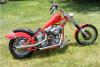
The only time I notice excessing heat with my carbed EVO is when I have to wait at a stop light. As you can see, there's not much between the rear head and my body to block the heat. Here in Texas the heat can be as bad as the current midwest temps. I do once in a while experience a vapor lock if I park it hot. 30-40 kicks later it will finally fire up. Kick only can be a challenge sometimes!


Road Master
Joined: Apr 2011
Posts: 1,145
Likes: 98
From: Colorado Springs
Nope. It's all in the tune. Mixture and timing. Any bike can be made cooler or hotter. EFI or carb, doesn't matter.
Some say it's easier to tune a carbed bike, but it's certainly more precise to tune an EFI bike.
Some say it's easier to tune a carbed bike, but it's certainly more precise to tune an EFI bike.
Trending Topics
Outstanding HDF Member
Joined: Jan 2008
Posts: 3,328
Likes: 15
From: Pacific Northwest
None of my carbed bikes ever ran as hot as my EFI bikes. That is not to say that a properly tuned EFI will always run hotter than a properly tuned carb. They'll run at about the same temps. It justs costs more to get the EFI right.
The biggest advantage for a carburetor is being able to tune it yourself. You don't need a degree in electronics and ECM mapping to tune your bike. Just a few jets and some simple hand tools. I have buds that as good to better mileage and have every bit as much power as my hot rodded 95" EFI - and they did their tuning all by themselves (no spendy dyno time, either).
Man I miss my carburetor - getting them 'right' was a lot of fun.
The biggest advantage for a carburetor is being able to tune it yourself. You don't need a degree in electronics and ECM mapping to tune your bike. Just a few jets and some simple hand tools. I have buds that as good to better mileage and have every bit as much power as my hot rodded 95" EFI - and they did their tuning all by themselves (no spendy dyno time, either).
Man I miss my carburetor - getting them 'right' was a lot of fun.
HD Forum Stories
The Best of Harley-Davidson for Lifelong Riders

7 Surprising Harley-Davidson Products that Are Not Motorcycles
Verdad Gallardo
8 Best Harley-Davidson Motorcycles Ever
Pouria Savadkouei
10 Worst Harley-Davidson Motorcycles Ever
Pouria Savadkouei
Killer Custom's Jail Break Is The Breakout That Refused to Blend In
Verdad Gallardo
Crazy Bunderbike Build Looks Amazing, But Is It Impossible to Ride?
Verdad Gallardo
Harley-Davidson Reveals Super Cool Cafe Racer Concept
Verdad Gallardo
Engraved Rebellion: Inside Bundnerbike's Glam Rock II
Verdad Gallardo
10 Motorcycles You Should Never Buy
Joe Kucinski
10 Things Harley-Davidson Needs to Fix in 2026
Verdad Gallardo
Road Warrior
Joined: Jun 2012
Posts: 1,672
Likes: 17
From: Orange, VA,
It has to do with fuel mixture and timing, I have a carbed 99 EG Standard that I love and will ride till I die, easy to work on and runs way cooler them my buddies newer efi bike, he gets better fuel mileage then me but to me the more electronics you put in them the more problems later, I like simplicity and will stick with my carbed 88 TC.

Club Member
Joined: Jun 2007
Posts: 45,429
Likes: 2,898
From: Bedford UK

The reason the industry went to EFI was as much to do with emissions as anything else. So carb bikes were able to meet those regulations until around the year 2000, when they were made tighter. So EFI bikes run hotter, comparing stock bikes, simply because they have to use leaner air/fuel ratios, which in turn makes them hotter.
In addition, when we owners modify our EFI bikes there is a general misunderstanding that it can be done without retuning the bike. Even different mufflers are likely to make an EFI bike run hotter.
We need to get much smarter chaps! If we retune an EFI bike to run on similar air/fuel ratios to a carb bike there is no reason why the two should be any different. Unfortunately it does involve some expense to do that properly on an EFI bike!
In addition, when we owners modify our EFI bikes there is a general misunderstanding that it can be done without retuning the bike. Even different mufflers are likely to make an EFI bike run hotter.
We need to get much smarter chaps! If we retune an EFI bike to run on similar air/fuel ratios to a carb bike there is no reason why the two should be any different. Unfortunately it does involve some expense to do that properly on an EFI bike!