



Engineers

Club Member


Joined: Jun 2007
Posts: 45,429
Likes: 2,898
From: Bedford UK

My inclination is to fashion a rubber extension to your front fender guard, and combine that with the 50% screen you mentioned. I am an engineer, if that helps, although don't read too much into that. Hope that helps a bit.

Thread Starter
|
Supporter
Joined: Mar 2008
Posts: 4,419
Likes: 90
From: Vermont

I must lead a sheltered life, I didn't realise they are putting them right down there! I can see it makes life easy in some ways, but I can also understand your concern for it. The fact that Harley makes a fancy bar and shield cover tends to support the case for your proposed protective screen.
My inclination is to fashion a rubber extension to your front fender guard, and combine that with the 50% screen you mentioned. I am an engineer, if that helps, although don't read too much into that. Hope that helps a bit.
My inclination is to fashion a rubber extension to your front fender guard, and combine that with the 50% screen you mentioned. I am an engineer, if that helps, although don't read too much into that. Hope that helps a bit.

Intermediate
Joined: May 2012
Posts: 39
Likes: 0
From: kansas
maybe slow down?
Just how fast are you driving or planning on driving these gravel roads?
I too live in gravel and 20mph is fast on my bikes. Slow tire speed = slow rock speed. 2 miles to blacktop one way 4 miles another way for me.
I too live in gravel and 20mph is fast on my bikes. Slow tire speed = slow rock speed. 2 miles to blacktop one way 4 miles another way for me.
Thread Starter
|
Supporter
Joined: Mar 2008
Posts: 4,419
Likes: 90
From: Vermont
This is why
So when I started this thread I asked if there were any engineers out there familiar with air flow etc and somebody asked why I needed an engineer. Here's why: I just received 3 different screens from McMaster Carr to choose from. The first is the 8x8 stainless woven wire cloth, .028 wire diameter, 12 x 12 inch square piece of screen. It is the stiffest and heaviest and has the largest little square holes. I thought this would flow the most air but from my experiments with a simple high volume computer fan, the air flow seems to be much less then with the other two screens. The next is less heavy, has smaller square holes and seems to flow more air. It is a 12x12, 0.23 wire diameter, 12x 12 inch sheet. And finally, the lightest screen of them all with the smallest little holes seems to flow the most unimpeded air. It is an epoxy coated 12x12 mesh, .009 wire diameter, and it is also 12x12 inches square. The air flow differences are not scientific lol. Its based strictly on the feel on my hand and also on how much it moved a piece of paper held behind the screen as opposed to in front of the screen. Very non scientific but it is all I could think of. So all of this has to have more of a scientific engineering type answer? Do the smaller holes act similar to a smaller pipe increasing the force of the air flow? or is the larger diameter of the wire used in the first screen impeding flow? I have no idea. So anybody care to offer an explanation based more on fact than what my pea brain has come up with? Thanks.

Stellar HDF Member

Joined: Aug 2012
Posts: 2,664
Likes: 184
From: Indiana, USA
Bernoullis Principle
Bernoulli's principle, physical principle formulated by Daniel Bernoulli that states that as the speed of a moving fluid (liquid or gas) increases, the pressure within the fluid decreases. The phenomenon described by Bernoulli's principle has many practical applications; it is employed in the carburetor and the atomizer, in which air is the moving fluid, and in the aspirator, in which water is the moving fluid. In the first two devices air moving through a tube passes through a constriction, which causes an increase in speed and a corresponding reduction in pressure. As a result, liquid is forced up into the air stream (through a narrow tube that leads from the body of the liquid to the constriction) by the greater atmospheric pressure on the surface of the liquid. In the aspirator air is drawn into a stream of water as the water flows through a constriction. Bernoulli's principle can be explained in terms of the law of conservation of energy (see conservation laws conservation laws, in physics, basic laws that together determine which processes can or cannot occur in nature; each law maintains that the total value of the quantity governed by that law, e.g., mass or energy, remains unchanged during physical processes.
..... Click the link for more information. , in physics). As a fluid moves from a wider pipe into a narrower pipe or a constriction, a corresponding volume must move a greater distance forward in the narrower pipe and thus have a greater speed. At the same time, the work done by corresponding volumes in the wider and narrower pipes will be expressed by the product of the pressure and the volume. Since the speed is greater in the narrower pipe, the kinetic energy of that volume is greater. Then, by the law of conservation of energy, this increase in kinetic energy must be balanced by a decrease in the pressure-volume product, or, since the volumes are equal, by a decrease in pressure.
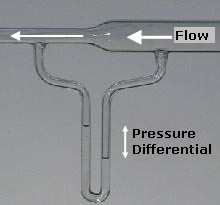
Bernoulli's principle, physical principle formulated by Daniel Bernoulli that states that as the speed of a moving fluid (liquid or gas) increases, the pressure within the fluid decreases. The phenomenon described by Bernoulli's principle has many practical applications; it is employed in the carburetor and the atomizer, in which air is the moving fluid, and in the aspirator, in which water is the moving fluid. In the first two devices air moving through a tube passes through a constriction, which causes an increase in speed and a corresponding reduction in pressure. As a result, liquid is forced up into the air stream (through a narrow tube that leads from the body of the liquid to the constriction) by the greater atmospheric pressure on the surface of the liquid. In the aspirator air is drawn into a stream of water as the water flows through a constriction. Bernoulli's principle can be explained in terms of the law of conservation of energy (see conservation laws conservation laws, in physics, basic laws that together determine which processes can or cannot occur in nature; each law maintains that the total value of the quantity governed by that law, e.g., mass or energy, remains unchanged during physical processes.
..... Click the link for more information. , in physics). As a fluid moves from a wider pipe into a narrower pipe or a constriction, a corresponding volume must move a greater distance forward in the narrower pipe and thus have a greater speed. At the same time, the work done by corresponding volumes in the wider and narrower pipes will be expressed by the product of the pressure and the volume. Since the speed is greater in the narrower pipe, the kinetic energy of that volume is greater. Then, by the law of conservation of energy, this increase in kinetic energy must be balanced by a decrease in the pressure-volume product, or, since the volumes are equal, by a decrease in pressure.
Thread Starter
|
Supporter
Joined: Mar 2008
Posts: 4,419
Likes: 90
From: Vermont
Bernoullis Principle
Bernoulli's principle, physical principle formulated by Daniel Bernoulli that states that as the speed of a moving fluid (liquid or gas) increases, the pressure within the fluid decreases. The phenomenon described by Bernoulli's principle has many practical applications; it is employed in the carburetor and the atomizer, in which air is the moving fluid, and in the aspirator, in which water is the moving fluid. In the first two devices air moving through a tube passes through a constriction, which causes an increase in speed and a corresponding reduction in pressure. As a result, liquid is forced up into the air stream (through a narrow tube that leads from the body of the liquid to the constriction) by the greater atmospheric pressure on the surface of the liquid. In the aspirator air is drawn into a stream of water as the water flows through a constriction. Bernoulli's principle can be explained in terms of the law of conservation of energy (see conservation laws conservation laws, in physics, basic laws that together determine which processes can or cannot occur in nature; each law maintains that the total value of the quantity governed by that law, e.g., mass or energy, remains unchanged during physical processes.
..... Click the link for more information. , in physics). As a fluid moves from a wider pipe into a narrower pipe or a constriction, a corresponding volume must move a greater distance forward in the narrower pipe and thus have a greater speed. At the same time, the work done by corresponding volumes in the wider and narrower pipes will be expressed by the product of the pressure and the volume. Since the speed is greater in the narrower pipe, the kinetic energy of that volume is greater. Then, by the law of conservation of energy, this increase in kinetic energy must be balanced by a decrease in the pressure-volume product, or, since the volumes are equal, by a decrease in pressure.
Bernoulli's principle, physical principle formulated by Daniel Bernoulli that states that as the speed of a moving fluid (liquid or gas) increases, the pressure within the fluid decreases. The phenomenon described by Bernoulli's principle has many practical applications; it is employed in the carburetor and the atomizer, in which air is the moving fluid, and in the aspirator, in which water is the moving fluid. In the first two devices air moving through a tube passes through a constriction, which causes an increase in speed and a corresponding reduction in pressure. As a result, liquid is forced up into the air stream (through a narrow tube that leads from the body of the liquid to the constriction) by the greater atmospheric pressure on the surface of the liquid. In the aspirator air is drawn into a stream of water as the water flows through a constriction. Bernoulli's principle can be explained in terms of the law of conservation of energy (see conservation laws conservation laws, in physics, basic laws that together determine which processes can or cannot occur in nature; each law maintains that the total value of the quantity governed by that law, e.g., mass or energy, remains unchanged during physical processes.
..... Click the link for more information. , in physics). As a fluid moves from a wider pipe into a narrower pipe or a constriction, a corresponding volume must move a greater distance forward in the narrower pipe and thus have a greater speed. At the same time, the work done by corresponding volumes in the wider and narrower pipes will be expressed by the product of the pressure and the volume. Since the speed is greater in the narrower pipe, the kinetic energy of that volume is greater. Then, by the law of conservation of energy, this increase in kinetic energy must be balanced by a decrease in the pressure-volume product, or, since the volumes are equal, by a decrease in pressure.

Road Master
Joined: Oct 2009
Posts: 785
Likes: 2
From: SE TN
The Bernoulli principle is spot on.
Hole size doesn't necessarily matter as much as the free cross sectional area of the screen. More material = greater pressure drop across from inlet to outlet. My hunch is the smaller screen has the most free cross sectional area, hence more "felt" air flow.
Hole size doesn't necessarily matter as much as the free cross sectional area of the screen. More material = greater pressure drop across from inlet to outlet. My hunch is the smaller screen has the most free cross sectional area, hence more "felt" air flow.
HD Forum Stories
The Best of Harley-Davidson for Lifelong Riders

Harley-Davidson Fat Boy Becomes a Dark, Decepticon-Inspired Custom
Verdad Gallardo
6 Weirdest Harley-Davidsons Ever Sold to the Public
Verdad Gallardo
7 Times Harley-Davidson Chucked Tradition Out the Window
Verdad Gallardo
7 Surprising Harley-Davidson Products that Are Not Motorcycles
Verdad Gallardo
8 Best Harley-Davidson Motorcycles Ever
Pouria Savadkouei
10 Worst Harley-Davidson Motorcycles Ever
Pouria Savadkouei
Killer Custom's Jail Break Is The Breakout That Refused to Blend In
Verdad Gallardo
Crazy Bunderbike Build Looks Amazing, But Is It Impossible to Ride?
Verdad Gallardo
Harley-Davidson Reveals Super Cool Cafe Racer Concept
Verdad Gallardo
Road Master
Joined: Jun 2010
Posts: 1,221
Likes: 4
From: Annemasse (border of Geneva-Switzerland) facing Mt-Blanc.
