










I was surprised Friday, would appreciate some input.
 I was surprised Friday, would appreciate some input.
This last Friday we decided to do some tests on different hose clamps.
Devin and I were both VERY Surprised at what we learned.
We have always tightened hose clamps down by visually noting how tight the clamp was getting on the hose.
This has worked for us on thousands of hose clamps, and I am sure that most of the billions of hose clamps currently in use around the world are tightened this way also.
What was amazing is how little torque it takes to get a hose clamp tightened down properly.
We purchased an inch pound torque wrench that was accurate down to 15 inch lbs, which is just a tad over 1 ft. lb.
Here is the surprising info we learned:
The photo below shows a hose clamp tightened down to the proper tightness.

It only takes 6-8 inch lbs to get it that tight.
18 inch lbs ( 1.5 ft. lbs ) is far too tight.
24 in lbs. ( 2 ft. lbs.) is so tight it is cutting into the hose.
Most hose clamps Failed (broke, and sometimes lost tightness, and sometimes did not) at 22-30 in lbs.
We were so surprised at how little it took we tested the calibration of our torque wrench.
These tests were done on 3/8" hose, using a quality, USA made worm drive hose clamp.
We also test a variety of other clamps, including pinch clamps.
How do you tighten a hose clamp?
Torque wrench, by feel, visually?
Any other info you can contribute would be useful.
We are going to publish a video of our test results, and include instructions on how to properly tighten a hose clamp. We would like to include any useful info you have that we may not already have in our footage.
Thanks
Devin and I were both VERY Surprised at what we learned.
We have always tightened hose clamps down by visually noting how tight the clamp was getting on the hose.
This has worked for us on thousands of hose clamps, and I am sure that most of the billions of hose clamps currently in use around the world are tightened this way also.
What was amazing is how little torque it takes to get a hose clamp tightened down properly.
We purchased an inch pound torque wrench that was accurate down to 15 inch lbs, which is just a tad over 1 ft. lb.
Here is the surprising info we learned:
The photo below shows a hose clamp tightened down to the proper tightness.
It only takes 6-8 inch lbs to get it that tight.
18 inch lbs ( 1.5 ft. lbs ) is far too tight.
24 in lbs. ( 2 ft. lbs.) is so tight it is cutting into the hose.
Most hose clamps Failed (broke, and sometimes lost tightness, and sometimes did not) at 22-30 in lbs.
We were so surprised at how little it took we tested the calibration of our torque wrench.
These tests were done on 3/8" hose, using a quality, USA made worm drive hose clamp.
We also test a variety of other clamps, including pinch clamps.
How do you tighten a hose clamp?
Torque wrench, by feel, visually?
Any other info you can contribute would be useful.
We are going to publish a video of our test results, and include instructions on how to properly tighten a hose clamp. We would like to include any useful info you have that we may not already have in our footage.
Thanks
__________________
DKCustomProducts.com
DKCustomProducts.com
Not sure when Dwayne will have the video edited and up on youtube, but these photos show some of the really surprising information discovered in our testing.
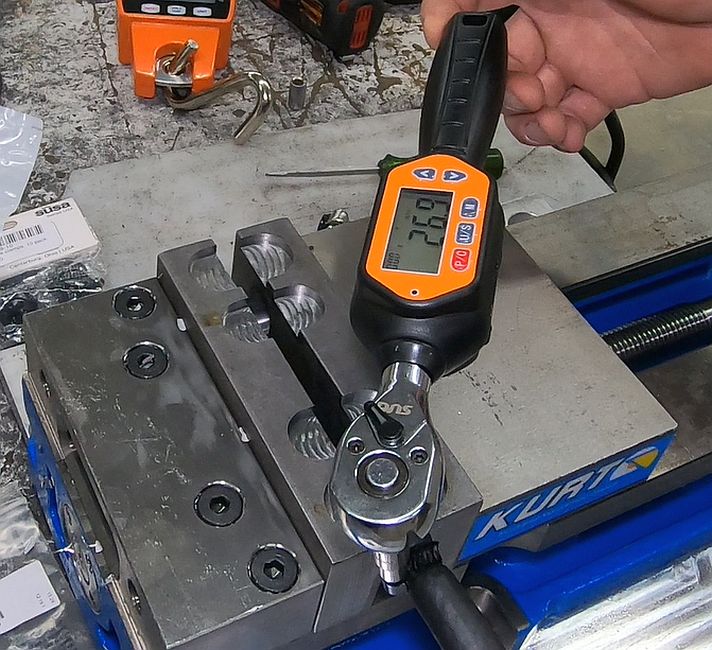
This first photo shows the clamp tightened to a measly 26.9 inch lbs...barely over 2 ft. lbs.
And this is a close up of how incredibly over-tightened that hose clamp is on the hose at a mere 2 ft. lbs.

Now, when you do a google search, there will be results all over the place, including many saying to tighten to 20 - 40 in lbs.
There are clearly difference between different clamps, as will be shown in the video, but with the USA made worm drive clamps we use, the amount of force needed to tighten them properly is very small...AND it does not take much at all to overtighten.
Fortunately it is easy to see what is the proper tightness, and not go any further.
This first photo shows the clamp tightened to a measly 26.9 inch lbs...barely over 2 ft. lbs.
And this is a close up of how incredibly over-tightened that hose clamp is on the hose at a mere 2 ft. lbs.
Now, when you do a google search, there will be results all over the place, including many saying to tighten to 20 - 40 in lbs.
There are clearly difference between different clamps, as will be shown in the video, but with the USA made worm drive clamps we use, the amount of force needed to tighten them properly is very small...AND it does not take much at all to overtighten.
Fortunately it is easy to see what is the proper tightness, and not go any further.
Forgot to post a photo of a properly tightened hose clamp.
I've tightened them by sight thousands of times over the last 1/2 century and never had one fail.

The problem with people wanting to use machines is that different hose clamps have different levels of mechanical friction, so there is no reliable way to tighten a hose clamp without knowing what it should look like.
Kevin

Seasoned HDF Member


Joined: Aug 2017
Posts: 7,323
Likes: 11,757
From: Omaha,NE
I personally have never used a torque wrench on a hose clamp, though I do on most other fasteners. I have found that with worm clamps, when you see it bite into the rubber, that's also the point where it becomes very difficult to rotate the hose on the nipple, if at all. That's all you need for a good seal.

Seasoned HDF Member


Joined: Apr 2012
Posts: 9,978
Likes: 5,218
From: Michigan
Many of us want to give that screw or bolt just another turn or so to make it really tight.
I was taught to always use a screw (or nut) driver (with wrist action only) to snug a clamp screw, which requires minimal torque.
Usually a small hand wrench, using wrist action only will provide adequate torque for most bolts (if a torque wrench is not available).
When a larger tool (ratchet or power bar) is used the chances of over-torque are greatly increased and can lead to stripping threads or breaking a bolt.
I was taught to always use a screw (or nut) driver (with wrist action only) to snug a clamp screw, which requires minimal torque.
Usually a small hand wrench, using wrist action only will provide adequate torque for most bolts (if a torque wrench is not available).
When a larger tool (ratchet or power bar) is used the chances of over-torque are greatly increased and can lead to stripping threads or breaking a bolt.
Supporter


Joined: Jun 2009
Posts: 63
Likes: 34
From: White Oak,PA
As a plumber I have found tightening a clamp is dependent upon the material being clamped. Tighten rubber till it can’t be turned on the fitting, then take into account the type of fitting: barbed , rounded( as in a radiator or heater fitting), or just a pipe without anything to keep the hose from sliding off. Now how much pressure is on it. We use ferncoso to connect non low pressure drainage pipe but never on high pressure. It’s more an educated guess on how we connect and TIGHTEN connections.
Trending Topics
The clamp of one type and size will maybe be fine at a given torque. But when that same clamp is used on different types of hose the torque may be quite different.
Also different types of clamps take different torque to properly squeeze the host to the fitting or pipe. If you are using barbed fittings the torque is different because you can cut the lining of many hoses. This will cause a failure of the hose or at a leak that can't be stopped.
The same hose could also be clamped with a wider clamp, or a narrow width clamp. Both a worm screw clamp but completely different tightening specs.
If you want to actually torque the hose clamps, use a tool you can get into the clamp with. NOT that type of a inch pound torque wrench.
They also make torque screw drivers that ratchet both ways and are adjustable for inch pound setting. I have one with a 1/4" drive so I can use a socket or a changeable bit for whatever small screw I want to tighten. That is more likely to be used as it is as handy as a screwdriver. Put a small socket on and you have a nut driver.
All being said, I mostly use the tighten until the hose is tight and stop there without all the fuss of a torque setting. If you can't stop the leak like that you need to repair the hose anyway.
Just my 2 cents !
Also different types of clamps take different torque to properly squeeze the host to the fitting or pipe. If you are using barbed fittings the torque is different because you can cut the lining of many hoses. This will cause a failure of the hose or at a leak that can't be stopped.
The same hose could also be clamped with a wider clamp, or a narrow width clamp. Both a worm screw clamp but completely different tightening specs.
If you want to actually torque the hose clamps, use a tool you can get into the clamp with. NOT that type of a inch pound torque wrench.
They also make torque screw drivers that ratchet both ways and are adjustable for inch pound setting. I have one with a 1/4" drive so I can use a socket or a changeable bit for whatever small screw I want to tighten. That is more likely to be used as it is as handy as a screwdriver. Put a small socket on and you have a nut driver.
All being said, I mostly use the tighten until the hose is tight and stop there without all the fuss of a torque setting. If you can't stop the leak like that you need to repair the hose anyway.
Just my 2 cents !
HD Forum Stories
The Best of Harley-Davidson for Lifelong Riders

8 Best Harley-Davidson Motorcycles Ever
Pouria Savadkouei
10 Worst Harley-Davidson Motorcycles Ever
Pouria Savadkouei
Killer Custom's Jail Break Is The Breakout That Refused to Blend In
Verdad Gallardo
Crazy Bunderbike Build Looks Amazing, But Is It Impossible to Ride?
Verdad Gallardo
Harley-Davidson Reveals Super Cool Cafe Racer Concept
Verdad Gallardo
Engraved Rebellion: Inside Bundnerbike's Glam Rock II
Verdad Gallardo
10 Motorcycles You Should Never Buy
Joe Kucinski
10 Things Harley-Davidson Needs to Fix in 2026
Verdad Gallardo