




...and so it begins
Dirt don't hurt


Joined: Jan 2011
Posts: 21,065
Likes: 4,561
From: Haslet Texas

--texashillcountry... I do not disagree with what you are saying, but in the course of my little detail job, I only disconnected three wires under the dash, a green wire, black wire and a round wire with a strange connector on it, and they all went back to the same place.
Something might not be making a good connection...
A while back a guy brought his '06 Heritage to me because it wasn't starting.
It turned out to be a loose connector going to the fuel pump.
Cruiser
Joined: Jul 2015
Posts: 209
Likes: 8
From: Northern Wisconsin
It would be unusual for both the pickup coil and module to both go bad at the same time. How did you check your module and pickup coil? You have to use either a Fluke 23 or the Kent-Moore meter (HD part# 35500) to test those components because the polarity on other meters is ambiguous on resistance mode, and therefore cheapy multi-meters will always show that the power supply diode or switching transistor has failed in the module, or that the pickup is shorted or open.
To check the ignition power circuit just disconnect the blue wire from the coil and hook up a .3 uF capacitor (steal one from a points ignition on a lawnmower engine or something) from the coil terminal to DC ground. Hook a jumper wire to the coil terminal and momentarily touch it to DC ground. Every time you make and break the connection with the jumper the coil should spark. If it does, the primary power circuit to the coil, and the coil itself, is fine. If it doesn't you got a problem with either the module or the pickup.
For testing the power supply diode or switching transistor in the module you'll need a Fluke 23 meter (or the HD specialty tool) that has the correct polarity and doesn't indiscriminately check resistance both ways.
It is not unusual to have the module fail when shutting the engine down. It can be running fine when you rode it into the shop and doesn't have to fail when it's running. When you shut it down you kill the power to the module and the voltage spike from filter capacitors in the module discharging can blow the switching transistor if the ground to the module has corroded or gained high resistance with age. The 5V from the module to the pickup is the switching side of the transistor. That transistor is a NPN type so the collector is the coil primary side power, the emitter provides the signal to the coil, and the base is the switching signal from the pickup. As with checking any transistor you can damage it by testing it with the wrong meter that puts a 9V signal to the base of the transistor on a resistance test.

Road Master


Joined: May 2014
Posts: 827
Likes: 59
From: Canada
That's a relief to hear, I thought it was just me.

Thread Starter
|
Intermediate
Joined: Apr 2016
Posts: 32
Likes: 0
From: az
--texashillcountry... tomorrow I am going to take the dash off again, check the round wire, if that's not it, I am going to pull the tank again and verify that nothing got hung up or disturbed when I put it back on.
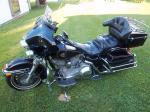
What, exactly, is that thing? I myself would not ride something like that.
--Harley-Davidson... LOL, don't be cruel, that is my 1981 Yamaha XJ750 Seca project I just finished... its my 'picking up the mail' bike The meter I am using is a Beckman (qualified for the job). I have a H-D FSM, so I went thru the troubleshooting procedure in it, but tomorrow I am going to try your recommendations, and this time actually document my findings
What, exactly, is that thing? I myself would not ride something like that.
--Harley-Davidson... LOL, don't be cruel, that is my 1981 Yamaha XJ750 Seca project I just finished... its my 'picking up the mail' bike
The meter I am using is a Beckman (qualified for the job). I have a H-D FSM, so I went thru the troubleshooting procedure in it, but tomorrow I am going to try your recommendations, and this time actually document my findings
Cruiser
Joined: Jul 2015
Posts: 209
Likes: 8
From: Northern Wisconsin
Very good. The FSM has the procedure to check the two main circuits (power supply and switching) in the module using a meter that will read resistance only one way (like a diode checker). The procedure does not work with most cheapie meters that are indiscriminate of polarity when checking a FET or transistor so that's why I mentioned that. If you got 12V to the coil that means the module power is also active so I don't see how you could've inadvertently disconnected anything that would prevent it from firing. If you got battery power to those two points the ignition system is active and armed. Based on what I've seen on these things before I'd suspect a bad (or high resistance) module ground blew the driver transistor in the module when you shut it off.
Thread Starter
|
Intermediate
Joined: Apr 2016
Posts: 32
Likes: 0
From: az
I started to go through the measurements again this morning, but first decided to check the coil.The spec is listed as 2.5-3.5 Ohm, primary and 11.2-13.75K Ohm, secondary. I measured 4.1 Ohm and 18.2K Ohm, respectively, so it would appear to be considerably out of spec (it is an Andrews coil, not sure if that makes a difference)
Cruiser
Joined: Jul 2015
Posts: 209
Likes: 8
From: Northern Wisconsin
I doubt it. Those readings are well within reason for a high secondary voltage aftermarket coil. Higher readings on both sides of the coil indicate it is wound with more turns than a stock one. Manually fire the coil with a cap and jumper if you want to test it, but I'll bet it works fine.
Thread Starter
|
Intermediate
Joined: Apr 2016
Posts: 32
Likes: 0
From: az
I tried to fire it this morning. After digging through the old parts pile (halfway to China) to find a condenser, I put together the little rig pictured in my FSM, and unless I was missing something, could not get it to fire...
) to find a condenser, I put together the little rig pictured in my FSM, and unless I was missing something, could not get it to fire...
HD Forum Stories
The Best of Harley-Davidson for Lifelong Riders

7 Surprising Harley-Davidson Products that Are Not Motorcycles
Verdad Gallardo
8 Best Harley-Davidson Motorcycles Ever
Pouria Savadkouei
10 Worst Harley-Davidson Motorcycles Ever
Pouria Savadkouei
Killer Custom's Jail Break Is The Breakout That Refused to Blend In
Verdad Gallardo
Crazy Bunderbike Build Looks Amazing, But Is It Impossible to Ride?
Verdad Gallardo
Harley-Davidson Reveals Super Cool Cafe Racer Concept
Verdad Gallardo
Engraved Rebellion: Inside Bundnerbike's Glam Rock II
Verdad Gallardo
10 Motorcycles You Should Never Buy
Joe Kucinski
10 Things Harley-Davidson Needs to Fix in 2026
Verdad Gallardo
Stellar HDF Member
Joined: Jul 2014
Posts: 2,721
Likes: 243
From: NC
Go back and loosen and reconnect all three wires you touched at first, sounds like that should be where the problem is. Double check that the wires aren't corroded around the connections etc. and look for something amiss in the general area where you were messing. I've done that before. Also have you cleaned/ checked out the ignition switch and connections there?
Cruiser
Joined: Jul 2015
Posts: 209
Likes: 8
From: Northern Wisconsin
If you have 12V to the coil positive terminal and make and break the negative side with a cap in there to buffer it, you should get a nice hot spark. To verify you don't have a high resistance connection on the coil power side hook your meter to the supply (positive) side of the coil when you make and break the jumper. A slight voltage drop is normal due to current draw from the coil primary. But if it drops significantly (like below 7-8 volts) then you have a coil supply circuit problem. If the voltage stays up and it doesn't spark, then the coil is highly suspect.
You will still get a spark without a cap in parallel but the spark will be very weak and short in duration.