



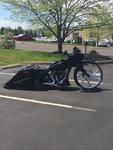






Pulled over wtf.

Tourer
Joined: Mar 2010
Posts: 430
Likes: 2
From: Dirty City

"First off I know exactly where they sit": That's great. It is totally irrelevent, anyway. What is the significance of this regarding you going 43 in a 30? Where he sits has no bearing on him clocking your speed. Your speed is the same regardless of the LEO's position.
"This is why they use lasers so when you cross the beams you get exact times speeds ect": This isn't an Olympic sporting event, dude. Human reaction times are NOT as long as you seem to think. They average 250 - 300 MILLISECONDS = 25-30 hundreds of a second.
Try this: http://www.humanbenchmark.com/tests/reactiontime/
"It's the principle": What, do you think you are going to do, set a precedent or something?
Go ahead and try to fight it. I did it once and you will learn what I did, it isn't worth it. Just bring your wallet with you. Good luck.
"This is why they use lasers so when you cross the beams you get exact times speeds ect": This isn't an Olympic sporting event, dude. Human reaction times are NOT as long as you seem to think. They average 250 - 300 MILLISECONDS = 25-30 hundreds of a second.
Try this: http://www.humanbenchmark.com/tests/reactiontime/
"It's the principle": What, do you think you are going to do, set a precedent or something?
Go ahead and try to fight it. I did it once and you will learn what I did, it isn't worth it. Just bring your wallet with you. Good luck.
Pertaining to reaction times, there are two factors that many seem to not be taking into account:
1. The reaction time for starting the timer is going to be about the same as stopping the timer. So it's not the total reaction time that affects the measured time, it's the delta between the two reaction times.
Using the link above I had a range of reaction times from 150 to 280 ms, or 0.15 to 0.28 seconds, but I average 230 ms. Well it's not the entire 230 ms that matters for figuring out how much error there is, just the delta between the delay in starting the timer, and the delay in stopping it. If the cop reacts to the start with a 150 ms delay, and the stop with a 280 ms delay, then the error is only 130 ms.
2. Unlike in the link above, the officer doesn't have to be as reactive because he can anticipate. He knows that the car is approaching the line and can better react to it when it gets to that point, which reduces the effective reaction time as well as the delta.
So, in reality, the timing error is going to be around 0.05 seconds.

Road Warrior
Joined: Sep 2011
Posts: 1,817
Likes: 116
From: Raleigh, NC
Working traffic enforcement, this is not something I would ever think of doing, but I am in California. I understand how you could do it with math, so I would say yes. You can attack where he saw you, argue that perception and reaction is a little over a second, so it took him longer to stop the watch once you were there, and then attack his math. I would subpoena his notes on his ticket. Your defense would have to argue that the way he got your speed was wrong or that his math is wrong. 13 over limit is a short window for a 100 foot distance, don't quite get that. This is something CHP aircraft do in California, but they use a considerable distance not 100 feet
He sees you coming, hits the button at the end of one line, then hits it again when you reach the beginning of the next. Each reaction wouldn't take a 1/4 of a second. Hell, a good grocery store clerk can scan several items a second, and that's a lot more movement than clicking a stop watch.
You're approaching this as if it took no time for him to start measuring but then some time to stop.
Remember that the time it takes for him to perceive reaching the end of one line and click-starting the watch is going to be about the same for him to perceive reaching the beginning of the next line and click stopping the watch. The reaction time is at both ends, not just one. This cancels out the reaction time for measurement.
It takes just over 2.25 seconds to cover 100 feet at 30 mph, where it takes just under 1.6 seconds to cover 100 ft at 43 mph.
Assuming that the reaction times are not equal, but off by 1/4 second, which would be a lot, adding that to the 1.6 seconds would be 1.85 seconds, which still means you're speeding!
Chickenshit for sure, but you'll lose if the prosecution has a brain and does the math.
Last edited by mmancuso; Feb 20, 2013 at 12:54 PM.
Road Warrior
Joined: Sep 2011
Posts: 1,817
Likes: 116
From: Raleigh, NC
Thanks for the link.
Pertaining to reaction times, there are two factors that many seem to not be taking into account:
1. The reaction time for starting the timer is going to be about the same as stopping the timer. So it's not the total reaction time that affects the measured time, it's the delta between the two reaction times.
Using the link above I had a range of reaction times from 150 to 280 ms, or 0.15 to 0.28 seconds, but I average 230 ms. Well it's not the entire 230 ms that matters for figuring out how much error there is, just the delta between the delay in starting the timer, and the delay in stopping it. If the cop reacts to the start with a 150 ms delay, and the stop with a 280 ms delay, then the error is only 130 ms.
2. Unlike in the link above, the officer doesn't have to be as reactive because he can anticipate. He knows that the car is approaching the line and can better react to it when it gets to that point, which reduces the effective reaction time as well as the delta.
So, in reality, the timing error is going to be around 0.05 seconds.
Pertaining to reaction times, there are two factors that many seem to not be taking into account:
1. The reaction time for starting the timer is going to be about the same as stopping the timer. So it's not the total reaction time that affects the measured time, it's the delta between the two reaction times.
Using the link above I had a range of reaction times from 150 to 280 ms, or 0.15 to 0.28 seconds, but I average 230 ms. Well it's not the entire 230 ms that matters for figuring out how much error there is, just the delta between the delay in starting the timer, and the delay in stopping it. If the cop reacts to the start with a 150 ms delay, and the stop with a 280 ms delay, then the error is only 130 ms.
2. Unlike in the link above, the officer doesn't have to be as reactive because he can anticipate. He knows that the car is approaching the line and can better react to it when it gets to that point, which reduces the effective reaction time as well as the delta.
So, in reality, the timing error is going to be around 0.05 seconds.


Road Captain
Joined: Aug 2012
Posts: 736
Likes: 1
From: Iowa
HD Forum Stories
The Best of Harley-Davidson for Lifelong Riders

7 Surprising Harley-Davidson Products that Are Not Motorcycles
Verdad Gallardo
8 Best Harley-Davidson Motorcycles Ever
Pouria Savadkouei
10 Worst Harley-Davidson Motorcycles Ever
Pouria Savadkouei
Killer Custom's Jail Break Is The Breakout That Refused to Blend In
Verdad Gallardo
Crazy Bunderbike Build Looks Amazing, But Is It Impossible to Ride?
Verdad Gallardo
Harley-Davidson Reveals Super Cool Cafe Racer Concept
Verdad Gallardo
Engraved Rebellion: Inside Bundnerbike's Glam Rock II
Verdad Gallardo
10 Motorcycles You Should Never Buy
Joe Kucinski