


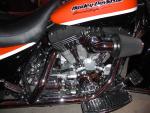


2000 Road King - replace fuel pressure regulator “while I’m in there”?

Thread Starter
|
Cruiser
Joined: Sep 2014
Posts: 246
Likes: 217
From: Phoenix, Az
 2000 Road King - replace fuel pressure regulator “while I’m in there”?
2000 Road King with 54k miles, EFI, all original fuel pump, filter, check valves and lines, etc. On this model the fuel pressure regulator is on the induction module, not in the tank like more current model years. I am troubleshooting what seems to be a fuel starvation issue, coughing and stalling at high speeds and loads, and I’m guessing so far the problem is most likely one of the aforementioned components within the tank, and I wanted to preemptively replace most of those items anyway because virtually all of them seem to fail with age and use. I’ve been lucky so far.
My question is that from what I’ve read the fuel pressure regulator’s on this model year don’t seem to have a substantial failure rate like the more current years which have the regulator in the tank, unlike the rest of the components, but is it best to go ahead and replace the regulator anyway while I’m doing so many of the other fueling components already? Again, everything I’ve mentioned is in the tank as an assembly except for the regulator which is in the induction module. Easy to get to though.
The pros for going ahead and doing the replacement is obviously it’s a preventative maintenance item and it appears to be a fairly easy swap, and the original is 21 years old. I am a big believer in preventative maintenance because I don’t like being stranded. The cons is that I am reluctant to disturb things on this bike that don’t need disturbing, because of the age and I don’t want to introduce other problems with things either not fitting together right or introducing leaks of some sort because so many fittings and rubber parts etc. tend to get brittle and not as pliable over time, and often times I end up dealing with problems that made me wish I had just left everything alone.
So what’s the wisdom here, go ahead and swap the regulator out now or wait until it fails (if it ever does).
Btw none of the aforementioned parts are still being produced by Harley OEM, all are aftermarket but reliable mfrs.
My question is that from what I’ve read the fuel pressure regulator’s on this model year don’t seem to have a substantial failure rate like the more current years which have the regulator in the tank, unlike the rest of the components, but is it best to go ahead and replace the regulator anyway while I’m doing so many of the other fueling components already? Again, everything I’ve mentioned is in the tank as an assembly except for the regulator which is in the induction module. Easy to get to though.
The pros for going ahead and doing the replacement is obviously it’s a preventative maintenance item and it appears to be a fairly easy swap, and the original is 21 years old. I am a big believer in preventative maintenance because I don’t like being stranded. The cons is that I am reluctant to disturb things on this bike that don’t need disturbing, because of the age and I don’t want to introduce other problems with things either not fitting together right or introducing leaks of some sort because so many fittings and rubber parts etc. tend to get brittle and not as pliable over time, and often times I end up dealing with problems that made me wish I had just left everything alone.
So what’s the wisdom here, go ahead and swap the regulator out now or wait until it fails (if it ever does).
Btw none of the aforementioned parts are still being produced by Harley OEM, all are aftermarket but reliable mfrs.
Fuel pressure problems on that model are typically a hole in a line inside the tank. The regulators were very good - unless it is a case of ethanol fuel left in until it wrnt horribly bad - then it might be a good idea.
Replacing it is very straight forward. You'll have the lines disconnected from the tank with your other work so if it makes you comfortable to replace it, it will not hury and you run a very low risk of screwing anything else up.
Replacing it is very straight forward. You'll have the lines disconnected from the tank with your other work so if it makes you comfortable to replace it, it will not hury and you run a very low risk of screwing anything else up.
Thread Starter
|
Cruiser
Joined: Sep 2014
Posts: 246
Likes: 217
From: Phoenix, Az
Thanks for the advice. Regarding the lines, what you mentioned is exactly why I just want to swap most of that stuff out before there’s a failure. I already took everything out of the tank and things actually look pretty good but clearly the lines have some age on them. Very little corrosion on any of the hard parts or wiring, and inside the tank is amazingly clean.
Right now I’m feeling like I’ll just take a crack at the regulator as well, I already ordered one just in case so may as well. That may change once I get the fuel pump assembly back in the tank........ boy oh boy what a pain that is.
Right now I’m feeling like I’ll just take a crack at the regulator as well, I already ordered one just in case so may as well. That may change once I get the fuel pump assembly back in the tank........ boy oh boy what a pain that is.
Thread Starter
|
Cruiser
Joined: Sep 2014
Posts: 246
Likes: 217
From: Phoenix, Az
Ugh really? I was thinking about that and was hoping to bypass that tool expense by using regular small hose clamps (worm style). Where do you even get that tool, besides from Harley? Did you have a failure with regular hose clamps?
Club Member


Joined: Jun 2008
Posts: 1,076
Likes: 296
From: Casa Grande Az

K-D TOOLS No.424 CV BOOT CLAMP PLIERS 9-1/4" LONG MADE IN U.S.A.
Paid $15 for mine on the bay.

Seasoned HDF Member
Joined: Aug 2012
Posts: 17,750
Likes: 3,347
From: maine
You will come to realize that some tools will save you a lot of trouble down the road. Buy it, use it, and be done with it. Those worm type are great when you use them for the right application. Inside your gas tank ain't it. Trust me.
Trending Topics
Thread Starter
|
Cruiser
Joined: Sep 2014
Posts: 246
Likes: 217
From: Phoenix, Az
I found at Napa down the street from me some Ear Type CV boot clamp pliers, seem to be the crimping tool that would work. I’m going to take a clamp in to check. Any of you familiar with that description? I seem to recall folks around here saying this tour goes by a few different names, depending on what you’re working on (fuel lines, ac, CV, etc). Not cost prohibitive either, which is good since I’ll rarely use this tool.
HD Forum Stories
The Best of Harley-Davidson for Lifelong Riders

8 Best Harley-Davidson Motorcycles Ever
Pouria Savadkouei
10 Worst Harley-Davidson Motorcycles Ever
Pouria Savadkouei
Killer Custom's Jail Break Is The Breakout That Refused to Blend In
Verdad Gallardo
Crazy Bunderbike Build Looks Amazing, But Is It Impossible to Ride?
Verdad Gallardo
Harley-Davidson Reveals Super Cool Cafe Racer Concept
Verdad Gallardo
Engraved Rebellion: Inside Bundnerbike's Glam Rock II
Verdad Gallardo
10 Motorcycles You Should Never Buy
Joe Kucinski
10 Things Harley-Davidson Needs to Fix in 2026
Verdad Gallardo
Southpaw Super Glide: A Left-Hand-Drive 1979 Harley FXE Built to Fit the Rider
Verdad Gallardo
Stage I
Joined: Dec 2022
Posts: 1
Likes: 0
From: Homestead
 2000 Road King Police Disassembled Fuel Pump Assembly
Hi,
Just out of curiosity do you know where I could find a manual or information on how to put together the fuel assembly on these 2000 fuel pumps? I have a 2000 Road King police bike that was left stranded for a couple of years with some gas and sufficed to say that the pump was trashed. I made the bone head move of removing the assembly that was so brittle it practically fell apart and now we can't seem to find any useful documentation on how to piece it back together. At a loss here...
Thanks
Just out of curiosity do you know where I could find a manual or information on how to put together the fuel assembly on these 2000 fuel pumps? I have a 2000 Road King police bike that was left stranded for a couple of years with some gas and sufficed to say that the pump was trashed. I made the bone head move of removing the assembly that was so brittle it practically fell apart and now we can't seem to find any useful documentation on how to piece it back together. At a loss here...
Thanks


Thread
Thread Starter
Forum
Replies
Last Post
KevinKruuz
Ignition/Tuner/ECM/Fuel Injection
0
Jul 29, 2012 07:12 PM