





Front Brake or Rear Brake

Thread Starter
|
Road Master
Joined: Jun 2006
Posts: 885
Likes: 0
From: Houston, Texas
 Front Brake or Rear Brake
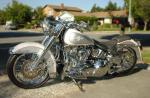
I an a fairly new owner of a 2003 Fatboy. It's been a while since I have ridden so I'm really just getting started again. I've noticed that it just seems natural to me to slow down by downshifting and using the front brake. I rarely of ever use the rear brake. My question is am I doing this wrong or is it really just a matter of preference? The only issue that I can see is that I'll wear out the front brake long before the rear.
Reply with your thoughts and advise please..........[8D]
Reply with your thoughts and advise please..........[8D]

Grand HDF Member
Joined: Dec 2004
Posts: 4,513
Likes: 4
From: Midland, TX
RE: Front Brake or Rear Brake
No problem really with just using the front brake but I'd get in the habit of using both. Reason being that if you are in the habit and have a situation where you need maximum braking, you'll be already in the mode to use both, which give you maximum braking.
RE: Front Brake or Rear Brake
As I was taught, the front brake gives you 75% of your braking power so its better to at least be ontop of that one if you had to choose. But using both evenly is best for maximum braking power, of course. Though, I'm not one to preach that because I gernally only use the front brake while downshifting as well, unless I'm in a turn or believe there could be some slippery surface ahead.
Ride safe!
Ride safe!
Intermediate
Joined: Jun 2006
Posts: 43
Likes: 0
From: Virginia
RE: Front Brake or Rear Brake
I was taught and have read that the front brake should provide 75% of your stopping power. Yes...Front brake. Many of the "experienced" guys I ride with disagree. They say you'll flip and do an endo. NOT THE CASE. Those riders have picked up a bad habbit and will end up in some sort of a power skid at 60mph by slammin on that back brake. The best way is downshifting if possible (called engine braking) then appling both brakes at the same time with. 75% in front and oh yes...I did the math...25% from the back. This method is taught by MSF, Harley's riders edge course, and every single DMV study guide from every single state of our beloved nation.
ORIGINAL: gconklin
As I was taught, the front brake gives you 75% of your braking power so its better to at least be ontop of that one if you had to choose. But using both evenly is best for maximum braking power, of course. Though, I'm not one to preach that because I gernally only use the front brake while downshifting as well, unless I'm in a turn or believe there could be some slippery surface ahead.
Ride safe!
As I was taught, the front brake gives you 75% of your braking power so its better to at least be ontop of that one if you had to choose. But using both evenly is best for maximum braking power, of course. Though, I'm not one to preach that because I gernally only use the front brake while downshifting as well, unless I'm in a turn or believe there could be some slippery surface ahead.
Ride safe!
Thread Starter
|
Road Master
Joined: Jun 2006
Posts: 885
Likes: 0
From: Houston, Texas
RE: Front Brake or Rear Brake
I really appreciate the input, seems as though I might change my riding style slightly. This is what I like about this site, good information without the condesending attitude.
Thanks again to those who have replied.
Thanks again to those who have replied.

Road Master
Joined: Jan 2006
Posts: 1,192
Likes: 4
From: Columbus, OH
RE: Front Brake or Rear Brake
I use both as stated above 90% of the time. Sometimes I will use only the rear if I need to scrub a little speed, like if some jacka$$ is going slow in front of me or I go into a corner a little hot. That's my way of trying to even pad wear from front to back.
Trending Topics
Guest
Posts: n/a
RE: Front Brake or Rear Brake
I use both and downshift. Use rear if I just need to knock down some speed a bit especially if I'm in a corner (just a bit of feathering)
HD Forum Stories
The Best of Harley-Davidson for Lifelong Riders

7 Surprising Harley-Davidson Products that Are Not Motorcycles
Verdad Gallardo
8 Best Harley-Davidson Motorcycles Ever
Pouria Savadkouei
10 Worst Harley-Davidson Motorcycles Ever
Pouria Savadkouei
Killer Custom's Jail Break Is The Breakout That Refused to Blend In
Verdad Gallardo
Crazy Bunderbike Build Looks Amazing, But Is It Impossible to Ride?
Verdad Gallardo
Harley-Davidson Reveals Super Cool Cafe Racer Concept
Verdad Gallardo
Engraved Rebellion: Inside Bundnerbike's Glam Rock II
Verdad Gallardo
10 Motorcycles You Should Never Buy
Joe Kucinski
10 Things Harley-Davidson Needs to Fix in 2026
Verdad Gallardo
Road Warrior
Joined: Apr 2005
Posts: 1,739
Likes: 153
From: Fayetteville, NC
RE: Front Brake or Rear Brake
yep----front brake is 75% of stopping power.......but you should use both. At least that's what I was taught by the professionals years ago when riding street bikes.........you should notice that you have to squeeze less on the front brake if you use it in conjuction with the rear brake and downshift also

Thread
Thread Starter
Forum
Replies
Last Post