



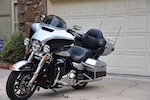



Break pedal trim

Thread Starter
|
Advanced
Joined: Nov 2013
Posts: 88
Likes: 1
From: California
 Break pedal trim
I have a question.
I have a '14 SG and the rear break pedal is pretty wide. I can't stretch my leg out. I pulled the cover off and noticed that, if I trim off about 3/4" of the "main" part of the pedal I can move it over (the adjusting slot allows for that) The question I have is, if I pull the pedal assembly off, I will need to unhook it from the break master cylinder. Will I then need to bleed the break when I re-install it? I could not find a return spring that pushes the pedal back so I am assuming the pressure in the cylinder pushes it back.
I attached a pic.
Thanks
Dave
I have a '14 SG and the rear break pedal is pretty wide. I can't stretch my leg out. I pulled the cover off and noticed that, if I trim off about 3/4" of the "main" part of the pedal I can move it over (the adjusting slot allows for that) The question I have is, if I pull the pedal assembly off, I will need to unhook it from the break master cylinder. Will I then need to bleed the break when I re-install it? I could not find a return spring that pushes the pedal back so I am assuming the pressure in the cylinder pushes it back.
I attached a pic.
Thanks
Dave

Stellar HDF Member


Joined: Oct 2005
Posts: 2,265
Likes: 935
From: Clearwater, Fl

You don't open the hydraulic system to remove the pedal. Remove floorboard. Loosen m/c reservoir. Remove pedal mounting bolt. Remove cotter pin and pin that attachs the pedal to the m/c rod.
Thats a quick version. Better version in your service annual.
Thats a quick version. Better version in your service annual.
Thread Starter
|
Advanced
Joined: Nov 2013
Posts: 88
Likes: 1
From: California
Won't the m/c rod push it's way out too far?? Therefor, draw in air??
Something is pushing back on the pedal. I could not find a return spring.
The bike has ABS. I understand bleeding the break system is not as easy as "pump and drain"
Something is pushing back on the pedal. I could not find a return spring.
The bike has ABS. I understand bleeding the break system is not as easy as "pump and drain"
Stellar HDF Member
Joined: Oct 2005
Posts: 2,265
Likes: 935
From: Clearwater, Fl

Thread Starter
|
Advanced
Joined: Nov 2013
Posts: 88
Likes: 1
From: California
I'm old school, Red. The new technology makes me a bit uneasy.
Guess I should have bought an older ride.
Guess I should have bought an older ride.
Trending Topics

Outstanding HDF Member
Joined: Mar 2014
Posts: 2,452
Likes: 23
From: Michigan
If this helps I had mine off and had no problems when I installed my new one, do what RED said and you will have nothing to worry about.
If I recall, you do not need to loosen the master cylinder either there is a pin from the master cylinder to the arm to disconnect.
The arm/switch/rod from the M/C is extended all the way out when the break arm is disengaged, so when you remove the connecting pin to the break arm there will be no more travel for the switch/rod to move, there for you do not need to worry about air or anything. I hope this makes sense.
Last edited by TcHunter; May 30, 2015 at 10:47 PM.
HD Forum Stories
The Best of Harley-Davidson for Lifelong Riders

7 Surprising Harley-Davidson Products that Are Not Motorcycles
Verdad Gallardo
8 Best Harley-Davidson Motorcycles Ever
Pouria Savadkouei
10 Worst Harley-Davidson Motorcycles Ever
Pouria Savadkouei
Killer Custom's Jail Break Is The Breakout That Refused to Blend In
Verdad Gallardo
Crazy Bunderbike Build Looks Amazing, But Is It Impossible to Ride?
Verdad Gallardo
Harley-Davidson Reveals Super Cool Cafe Racer Concept
Verdad Gallardo
Engraved Rebellion: Inside Bundnerbike's Glam Rock II
Verdad Gallardo
10 Motorcycles You Should Never Buy
Joe Kucinski
10 Things Harley-Davidson Needs to Fix in 2026
Verdad Gallardo


Extreme HDF Member
Joined: Jun 2007
Posts: 12,653
Likes: 18
From: Broken Arrow, Oklahoma
Maybe I'm missing something here. If you trim off part of the metal pedal, what are you going to use to cover it back up??? The rubber pad isn't going to fit any more, and nothing I know of is going to fit unless you find a smaller pad and trim the pedal to it's specs.
Or, you could buy some highway pegs and skip all that crap.
Or, you could buy some highway pegs and skip all that crap.