



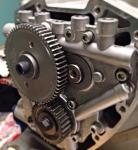



Primary chain adjusters

Thread Starter
|
Seasoned HDF Member


Joined: Oct 2012
Posts: 11,226
Likes: 3,049
From: St.Louis Mo.

Did you buy the newest updated "C" version of the adjuster ? I think they are now on the 3rd one.
I wonder why your chain was rubbing the bracket for the Baker adjuster ?
I wonder why your chain was rubbing the bracket for the Baker adjuster ?

Grand HDF Member


Joined: Jun 2009
Posts: 4,006
Likes: 1,240
From: On the Front Range, CO
Unless you have done the Baker install, it's kind of hard to explain. The only things that holds the Baker unit in place are the same two OEM mounting bolt locations, under the shoe at either end and the hold they bottom of the rear adjustment bracket. The portion of the bracket that extends upwards is use for adjustment. The shoe sort of floats except that there is a thin metal T shaped piece (the one that broke in two places on mine) that attaches at the same place as the OEM bolts, and then to the bolt on the outside of the shoe.
When mine broke, the adjustment portion snapped off the main bracket (and remained bolted to the shoe bracket), and then the outer support T shaped piece broke in two places thus allowing the shoe to basically flop around.
That's how the chain was able to eat into the bracket.
Thread Starter
|
Seasoned HDF Member
Joined: Oct 2012
Posts: 11,226
Likes: 3,049
From: St.Louis Mo.
I get it now. You were very lucky the entire thing didn't get into the clutch basket and destroy everything in there an lock up the wheel. Any noise before that happen to you ?
I wonder how many of these things Baker has sold and how many failures there have been. A failure like this could put a guy on his head !
I wonder how many of these things Baker has sold and how many failures there have been. A failure like this could put a guy on his head !
Grand HDF Member
Joined: Jun 2009
Posts: 4,006
Likes: 1,240
From: On the Front Range, CO
Originally Posted by hardheaded;[url=tel:20169245
20169245[/url]]I get it now. You were very lucky the entire thing didn't get into the clutch basket and destroy everything in there an lock up the wheel. Any noise before that happen to you ?
I wonder how many of these things Baker has sold and how many failures there have been. A failure like this could put a guy on his head !
I wonder how many of these things Baker has sold and how many failures there have been. A failure like this could put a guy on his head !
It certainly made all sorts of racket! I have a solid sprocket in lieu of a compensator, so I had a good idea something like this had happened as soon as I heard it.
I sidelined the bike until I could inspect it and fix the issue.
You are very spot on though - it could have been very catastrophic for the bike and certainly very dangerous for a rider. I feel fortunate to have avoided both worst case scenarios.
Imagine if you aren’t mechanically inclined too. It would suck to have to keep paying to repair the same ‘upgraded’ part.

Banned
Joined: Aug 2012
Posts: 14,866
Likes: 31,162
From: Whiskey Falls, Texas
I remember when I installed the Hayden, I tried to force it to make contact with the primary, and wasn't even close when it bottomed out. I was impressed.
Seasoned HDF Member


Joined: Sep 2008
Posts: 14,165
Likes: 11,256
From: San Diego, CA
REDBEARD isn't the only one....
I've read of one other similar instance with the Baker tensioner. His didn't break, but bent so he couldn't adjust it... In that case, IIRC, he had a built engine and wasn't shy about using the power...

Stellar HDF Member

Joined: Aug 2020
Posts: 3,185
Likes: 2,228
From: College Station, TX
I've run the BakerBaker on a Touring bike and it worked well and did improve the neutral to first shift as well as the others too, but was too much of a pain and mess to pull the cover to adjust it as a maintenance task. And, the chain adjustment procedure is tedious in that you have to rotate the engine check the slack in the chain at many locations to find the tightest and losest spots (I used 10 locations on the chain to fine the tightest location since the comp sprocket is smaller than the sprocket on the clutch basket and you need to be sure to cover all of that) so that the tightest part is within Bakers specs. If you have much flywheel runout the sprocket shaft is rocking back and forth as the flywheels turn, and there is always some runout on the clutch basket as well. That leads to lose and tight spots in the chain as the engine sprocket and clutch basket rotate toward and away from each other. So you can easily end up with a chain that is over tightened, which we all know can damage bearings and other parts. Think about how using gear drive cams can lead to damage if there is too much runout, this is sort of similar because the Baker attitude chain adjuster is not spring loaded, there is no give in it so something else will give and it won't be good.
If you are lucky enough to have very little runout at either the sprocket shaft / compensator sprocket or clutch basket, it should be easy to adjust and have no problems with. But we also know HD has relaxed the runout specs on the flywheels on the latye models, which doesn't help with this or much of anytjhing else.
Bakler claims that not allowing enough slack in the chain causes the bracket to first bend, allowing the chain to walk inward wearing against the bracket, which ultimately breaks. The chain adjustment procedure from Baker indicated that damage due to improper adjustment is not warrantied. If your running large displacement (and a welded crank) with big Dyno numbers, a Baker Armor Attitude Adjuster may be a good idea. But I think for most street bikes the late OEM auto adjuster is fine.
Paul
If you are lucky enough to have very little runout at either the sprocket shaft / compensator sprocket or clutch basket, it should be easy to adjust and have no problems with. But we also know HD has relaxed the runout specs on the flywheels on the latye models, which doesn't help with this or much of anytjhing else.
Bakler claims that not allowing enough slack in the chain causes the bracket to first bend, allowing the chain to walk inward wearing against the bracket, which ultimately breaks. The chain adjustment procedure from Baker indicated that damage due to improper adjustment is not warrantied. If your running large displacement (and a welded crank) with big Dyno numbers, a Baker Armor Attitude Adjuster may be a good idea. But I think for most street bikes the late OEM auto adjuster is fine.
Paul
HD Forum Stories
The Best of Harley-Davidson for Lifelong Riders

7 Times Harley-Davidson Chucked Tradition Out the Window
Verdad Gallardo
7 Surprising Harley-Davidson Products that Are Not Motorcycles
Verdad Gallardo
8 Best Harley-Davidson Motorcycles Ever
Pouria Savadkouei
10 Worst Harley-Davidson Motorcycles Ever
Pouria Savadkouei
Killer Custom's Jail Break Is The Breakout That Refused to Blend In
Verdad Gallardo
Crazy Bunderbike Build Looks Amazing, But Is It Impossible to Ride?
Verdad Gallardo
Harley-Davidson Reveals Super Cool Cafe Racer Concept
Verdad Gallardo
Engraved Rebellion: Inside Bundnerbike's Glam Rock II
Verdad Gallardo
10 Motorcycles You Should Never Buy
Joe Kucinski
Seasoned HDF Member
Joined: Nov 2006
Posts: 5,895
Likes: 1,908
From: East Coast, USA
I've run the BakerBaker on a Touring bike and it worked well and did improve the neutral to first shift as well as the others too, but was too much of a pain and mess to pull the cover to adjust it as a maintenance task. And, the chain adjustment procedure is tedious in that you have to rotate the engine check the slack in the chain at many locations to find the tightest and losest spots (I used 10 locations on the chain to fine the tightest location since the comp sprocket is smaller than the sprocket on the clutch basket and you need to be sure to cover all of that) so that the tightest part is within Bakers specs. If you have much flywheel runout the sprocket shaft is rocking back and forth as the flywheels turn, and there is always some runout on the clutch basket as well. That leads to lose and tight spots in the chain as the engine sprocket and clutch basket rotate toward and away from each other. So you can easily end up with a chain that is over tightened, which we all know can damage bearings and other parts. Think about how using gear drive cams can lead to damage if there is too much runout, this is sort of similar because the Baker attitude chain adjuster is not spring loaded, there is no give in it so something else will give and it won't be good.
If you are lucky enough to have very little runout at either the sprocket shaft / compensator sprocket or clutch basket, it should be easy to adjust and have no problems with. But we also know HD has relaxed the runout specs on the flywheels on the latye models, which doesn't help with this or much of anytjhing else.
Bakler claims that not allowing enough slack in the chain causes the bracket to first bend, allowing the chain to walk inward wearing against the bracket, which ultimately breaks. The chain adjustment procedure from Baker indicated that damage due to improper adjustment is not warrantied. If your running large displacement (and a welded crank) with big Dyno numbers, a Baker Armor Attitude Adjuster may be a good idea. But I think for most street bikes the late OEM auto adjuster is fine.
Paul
If you are lucky enough to have very little runout at either the sprocket shaft / compensator sprocket or clutch basket, it should be easy to adjust and have no problems with. But we also know HD has relaxed the runout specs on the flywheels on the latye models, which doesn't help with this or much of anytjhing else.
Bakler claims that not allowing enough slack in the chain causes the bracket to first bend, allowing the chain to walk inward wearing against the bracket, which ultimately breaks. The chain adjustment procedure from Baker indicated that damage due to improper adjustment is not warrantied. If your running large displacement (and a welded crank) with big Dyno numbers, a Baker Armor Attitude Adjuster may be a good idea. But I think for most street bikes the late OEM auto adjuster is fine.
Paul
Stellar HDF Member
Joined: Aug 2020
Posts: 3,185
Likes: 2,228
From: College Station, TX
Interesting perspective! I don't recall reading about any issues with EVO engines running with their manual primary chain adjuster. I'm sure there are people running high power in these engines. Is the runout that much better in an EVO? What about the clutch basket runout? Is that better in an EVO too?
The EVO flywheels have a tighter runout spec from the factory and aren't pressed together, although you can still tweek them. And it's difficult to get as much torque and HP out of an HD EVO engine without boring the cases and longer stroke flywheels etc. And if you do all of that with HD cases, it isn't likely to last long. It just wasn't designed for it.
And, consider the diameter of an 25 tooth EVO egine sprocket compared to a 34 tooth Twin Cam or M8. I believe the effect of additional runout on the sprocket shaft or sprocket is exagerated with the larger sprocket.
Paul