




Reversion - please explain....

Thread Starter
|
Road Master
Joined: Jul 2010
Posts: 1,042
Likes: 86
From: Centeral Coast, California
 Reversion - please explain....
I recently installed the Woods TW-222 cams in my 2012 Road Glide. The "knocking" that I am hearing I've identified as coming from directly behind the air filter, in front of the throttle body....if you will.
Let me say that everything seems perfect. I probably have 500 miles on these cams, and they're pretty incredible. I am pretty sure that the "knocking", which goes away as there's an increase in RPM, isn't a sign of parts flying through my motor!
I've read that others have had the same sound after installing a more performance cam than the stock cams, and that it's called "reversion", which comes from the overlap in said cam. Why? What is reversion other than a sound? What about the overlap in a more "performance" cam causes reversion?
Curious if there's a more technical explanation to this than what I have found thus far.
Let me say that everything seems perfect. I probably have 500 miles on these cams, and they're pretty incredible. I am pretty sure that the "knocking", which goes away as there's an increase in RPM, isn't a sign of parts flying through my motor!
I've read that others have had the same sound after installing a more performance cam than the stock cams, and that it's called "reversion", which comes from the overlap in said cam. Why? What is reversion other than a sound? What about the overlap in a more "performance" cam causes reversion?
Curious if there's a more technical explanation to this than what I have found thus far.

Seasoned HDF Member


Joined: Jan 2011
Posts: 157,521
Likes: 57,074
From: Michigan 15 Minutes East Of Hell
Reversion is the backflow of exhaust gases. Reversion can be created by low exhaust velocity or pulses arriving at the combustion chamber at the wrong time. A major deterrent of drag pipes. Anti reversion cones can diminish/eliminate reversion.
http://www.ebay.com/itm/ANTI-REVERSI...-/271137096909
http://www.ebay.com/itm/ANTI-REVERSI...-/271137096909

Outstanding HDF Member
Joined: Dec 2008
Posts: 2,007
Likes: 353
From: Ohio
It's simply that exhaust and intake gases move backward for an instant while the overlap last. It happens because at lower rpm's, without exhaust flow momentum, the piston forces some of the exhaust gas into the intake passage. Makes for rough spots at low speeds and idle.

Road Warrior


Joined: May 2012
Posts: 1,423
Likes: 535
From: Oregon
The reason the gases are mixing is that the intake and exhaust valves are open at the same time=Overlap. The more overlap the worse the reversion can be at low rpm.
Another issue is when you use a cam like the 255 which has almost no overlap the reversion hits the closed exhaust valve and sounds like the engine is pinging at low RPM.
Another issue is when you use a cam like the 255 which has almost no overlap the reversion hits the closed exhaust valve and sounds like the engine is pinging at low RPM.

HDF Community Team

Joined: Jun 2006
Posts: 12,776
Likes: 2,607
From: san antonio

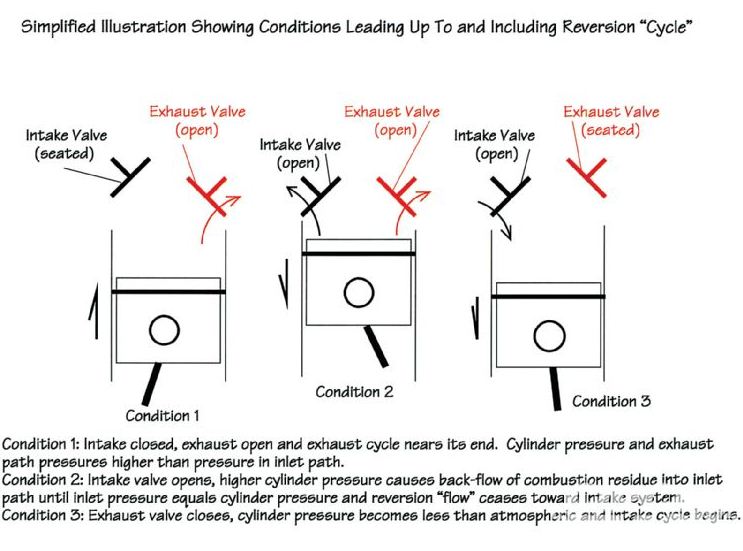
What you are hearing is the reversion pressure wave bouncing off the throttle body in the manifold. The noise may vary in intensity or go away depending on cam, valve timing, throttle body, and intake etc. The noise is amplified with an ope A/C like a heavy breather; the SE A/C with the football cover will muffle the noise. Very common with fast ramp cams with generous overlap. See the graphic below for an illustration of reversion.

Thread Starter
|
Road Master
Joined: Jul 2010
Posts: 1,042
Likes: 86
From: Centeral Coast, California
Thank you all for the replies. I do have an open breather system, a Big Sucker as a matter of fact, so the sound is amplified.
Is this something that would be problematic as far as you're all concerned? Do I need to buy cones or something else to eliminate it, or is it something that I'll get used to such that I won't even hear it any more? I am almost at that point already, but I just want to be confident that it's not slowly damaging something.
Thanks again for the responses. Very helpful.
Is this something that would be problematic as far as you're all concerned? Do I need to buy cones or something else to eliminate it, or is it something that I'll get used to such that I won't even hear it any more? I am almost at that point already, but I just want to be confident that it's not slowly damaging something.
Thanks again for the responses. Very helpful.
HDF Community Team
Joined: Jun 2006
Posts: 12,776
Likes: 2,607
From: san antonio
Thank you all for the replies. I do have an open breather system, a Big Sucker as a matter of fact, so the sound is amplified.
Is this something that would be problematic as far as you're all concerned? Do I need to buy cones or something else to eliminate it, or is it something that I'll get used to such that I won't even hear it any more? I am almost at that point already, but I just want to be confident that it's not slowly damaging something.
Thanks again for the responses. Very helpful.
Is this something that would be problematic as far as you're all concerned? Do I need to buy cones or something else to eliminate it, or is it something that I'll get used to such that I won't even hear it any more? I am almost at that point already, but I just want to be confident that it's not slowly damaging something.
Thanks again for the responses. Very helpful.
Last edited by djl; Oct 15, 2013 at 11:43 AM.
Trending Topics
Thread Starter
|
Road Master
Joined: Jul 2010
Posts: 1,042
Likes: 86
From: Centeral Coast, California
"ride and forget about it if you can."
I can. Thank you!
HD Forum Stories
The Best of Harley-Davidson for Lifelong Riders

7 Surprising Harley-Davidson Products that Are Not Motorcycles
Verdad Gallardo
8 Best Harley-Davidson Motorcycles Ever
Pouria Savadkouei
10 Worst Harley-Davidson Motorcycles Ever
Pouria Savadkouei
Killer Custom's Jail Break Is The Breakout That Refused to Blend In
Verdad Gallardo
Crazy Bunderbike Build Looks Amazing, But Is It Impossible to Ride?
Verdad Gallardo
Harley-Davidson Reveals Super Cool Cafe Racer Concept
Verdad Gallardo
Engraved Rebellion: Inside Bundnerbike's Glam Rock II
Verdad Gallardo
10 Motorcycles You Should Never Buy
Joe Kucinski
10 Things Harley-Davidson Needs to Fix in 2026
Verdad Gallardo
Club Member

Joined: Jun 2007
Posts: 45,429
Likes: 2,898
From: Bedford UK

What you are experiencing is good! At least in performance terms. This confirms the adverse effect of EPA noise regulations, in reducing vehicle noise on the one hand, while also reducing performance on the other, certainly where bikes are concerned. Once upon a time all vehicles made similar noises, except the most mildly tuned ones.
Ride on and enjoy. Also wear earplugs on longer trips, but you already knew that.....
Ride on and enjoy. Also wear earplugs on longer trips, but you already knew that.....

Extreme HDF Member
Joined: Sep 2010
Posts: 14,744
Likes: 402
From: Phoenix '53, '88, '09 Big Twins
I might suggest that the reversion characteristics can be altered by changing the exhaust tract
either the length, diameter, baffling etc.
this may not eliminate reversion, but can shift it to another rpm range.
( oh look, another advantage of tunable pipes such as supertrapps)
reversion can be interesting esp. on carbed bikes as the air/fuel vapour can sometimes be seen exiting the throat of the intake.
if an air cleaner is in place, the fuel may wash out oil from the air filter and make a mess- sometimes the rider thinks "blow-by"
mike
either the length, diameter, baffling etc.
this may not eliminate reversion, but can shift it to another rpm range.
( oh look, another advantage of tunable pipes such as supertrapps)
reversion can be interesting esp. on carbed bikes as the air/fuel vapour can sometimes be seen exiting the throat of the intake.
if an air cleaner is in place, the fuel may wash out oil from the air filter and make a mess- sometimes the rider thinks "blow-by"
mike