




The Wobble, A Comprehensive Look into Cause, Effect, and Fix

Banned
Joined: Apr 2014
Posts: 678
Likes: 1
From: LA

What interested me the most was how the weight of the rider - and strapping on additional weights - made an instant difference to the bike, perhaps adding to the equation of why some riders don't complain about the issue?
I measure the wiggle on my swing arm pivot through the transmission and back and forward free play equates to about 12 to 14 thou.
That's done on a dial gauge but not really a proper measurement. I hold one end and rock it on a horizontal plane. That's how much the other end moves.
I measure the wiggle on my swing arm pivot through the transmission and back and forward free play equates to about 12 to 14 thou.
That's done on a dial gauge but not really a proper measurement. I hold one end and rock it on a horizontal plane. That's how much the other end moves.

Club Member


Joined: Jun 2007
Posts: 45,429
Likes: 2,898
From: Bedford UK
That video is about 40 years old!
Banned
Joined: Apr 2014
Posts: 678
Likes: 1
From: LA
... but H-D's chassis design in 50 years old and the laws of physics remain the same.
Nice to see an old Laverda in action. A real "man's" bike. Jota was it? Outrageous bike for the time. So big and powerful for the time that the front forks used to flex trapping the front fender stays between downpipes in corners!
Nice to see an old Laverda in action. A real "man's" bike. Jota was it? Outrageous bike for the time. So big and powerful for the time that the front forks used to flex trapping the front fender stays between downpipes in corners!
Club Member
Joined: Jun 2007
Posts: 45,429
Likes: 2,898
From: Bedford UK

... but H-D's chassis design in 50 years old and the laws of physics remain the same.
Nice to see an old Laverda in action. A real "man's" bike. Jota was it? Outrageous bike for the time. So big and powerful for the time that the front forks used to flex trapping the front fender stays between downpipes in corners!
Nice to see an old Laverda in action. A real "man's" bike. Jota was it? Outrageous bike for the time. So big and powerful for the time that the front forks used to flex trapping the front fender stays between downpipes in corners!

Banned
Joined: Apr 2014
Posts: 678
Likes: 1
From: LA
Weight, or lack of it, must play a part.
It's interesting but I've never once read of a steering dampener being fitted to a Tourer to take the edge off it ... of course, if it is all in the rear rubber donuts, perhaps it still would not. I've rarely heard of a Harley with one, even though 'back in the day' hardly a sporting bike would leave the garage without one fitted, and many models came with them built in, i.e. the old 'screw down' headstock.
It's one of my regrets that I never made to ride one of those classic Laverdas, although I did race one on one of those notoriously wobbly/weaving Kawasakis.
Indeed, I once won a race on one of them purely because the person behind me was so frightened I was about to fall out and take him with me, that he dropped right back to avoid doing so!!!
As Walker said, "all bikes" really do wobble and weave ... it's just that you can tune them to do so at different speeds and places preferably well beyond normal use or forces ... and that is point.
You answer is the True-trak and I know it. I agree it moves the effect up and beyond even quite challenging use (more powerful engine, higher speeds, two heavier riders - no offence intended).
I'm not arguing against that. I am just interested in taking the discussion even further and dealing with the minor "shimmies" or instabilities which include be frame flexing, swing arm pivot slackness, fork yoke/triple trees twisting (did you fit your CCE top yoke yet?), or actual angle.
Rather than be a slave to the classic design ... in my mind I am considering the 'absolute' Harley tourer which would have Yamaha GTS1000 type front suspension.
I reckon it would be *really* easily doable and make for a incredibly low slung, railway track-like stability. You would not even need the frame going above the engine, more just slung under it like an old fashion automobile chassis for various styles of body to be dropped upon.
A vision of the future ... from 20 years ago. I reckon you could even still make the bike look "trad" at the same time, in a kind of 1930s art deco/streamliner look.


Last edited by Dun Roamin; Oct 17, 2014 at 09:18 AM.

HDF Community Team


Joined: Nov 2012
Posts: 6,191
Likes: 2,423
From: USA

There are steering dampers for the touring frame Harleys. They are not common, but they exist. Several different mounting configurations, with the same extending friction/damper tube. They have been discussed on some of the other techie forums, but without serious details or analysis. A few using them and claiming improvements to various degrees, others without them insisting they are superfluous.
A key thing, imo, with regards to Walkers and Dunlops videos regarding weave and wobble are the similarities of all the bikes. When it's all said and done, all motorcycles have about the same dimensions, especially with regards to the steering head placement. They all ride on similar sized tires, spaced similarly far apart, etc. Which I suspect is why the frequencies of weave and wobble is so uniform.
I am one who did have a lot of play in my rear swing arm, and did remove almost all of it. It did make a substantial change. It eliminated the vague and weird feeling rear steer, which if started while leaned over in a turn would become a very rhythmic oscillation. My theory is this rhythmic nature has to do with belt elasticity and bike mass.
I can still very much induce low frequency weaving or bobbing, especially when turned on a classic interstate sweeper. I've not bothered to rig up pointer and table on the tank to document it, but I can clearly feel it and see it in the handlebars, and can dampen or induce it easily with my hands. As soft and floppy as Harley calls for the steering head specs to be, this does not surprise me. I have played with steering head tension on other bikes, very much regulating this phenomena. I know of no reason it would not be the same on a touring Harley. Which gets back to the benefits of a steering damper.
I've no doubt fork tube rigidity has some bearing, but perhaps not as much as is suspected. In riding and watching my 04 RK, I see no visual deflection of the front wheel in relation to the handlebars, nor do I see the fork tubes deflecting or twisting. That is not as comical a farce question as it might seem. For at the other end of the spectrum, I've an old Honda XL500, with the most remarkably flexy fork tubes. I can easily watch the front wheel wander back and forth as the tubes twist going down the road. When things get obnoxiously tweaked, I just nose it up against a sign post and twist the handlebars back straightish again. It's that weak and flexible. But, while it is remarkably vague, and the knobby tires do not help that, it does not particularly bob of weave. Not attempting to draw a conclusion here, just an observation that fork flexing may not be a significant factor, especially compared to the flexibility of the steering head.
Something else I can detect on my RK is an odd bunched up feeling when I front brake hard, especially if turning. The bike feels like it is pushing behind the steering head, much like a trailer without brakes does on the hitch when you brake hard. A quick side to side variance of the pushing forces.
I've never ridden that Yamaha, but have long wished to. That's a fascinating front end. I have ridden a BMW with the Ike or leading link front suspension. That was peculiarly unpleasant. Something I have been told by others is to be expected. That design works well with side cars, but not without.
Just some random points for thought.
A key thing, imo, with regards to Walkers and Dunlops videos regarding weave and wobble are the similarities of all the bikes. When it's all said and done, all motorcycles have about the same dimensions, especially with regards to the steering head placement. They all ride on similar sized tires, spaced similarly far apart, etc. Which I suspect is why the frequencies of weave and wobble is so uniform.
I am one who did have a lot of play in my rear swing arm, and did remove almost all of it. It did make a substantial change. It eliminated the vague and weird feeling rear steer, which if started while leaned over in a turn would become a very rhythmic oscillation. My theory is this rhythmic nature has to do with belt elasticity and bike mass.
I can still very much induce low frequency weaving or bobbing, especially when turned on a classic interstate sweeper. I've not bothered to rig up pointer and table on the tank to document it, but I can clearly feel it and see it in the handlebars, and can dampen or induce it easily with my hands. As soft and floppy as Harley calls for the steering head specs to be, this does not surprise me. I have played with steering head tension on other bikes, very much regulating this phenomena. I know of no reason it would not be the same on a touring Harley. Which gets back to the benefits of a steering damper.
I've no doubt fork tube rigidity has some bearing, but perhaps not as much as is suspected. In riding and watching my 04 RK, I see no visual deflection of the front wheel in relation to the handlebars, nor do I see the fork tubes deflecting or twisting. That is not as comical a farce question as it might seem. For at the other end of the spectrum, I've an old Honda XL500, with the most remarkably flexy fork tubes. I can easily watch the front wheel wander back and forth as the tubes twist going down the road. When things get obnoxiously tweaked, I just nose it up against a sign post and twist the handlebars back straightish again. It's that weak and flexible. But, while it is remarkably vague, and the knobby tires do not help that, it does not particularly bob of weave. Not attempting to draw a conclusion here, just an observation that fork flexing may not be a significant factor, especially compared to the flexibility of the steering head.
Something else I can detect on my RK is an odd bunched up feeling when I front brake hard, especially if turning. The bike feels like it is pushing behind the steering head, much like a trailer without brakes does on the hitch when you brake hard. A quick side to side variance of the pushing forces.
I've never ridden that Yamaha, but have long wished to. That's a fascinating front end. I have ridden a BMW with the Ike or leading link front suspension. That was peculiarly unpleasant. Something I have been told by others is to be expected. That design works well with side cars, but not without.
Just some random points for thought.

Seasoned HDF Member

Joined: Jul 2011
Posts: 27,097
Likes: 4,676
From: Frozelandia, Minnysota
Brought back a memory; don't remember which ones, but I've ridden more than one bike in the past that you could watch the front wheel, (I know, actually the fork), move back and forth on road irregularities. On some roads, the wheel would almost blur, like it was vibrating back and forth. Probably wasn't really that much movement, I'd guess well under an inch. I'll have to watch the sporty's wheel sometime and see if it has any movement; can't see the Glide's front wheel of course. I'd guess if the fork deflected visibly like that in a high speed turn, it could add to the wobble effect, if not actually initiating it.
Club Member
Joined: Jun 2007
Posts: 45,429
Likes: 2,898
From: Bedford UK
The forks on pre-2014 touring bikes are a weak link and it is probably a good thing that we can't see the front wheel while riding! However CCE has a solution that should dramatically improve that 'feature'. There are indeed several aftermarket products which can significantly improve our lot while riding, for those of us concerned about such things.
HD Forum Stories
The Best of Harley-Davidson for Lifelong Riders

7 Times Harley-Davidson Chucked Tradition Out the Window
Verdad Gallardo
7 Surprising Harley-Davidson Products that Are Not Motorcycles
Verdad Gallardo
8 Best Harley-Davidson Motorcycles Ever
Pouria Savadkouei
10 Worst Harley-Davidson Motorcycles Ever
Pouria Savadkouei
Killer Custom's Jail Break Is The Breakout That Refused to Blend In
Verdad Gallardo
Crazy Bunderbike Build Looks Amazing, But Is It Impossible to Ride?
Verdad Gallardo
Harley-Davidson Reveals Super Cool Cafe Racer Concept
Verdad Gallardo
Engraved Rebellion: Inside Bundnerbike's Glam Rock II
Verdad Gallardo
10 Motorcycles You Should Never Buy
Joe Kucinski
Club Member
Joined: Jun 2007
Posts: 45,429
Likes: 2,898
From: Bedford UK

My local Yamaha dealer built a racing version of that YZF, although there was probably nothing of the original bike left. He even used a racing engine, probably an R1, and ran it for a couple of years at the Isle of Man TT Races. I agree that the concept has great promise, unfortunately nobody has stuck with it for long enough to prove and refine it. Modern engineering and suspension should give a truly superior beasty!
Banned
Joined: Apr 2014
Posts: 678
Likes: 1
From: LA
Found it! Here ya go.....
There's an interesting article about James Parker's experience with the GTS and Yamaha, here:
http://silodrome.com/yamaha-gts-1000/
Foale's commentary is here. a gallery of alternatives, here, and you've discuss Howard at Motorcycle Metal's upside downers before, also here. Do they kick the front end further forward or is it just the photos? Does he do a set for the Road King nacelle?

Did anyone else get an alternative front end to really work? There's a lot of investment into standard forks but, really, the masses and forces entailed in motorcycling really have outgrown them, even more in touring than racing.
I think Touring engine is eminently suitable for a low slung frame and front fork chassis on which to drop a wide range of bodywork. I'd like to be sitting back with my butt right above the swing arm. Look at the disadvantages of trying to use something like the BMW engine ... (I also would not like to be in a crash with all that leg snapping metal around me).
I know Craig Vetter played around with Feet Forward motorcycles for a while, since the 1980s (see with Paul Blezzard below), but Harley's have been surprising absent from that crazy, non-conformist world, see:
http://www.bikeweb.com/image/tid/4

Perhaps as petroleum prices keep hiking we'll have to be concerned with streamlining one day.
Streamliners are not gay folks ...
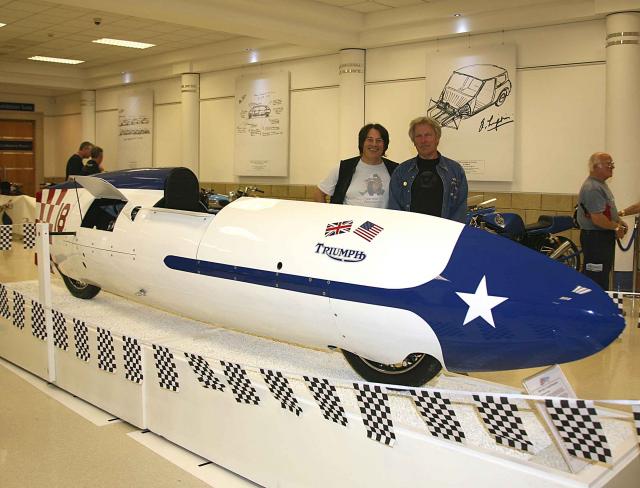
And I could see a John Deere green version of one of these with a H-D engine ... but why stick with a V-2 when you can have a V-8?

Last edited by Dun Roamin; Oct 18, 2014 at 05:17 PM.