







Fork oil for switchback

Cruiser

Joined: Dec 2015
Posts: 118
Likes: 24
From: virginia

Agree with most of the above, but have a point to add. My FXD was killing me over the bridge approach slabs on my back road "jaunts". A friend and I like to go pretty fast; not race fast like I did when young, mountain roads and blue ridge parkway in Va. But, my Dyna would hammer on the front end as it hit some of the "bumps" on the bridges. I actually got off to look at some of the bad ones....about 1-1 1/2 inch steps in the pavement. So, off came the front shocks. This was last year after I got it with about 10k on the odo. Oil was pretty heavy....fairly clean. I did a rough measure of visco using an eye dropper and time to empty. Seemed to be about 20wt. I put back mostly 10wt with just a taste of 5wt. Much better. Next change will be 7wt. As above, the springs hold the weight, and the damper with oil does just that....damps. These mundane shocks are not adjustable for either compression or rebound as are the racing shocks. BUT, they will work pretty well with proper hydraulic fluid. Agree with add of better valving, since the holes in the damper tubes do not compensate, but are constant size. They work OK, but could be improved. Mine is fine for a street bike now. And remember Russian Adm Gorshkov......better is the enemy of good enough.
Keep in mind, oil doesn't hold the bike up, the springs do. The weight of the oil determines the overall springiness feel of the forks. 20w would make for a harsh ride better suited to a racing bike on smooth roads. 10w oil is a good overall choice for softer feel on bumps but still enough to slow the rate of compression and may prevent bottoming out on pot holes and high bumps. Also helps on those washboard intersections. 20w may actually let the front wheel come off the pavement, something you don't want.
Keep in mind fork oil should be changed about every 2 years so just replacing it with stock oil will improve the handling. Try some 10w and see what you think. It's easy and cheap to experiment with different weights from 7.5 to 15 w.
Keep in mind fork oil should be changed about every 2 years so just replacing it with stock oil will improve the handling. Try some 10w and see what you think. It's easy and cheap to experiment with different weights from 7.5 to 15 w.
Some real good info here.
Keep it simplea nd start with 10w as mentioned above, best compromise for country and freeway riding.
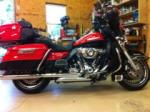
I have a 2013 switchback I bought used 8months ago, had 30,000 on the clock, and yes the front was a bit bouncy.
I dumped the fork oil and put in 10w....it did improve the overall ride of the bike.
Dave.
Road Captain
Joined: Jul 2008
Posts: 613
Likes: 33
From: East Alton, IL
You would have to consult the Factory Service manual for your year and model but generally there is a drain screw at the bottom of the fork and a cap at the top. Loosen the cap, remove the drain screw to get the old oil out. Put the drain screw back in and fill, through the cap at the top, with recommended quantity of oil.
Road Captain
Joined: Jul 2008
Posts: 613
Likes: 33
From: East Alton, IL
It would be a small phillips head screw on the back side of the folk lowers just above the axle nut. if you don't have that screw then you have to pull the wheel and axle and it will be a allen head cap screw (metric) directly through the bottom of the forks. You have to have the Factory Service manual for your year and model. Otherwise you are guessing and probably guess wrong. Look online for free PDF otherwise about $60 from the dealer for a printed copy.

Seasoned HDF Member


Joined: Sep 2013
Posts: 6,175
Likes: 1,966
From: Great State of Canada
A notable difference between the Richors and the Gold Valves is, that you don't modify your damper tubes when installing the Richors. They're a drop in component, set up for you at the factory.
With fixed aperture technology, (damper tubes), all you're gonna do is trade off riding smoothness for handling by dicking with oil weights. Override the damper tubes with a valved system, and the game changes and oil becomes more than a trade-off choice.
FYI:
https://www.hdforums.com/forum/softa...ools-tips.html
HD Forum Stories
The Best of Harley-Davidson for Lifelong Riders

7 Surprising Harley-Davidson Products that Are Not Motorcycles
Verdad Gallardo
8 Best Harley-Davidson Motorcycles Ever
Pouria Savadkouei
10 Worst Harley-Davidson Motorcycles Ever
Pouria Savadkouei
Killer Custom's Jail Break Is The Breakout That Refused to Blend In
Verdad Gallardo
Crazy Bunderbike Build Looks Amazing, But Is It Impossible to Ride?
Verdad Gallardo
Harley-Davidson Reveals Super Cool Cafe Racer Concept
Verdad Gallardo
Engraved Rebellion: Inside Bundnerbike's Glam Rock II
Verdad Gallardo
10 Motorcycles You Should Never Buy
Joe Kucinski
10 Things Harley-Davidson Needs to Fix in 2026
Verdad Gallardo
Outstanding HDF Member

Joined: Dec 2012
Posts: 2,557
Likes: 235
From: Texas
I am 6'2" @ 280. I had a bottoming out issue with excessive sag (talking about the bike here  ) and tried several different pre-loads and oil weights before finally giving up on the OEM springs and installed Progressive springs with 20W Bel-Ray High Performance fork oil. The front feels a little stiff on the road but it is steady in hard curves and the brake dive has been greatly reduced...and no more bottoming out so far...
) and tried several different pre-loads and oil weights before finally giving up on the OEM springs and installed Progressive springs with 20W Bel-Ray High Performance fork oil. The front feels a little stiff on the road but it is steady in hard curves and the brake dive has been greatly reduced...and no more bottoming out so far...

Thread
Thread Starter
Forum
Replies
Last Post
rhallman
Frame/Suspension/Front End/Brakes
1
Apr 27, 2019 08:13 PM
klf33
Softail Models
25
Oct 16, 2013 09:57 PM