




2 up touring power

Thread Starter
|
Advanced
Joined: May 2009
Posts: 62
Likes: 0
From: Rio Rancho, NM
 2 up touring power
Long time first time…I’ve been lurking for awhile now and its time to pop that cherry.
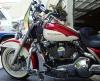
Intro – 1998 Road King Classic with 115,000 miles. The motor is fuel injected with stage 2 upgrade, and has not been apart except for the EV27, cam bearing, and new lifters that went in maybe 90,000 miles ago. All other motor and drive train components (except tires and brake pads) are original. I do my own work and have run car oil for maybe 100,000. I’ve run just about every make of 20W-50 but mostly Mobil1 and a Fram TG3614 oil filter, with 5000 mile change intervals. If I run Dino oil, currently Castrol 20W-50 and Lucas oil treatment, the oil change intervals are 2500 miles. I live in New Mexico at 5600 foot and ride mainly from 4500 to 10,000 foot, with occasional trips down to sea level in Mexico. When the wife and I go on long trips, we pull a trailer. The way I ride the motor lives between 3000 – 4000 rpm and might see 5000 but vary rarely, and only while running through gears.
Problem – The base gaskets have been leaking for years. I’ve lived with it because I wanted to see how far I could push this bike. If anyone said anything about the oil leaks, I’d point at the odometer and they’d shut up. I park it on an old piece of carpet until the carpet gets saturated and then move onto another piece.
Well now the leaks are so bad I need to do something. The oil is getting all over everything behind the motor and I’m rolling through it leaving oily tire marks in the parking lot at work. I now have a shop rag stuffed between the motor and transmission which helps a little. I was originally playing with the idea of simply taking the top end off, putting new base gaskets in, maybe a quick deglaze and .005 over rings, and running it some more. I did a compression check this past weekend and found the following: Cold = front 125 , rear 115 , and after running at fast idle for approximately 5 minutes (rocker boxes were warm/hot to the touch) front 135 , rear130. I don’t recall exactly what they should be but something in my head has me thinking those numbers seem low??
Now I’m thinking that as long as it’s apart I need more power. The 80” motor has served me well locally or up in the mountains, even pulling the trailer. 4th gear has a lot of mountain miles on it but all in all it’s been ok. The problem has always been when I get on the highway, trying to go 80 - 85mph, heading west into any kind of headwind. That’s when the motor lets me know it’s underpowered. If there is no wind I’m fine. But if there is wind I’ve spent many a mile drafting behind a 5th wheel or horse trailer to go 80. I want it to ride like it does when I have a tail wind.
Question – Can any of the experts here give me advice (real world ideas, not manufacture advertisements) of reliable power upgrades? I know motors but not motor designs. I’ve rebuilt my shovelhead to include balancing and truing the flywheels but needed help to choose a cam? There is much hype out there as far as power gains and I’ve learned over the years (from my cars and trucks) that the components need to work together and, in most cases, to choose the smaller of the cams I was looking at! That’s where I need help, what real world parts and/or modifications do I need for reliable torque number between 3000 – 4000 rpm? I do not care about horse power numbers because I doubt that motor will ever pass 5252 rpm. I want as much torque as I can get. I’ve looked into boring the cases for larger jugs but am worried about the cases cracking. My shovel is bored out to 3 5/8ths but it won’t be ridden to Alaska like the evo has been. Stroking it is another option but then there is piston speed/wear/vibration issues? I’ve also looked at Ultima motors, especially that touring 124” they keep claiming that they have, but after reading about some of their reliability issues, have gone back to exploring ways of rebuilding what I have. I’m open to any and all suggestions though, to include losing the Fuel injection. I have a newer 6 gallon Harley tank I want to use anyway and since it’s only got the single hole in the bottom, my current M&M fuel injection will not work with it.
Thanks in advance for any inputs
CB
Intro – 1998 Road King Classic with 115,000 miles. The motor is fuel injected with stage 2 upgrade, and has not been apart except for the EV27, cam bearing, and new lifters that went in maybe 90,000 miles ago. All other motor and drive train components (except tires and brake pads) are original. I do my own work and have run car oil for maybe 100,000. I’ve run just about every make of 20W-50 but mostly Mobil1 and a Fram TG3614 oil filter, with 5000 mile change intervals. If I run Dino oil, currently Castrol 20W-50 and Lucas oil treatment, the oil change intervals are 2500 miles. I live in New Mexico at 5600 foot and ride mainly from 4500 to 10,000 foot, with occasional trips down to sea level in Mexico. When the wife and I go on long trips, we pull a trailer. The way I ride the motor lives between 3000 – 4000 rpm and might see 5000 but vary rarely, and only while running through gears.
Problem – The base gaskets have been leaking for years. I’ve lived with it because I wanted to see how far I could push this bike. If anyone said anything about the oil leaks, I’d point at the odometer and they’d shut up. I park it on an old piece of carpet until the carpet gets saturated and then move onto another piece.
Well now the leaks are so bad I need to do something. The oil is getting all over everything behind the motor and I’m rolling through it leaving oily tire marks in the parking lot at work. I now have a shop rag stuffed between the motor and transmission which helps a little. I was originally playing with the idea of simply taking the top end off, putting new base gaskets in, maybe a quick deglaze and .005 over rings, and running it some more. I did a compression check this past weekend and found the following: Cold = front 125 , rear 115 , and after running at fast idle for approximately 5 minutes (rocker boxes were warm/hot to the touch) front 135 , rear130. I don’t recall exactly what they should be but something in my head has me thinking those numbers seem low??
Now I’m thinking that as long as it’s apart I need more power. The 80” motor has served me well locally or up in the mountains, even pulling the trailer. 4th gear has a lot of mountain miles on it but all in all it’s been ok. The problem has always been when I get on the highway, trying to go 80 - 85mph, heading west into any kind of headwind. That’s when the motor lets me know it’s underpowered. If there is no wind I’m fine. But if there is wind I’ve spent many a mile drafting behind a 5th wheel or horse trailer to go 80. I want it to ride like it does when I have a tail wind.
Question – Can any of the experts here give me advice (real world ideas, not manufacture advertisements) of reliable power upgrades? I know motors but not motor designs. I’ve rebuilt my shovelhead to include balancing and truing the flywheels but needed help to choose a cam? There is much hype out there as far as power gains and I’ve learned over the years (from my cars and trucks) that the components need to work together and, in most cases, to choose the smaller of the cams I was looking at! That’s where I need help, what real world parts and/or modifications do I need for reliable torque number between 3000 – 4000 rpm? I do not care about horse power numbers because I doubt that motor will ever pass 5252 rpm. I want as much torque as I can get. I’ve looked into boring the cases for larger jugs but am worried about the cases cracking. My shovel is bored out to 3 5/8ths but it won’t be ridden to Alaska like the evo has been. Stroking it is another option but then there is piston speed/wear/vibration issues? I’ve also looked at Ultima motors, especially that touring 124” they keep claiming that they have, but after reading about some of their reliability issues, have gone back to exploring ways of rebuilding what I have. I’m open to any and all suggestions though, to include losing the Fuel injection. I have a newer 6 gallon Harley tank I want to use anyway and since it’s only got the single hole in the bottom, my current M&M fuel injection will not work with it.
Thanks in advance for any inputs
CB

Club Member


Joined: Jun 2007
Posts: 45,429
Likes: 2,898
From: Bedford UK
Charlie,
Welcome from HDF. My FLHS had the same base gasket leak, but changing gaskets cured it. Be grateful that the oil will probably let you dismantle the swingarm axle without too much trouble!
I stroked my bike about ten years ago, but recently fitted an S&S 107 motor. Current thinking from at least one of the sponsors on HDF is that great performance can be had without stroking. With your later motor you have stronger cases than my 1990 bike, so it can more easily deliver modern performance.
You could take a short cut by simply contacting a sponsor or two (see Vendor Directory above). They will guide you to chose a matching set of components and can do some or all of the work such as porting your heads.
Welcome from HDF. My FLHS had the same base gasket leak, but changing gaskets cured it. Be grateful that the oil will probably let you dismantle the swingarm axle without too much trouble!
I stroked my bike about ten years ago, but recently fitted an S&S 107 motor. Current thinking from at least one of the sponsors on HDF is that great performance can be had without stroking. With your later motor you have stronger cases than my 1990 bike, so it can more easily deliver modern performance.
You could take a short cut by simply contacting a sponsor or two (see Vendor Directory above). They will guide you to chose a matching set of components and can do some or all of the work such as porting your heads.

Banned
Joined: Sep 2009
Posts: 3,569
Likes: 624
From: deland,florida
i would go with a set of axtell 3.812 cylinders with your stock stroke (97"),S&S .520 cam,compresion 9.8-1.we`ve done tons of these for touring evo`s.makes a very nice,very dependable,torquey & powerful bagger motor.when we do a complete rebuild on evo`s,we machine the cases for o rings,like twin cam motors too,no more base leaks

Road Warrior
Joined: Oct 2009
Posts: 1,251
Likes: 1
we could give you suggestions all day long, it all depends on how much you wanna spend, if you have a little dough to spend, what prodrag recommended is great advice, If you looking to keep it budget, Tear the heads, jugs and send them off to a shop of your choice, have them .010 or .020 over the jugs, id replace the valves with a nice stainless pieces, new valve springs. Use some kb 9.5 to 1 pistons and retain the ev27 and youd be a happy camper, Its all in what you wanna spend, I know the lower end of those bikes are normally bulletproof and have no babbit bearings to wear out like a car, its all needle/roller bearings that require little maintenance. chad.

Road Captain
Joined: Apr 2005
Posts: 535
Likes: 14
From: Highspire Pa
Many of the problems with Ultima engines that I read about had to do with assembly, perhaps you could consider buying an unassembled Ultima engine so you can personally make sure everything is as it should be. The 80" in our 1990 Ultra had the usual performance upgrades including the EV-27, head work with stronger springs, bigger valves, 10:1 pistons, single fire ignition pushrods etc. etc. and it was pretty good for 2 up touring but did not have the torque our Ultima 113" has. I did not have the 80" on the dyno after the work was done, but I did have the Ultima on the dyno and the way I have it set up with quiet CVO touring mufflers ( 1.75 Fullsac baffles) it developed over 100 lbs of torque at 2900 rpm and stayed above 100 up to the rev limiter set at 5500 rpms - it peaks at 114 lbs of torque at about 4000 rpms. This was without professional tuning, I may get it tuned some day, but when I saw the first run, I though, heck that is good enough for me.
Although I don't normally cruise at the 80+ mph as you do, at 55-60 mph hauling 2 people with a combined weight well over 500 pounds, it has no problems passing cars with just rolling on the throttle. Riding 2 up it will easily exceed 100+ mph but the old bagger isn't as stable as I would like at those speeds, especially passing 18 wheelers, it's just not something I enjoy doing.
Although I don't normally cruise at the 80+ mph as you do, at 55-60 mph hauling 2 people with a combined weight well over 500 pounds, it has no problems passing cars with just rolling on the throttle. Riding 2 up it will easily exceed 100+ mph but the old bagger isn't as stable as I would like at those speeds, especially passing 18 wheelers, it's just not something I enjoy doing.
Trending Topics

HDF Community Team


Joined: Dec 2005
Posts: 5,421
Likes: 2,621
From: NC USA
Those are the later cases that do accept boring without problems found in earlier cases. However, boring the cases is a one-way street, there's no going back, it cannot be undone, plus you would need appropriate heads/mods to realize the full potential of the bigger hole. Also, with that mileage the rod webbings have stretched (trust me) and the bottom end should definitely be addressed. Otherwise, you'll be putting brand new, high longevity parts onto a compromised crankpin and bearings that likely would not last the life of the top end.
With strokers, the pistons do travel faster and further so cam timing (design) is very important. At the same time, the torque applied to the output is greatly increased - like breaking a bolt loose with a 24" ratchet as opposed to a 6"... follow me? They tend to decrease upper rpm power unless one gets radical with cam choices. But in the 3-5k rpm range they do extremely well. Longevity is excellent if you stay away from high compression and vibration is not a problem assuming it's balanced correctly. Some stroker manufacturers use light flywheels and consequently a higher balance factor in an attempt to keep lower rpm torque up. This makes for some nasty rough spots through the rpm range. Heavier wheels can be balanced at a lower factor giving less chance of that without giving up any low rpm loss in torque. The biggest downside (for me) with an Evo stroker is that you are very limited with piston choices. Since the stroke is longer, the piston has to be shorter from the pin to the top and only a few places offer that type.
Lots of folks try building an engine to a cam which is backwards to me. One should first decide on all the other components then select a cam that will complement that with whatever degree of power and/or economy one hopes to acheive. Head modifications are necessary for some cams if nothing more than different springs, but most other mods increasing "flow" are for the upper rpm ranges and only degrade economy, though polishing the exhaust and combustion chamber is a win-win regardless of the application.
You won't lose or gain any power by retrofitting a carburetor unless you over-do it and lose some economy, and it would greatly simplify tuning. Countless options for "more power" and an infinite number of opinions as to the perfect combinations and from reading your initial post, I'm assuming this is your #1 road bike so... With that many miles and the resulting lowered compression, you'd be shocked with the increase in power you'd get from by simply rebuilding what you have. Longevity and economy are big factors on a tour bike, not to mention avaliability of parts, should something give out on the road. My preference for "more" is to get it from the bottom rather than the top from a longevity standpoint, and getting it from the top only is easy but less "tour friendly." Getting it from both "ends" will definitley work and more power is addictive, the more you have - the more you want
With strokers, the pistons do travel faster and further so cam timing (design) is very important. At the same time, the torque applied to the output is greatly increased - like breaking a bolt loose with a 24" ratchet as opposed to a 6"... follow me? They tend to decrease upper rpm power unless one gets radical with cam choices. But in the 3-5k rpm range they do extremely well. Longevity is excellent if you stay away from high compression and vibration is not a problem assuming it's balanced correctly. Some stroker manufacturers use light flywheels and consequently a higher balance factor in an attempt to keep lower rpm torque up. This makes for some nasty rough spots through the rpm range. Heavier wheels can be balanced at a lower factor giving less chance of that without giving up any low rpm loss in torque. The biggest downside (for me) with an Evo stroker is that you are very limited with piston choices. Since the stroke is longer, the piston has to be shorter from the pin to the top and only a few places offer that type.
Lots of folks try building an engine to a cam which is backwards to me. One should first decide on all the other components then select a cam that will complement that with whatever degree of power and/or economy one hopes to acheive. Head modifications are necessary for some cams if nothing more than different springs, but most other mods increasing "flow" are for the upper rpm ranges and only degrade economy, though polishing the exhaust and combustion chamber is a win-win regardless of the application.
You won't lose or gain any power by retrofitting a carburetor unless you over-do it and lose some economy, and it would greatly simplify tuning. Countless options for "more power" and an infinite number of opinions as to the perfect combinations and from reading your initial post, I'm assuming this is your #1 road bike so... With that many miles and the resulting lowered compression, you'd be shocked with the increase in power you'd get from by simply rebuilding what you have. Longevity and economy are big factors on a tour bike, not to mention avaliability of parts, should something give out on the road. My preference for "more" is to get it from the bottom rather than the top from a longevity standpoint, and getting it from the top only is easy but less "tour friendly." Getting it from both "ends" will definitley work and more power is addictive, the more you have - the more you want
HD Forum Stories
The Best of Harley-Davidson for Lifelong Riders

7 Surprising Harley-Davidson Products that Are Not Motorcycles
Verdad Gallardo
8 Best Harley-Davidson Motorcycles Ever
Pouria Savadkouei
10 Worst Harley-Davidson Motorcycles Ever
Pouria Savadkouei
Killer Custom's Jail Break Is The Breakout That Refused to Blend In
Verdad Gallardo
Crazy Bunderbike Build Looks Amazing, But Is It Impossible to Ride?
Verdad Gallardo
Harley-Davidson Reveals Super Cool Cafe Racer Concept
Verdad Gallardo
Engraved Rebellion: Inside Bundnerbike's Glam Rock II
Verdad Gallardo
10 Motorcycles You Should Never Buy
Joe Kucinski
10 Things Harley-Davidson Needs to Fix in 2026
Verdad Gallardo
Road Captain
Joined: Aug 2008
Posts: 550
Likes: 8
From: Twin Cities,Mn.
Long time first time…I’ve been lurking for awhile now and its time to pop that cherry.
Intro – 1998 Road King Classic with 115,000 miles. The motor is fuel injected with stage 2 upgrade, and has not been apart except for the EV27, cam bearing, and new lifters that went in maybe 90,000 miles ago. All other motor and drive train components (except tires and brake pads) are original. I do my own work and have run car oil for maybe 100,000. I’ve run just about every make of 20W-50 but mostly Mobil1 and a Fram TG3614 oil filter, with 5000 mile change intervals. If I run Dino oil, currently Castrol 20W-50 and Lucas oil treatment, the oil change intervals are 2500 miles. I live in New Mexico at 5600 foot and ride mainly from 4500 to 10,000 foot, with occasional trips down to sea level in Mexico. When the wife and I go on long trips, we pull a trailer. The way I ride the motor lives between 3000 – 4000 rpm and might see 5000 but vary rarely, and only while running through gears.
Problem – The base gaskets have been leaking for years. I’ve lived with it because I wanted to see how far I could push this bike. If anyone said anything about the oil leaks, I’d point at the odometer and they’d shut up. I park it on an old piece of carpet until the carpet gets saturated and then move onto another piece.
Well now the leaks are so bad I need to do something. The oil is getting all over everything behind the motor and I’m rolling through it leaving oily tire marks in the parking lot at work. I now have a shop rag stuffed between the motor and transmission which helps a little. I was originally playing with the idea of simply taking the top end off, putting new base gaskets in, maybe a quick deglaze and .005 over rings, and running it some more. I did a compression check this past weekend and found the following: Cold = front 125 , rear 115 , and after running at fast idle for approximately 5 minutes (rocker boxes were warm/hot to the touch) front 135 , rear130. I don’t recall exactly what they should be but something in my head has me thinking those numbers seem low??
Now I’m thinking that as long as it’s apart I need more power. The 80” motor has served me well locally or up in the mountains, even pulling the trailer. 4th gear has a lot of mountain miles on it but all in all it’s been ok. The problem has always been when I get on the highway, trying to go 80 - 85mph, heading west into any kind of headwind. That’s when the motor lets me know it’s underpowered. If there is no wind I’m fine. But if there is wind I’ve spent many a mile drafting behind a 5th wheel or horse trailer to go 80. I want it to ride like it does when I have a tail wind.
Question – Can any of the experts here give me advice (real world ideas, not manufacture advertisements) of reliable power upgrades? I know motors but not motor designs. I’ve rebuilt my shovelhead to include balancing and truing the flywheels but needed help to choose a cam? There is much hype out there as far as power gains and I’ve learned over the years (from my cars and trucks) that the components need to work together and, in most cases, to choose the smaller of the cams I was looking at! That’s where I need help, what real world parts and/or modifications do I need for reliable torque number between 3000 – 4000 rpm? I do not care about horse power numbers because I doubt that motor will ever pass 5252 rpm. I want as much torque as I can get. I’ve looked into boring the cases for larger jugs but am worried about the cases cracking. My shovel is bored out to 3 5/8ths but it won’t be ridden to Alaska like the evo has been. Stroking it is another option but then there is piston speed/wear/vibration issues? I’ve also looked at Ultima motors, especially that touring 124” they keep claiming that they have, but after reading about some of their reliability issues, have gone back to exploring ways of rebuilding what I have. I’m open to any and all suggestions though, to include losing the Fuel injection. I have a newer 6 gallon Harley tank I want to use anyway and since it’s only got the single hole in the bottom, my current M&M fuel injection will not work with it.
Thanks in advance for any inputs
CB
Intro – 1998 Road King Classic with 115,000 miles. The motor is fuel injected with stage 2 upgrade, and has not been apart except for the EV27, cam bearing, and new lifters that went in maybe 90,000 miles ago. All other motor and drive train components (except tires and brake pads) are original. I do my own work and have run car oil for maybe 100,000. I’ve run just about every make of 20W-50 but mostly Mobil1 and a Fram TG3614 oil filter, with 5000 mile change intervals. If I run Dino oil, currently Castrol 20W-50 and Lucas oil treatment, the oil change intervals are 2500 miles. I live in New Mexico at 5600 foot and ride mainly from 4500 to 10,000 foot, with occasional trips down to sea level in Mexico. When the wife and I go on long trips, we pull a trailer. The way I ride the motor lives between 3000 – 4000 rpm and might see 5000 but vary rarely, and only while running through gears.
Problem – The base gaskets have been leaking for years. I’ve lived with it because I wanted to see how far I could push this bike. If anyone said anything about the oil leaks, I’d point at the odometer and they’d shut up. I park it on an old piece of carpet until the carpet gets saturated and then move onto another piece.
Well now the leaks are so bad I need to do something. The oil is getting all over everything behind the motor and I’m rolling through it leaving oily tire marks in the parking lot at work. I now have a shop rag stuffed between the motor and transmission which helps a little. I was originally playing with the idea of simply taking the top end off, putting new base gaskets in, maybe a quick deglaze and .005 over rings, and running it some more. I did a compression check this past weekend and found the following: Cold = front 125 , rear 115 , and after running at fast idle for approximately 5 minutes (rocker boxes were warm/hot to the touch) front 135 , rear130. I don’t recall exactly what they should be but something in my head has me thinking those numbers seem low??
Now I’m thinking that as long as it’s apart I need more power. The 80” motor has served me well locally or up in the mountains, even pulling the trailer. 4th gear has a lot of mountain miles on it but all in all it’s been ok. The problem has always been when I get on the highway, trying to go 80 - 85mph, heading west into any kind of headwind. That’s when the motor lets me know it’s underpowered. If there is no wind I’m fine. But if there is wind I’ve spent many a mile drafting behind a 5th wheel or horse trailer to go 80. I want it to ride like it does when I have a tail wind.
Question – Can any of the experts here give me advice (real world ideas, not manufacture advertisements) of reliable power upgrades? I know motors but not motor designs. I’ve rebuilt my shovelhead to include balancing and truing the flywheels but needed help to choose a cam? There is much hype out there as far as power gains and I’ve learned over the years (from my cars and trucks) that the components need to work together and, in most cases, to choose the smaller of the cams I was looking at! That’s where I need help, what real world parts and/or modifications do I need for reliable torque number between 3000 – 4000 rpm? I do not care about horse power numbers because I doubt that motor will ever pass 5252 rpm. I want as much torque as I can get. I’ve looked into boring the cases for larger jugs but am worried about the cases cracking. My shovel is bored out to 3 5/8ths but it won’t be ridden to Alaska like the evo has been. Stroking it is another option but then there is piston speed/wear/vibration issues? I’ve also looked at Ultima motors, especially that touring 124” they keep claiming that they have, but after reading about some of their reliability issues, have gone back to exploring ways of rebuilding what I have. I’m open to any and all suggestions though, to include losing the Fuel injection. I have a newer 6 gallon Harley tank I want to use anyway and since it’s only got the single hole in the bottom, my current M&M fuel injection will not work with it.
Thanks in advance for any inputs
CB
Extreme HDF Member
Joined: Nov 2006
Posts: 13,389
Likes: 26
From: Windham,Maine
115K will need more than a deglazing I am sure.But it is your call once the motor is opened up.Huge off idle torque only comes from big cubic inch,and is very addicting.Look things over real close when it comes to doing the work your motor will need.Personally have always used S&S,have a 124" Evo in Road King.Also using one of R&R's jewels.Good luck