



Taking motor out
Thread Starter
|
Road Warrior


Joined: Sep 2006
Posts: 1,605
Likes: 82
From: nj
 Taking motor out
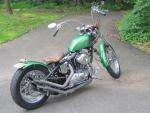
I was wondering do i have to disassemble the motor before taking it out of the frame.I just want to repaint the frame and the tank and fenders this winter. i have a 84 and a hard tail frame which you can see in my pictures thanks Now the frame I do not know what manufacture
Tourer
Joined: Dec 2007
Posts: 388
Likes: 0
From: West Tennessee
Yah pococj is right it will slide right out. It will be heavier, but it will still come out!
Let us know if you need any help. Painting mine as well. So I'm going through the same things as you. Except I took mine apart because I wanted to re-assure that everything was fine.
Let us know if you need any help. Painting mine as well. So I'm going through the same things as you. Except I took mine apart because I wanted to re-assure that everything was fine.
Tourer
Joined: Apr 2006
Posts: 351
Likes: 0
From:
The motor will come out easier if it's tilted to the right and then lifted up out of the frame. They are a lot heavier than they look, so it's not a good idea to try by yourself. When it comes time to re-install it, make sure you have everything taped off that you don't want chipped up or scratched. The first one I did needed touchup in a few spots. The nice thing about having a hardtail frame is you don't have to worry about getting the swingarm bolt lined up with the slot in the engine case.
Thread Starter
|
Road Warrior
Joined: Sep 2006
Posts: 1,605
Likes: 82
From: nj
I was looking at the motor today and I decided to give the thread a chance. Now you said the right, now do you mean tilting out the brake side right. I looked under the frame I did notice that the motor sits in between the frame and sits lower a little( the motor). Now how does it work out for this type of frame Do the orig frame motor sit the same way. Thanks for your help. I was going to get one of those lifts that lift the hole bike to give me some help. How much does these motor weigh the motor is a early 84 with a gen.

Stellar HDF Member
Joined: Feb 2006
Posts: 3,035
Likes: 17
From: Houston Texas
I was looking at the motor today and I decided to give the thread a chance. Now you said the right, now do you mean tilting out the brake side right. I looked under the frame I did notice that the motor sits in between the frame and sits lower a little( the motor). Now how does it work out for this type of frame Do the orig frame motor sit the same way. Thanks for your help. I was going to get one of those lifts that lift the hole bike to give me some help. How much does these motor weigh the motor is a early 84 with a gen.
Taking it out is easy. Putting it back in is a bit more difficult if you want to protect that new paint you just put on the frame.
The engine weight will want to get away from you about the time you try to stab the mount bolts in place. I, being both old and weak did mine by myself. The 188 lbs was a strain, but I got it done. Therefore, anyone can do this.
What I do is lay some bath towels over the newly painted frame tubes and set the engine down gently. Then move it carefully as you align the mount holes in the rear mount. Once those are in place you have it whipped.
Speaking of paint.......For anyone out there planning to paint their bike, and it sounds like a few are, I strongly urge you to either use, or consider using, a 2 part epoxy paint and 2 part epoxy primer to do your machines. You do that and finish it with a clear coat and you will love the results you will get.
Sorry, I am not a rattle-can type of painter myself..............pg
Seasoned HDF Member


Joined: Dec 2004
Posts: 11,068
Likes: 1,477
From: Texas! Ya mean there's someplace else?
And remember to either mask engine mount mating surfaces prior to painting, or scrape it off after painting.
Trending Topics
Tourer
Joined: Dec 2007
Posts: 388
Likes: 0
From: West Tennessee
The total weight of the engine/transmission is 188 lbs. Same weight as a fire plug by the way.
Taking it out is easy. Putting it back in is a bit more difficult if you want to protect that new paint you just put on the frame.
The engine weight will want to get away from you about the time you try to stab the mount bolts in place. I, being both old and weak did mine by myself. The 188 lbs was a strain, but I got it done. Therefore, anyone can do this.
What I do is lay some bath towels over the newly painted frame tubes and set the engine down gently. Then move it carefully as you align the mount holes in the rear mount. Once those are in place you have it whipped.
Speaking of paint.......For anyone out there planning to paint their bike, and it sounds like a few are, I strongly urge you to either use, or consider using, a 2 part epoxy paint and 2 part epoxy primer to do your machines. You do that and finish it with a clear coat and you will love the results you will get.
Sorry, I am not a rattle-can type of painter myself..............pg
Taking it out is easy. Putting it back in is a bit more difficult if you want to protect that new paint you just put on the frame.
The engine weight will want to get away from you about the time you try to stab the mount bolts in place. I, being both old and weak did mine by myself. The 188 lbs was a strain, but I got it done. Therefore, anyone can do this.
What I do is lay some bath towels over the newly painted frame tubes and set the engine down gently. Then move it carefully as you align the mount holes in the rear mount. Once those are in place you have it whipped.
Speaking of paint.......For anyone out there planning to paint their bike, and it sounds like a few are, I strongly urge you to either use, or consider using, a 2 part epoxy paint and 2 part epoxy primer to do your machines. You do that and finish it with a clear coat and you will love the results you will get.
Sorry, I am not a rattle-can type of painter myself..............pg
On the paint, I couldn't agree more. Epoxy paint is the only way to go on motor and frame. Unless you have a way of powder coating. You don't necessarily have to have clear coat applied. It is a nice way of preventing the paint from being chipped though. In some cases though the clear coat can actually hinder the result your looking for. For example, I'm painting my frame and motor a flat black. I don't want any shine on the frame. I want the fender and the tanks to be the eye catchers. If I apply a clear coat on top of the flat black, it will only leave a glossier look.
And another thing. CURE THE PAINT!!!! The paint should be left to cure on the frame and motor for at least 3 to 4 hours. That paint should be perfectly baked on before trying to do anything. It will help so much on chips and chemical damage. I leave my painted parts in my shed with the doors closed. It bakes in there at 130 degree's. But that's only because I'm in the deep south and we have temps so high that when you walk outside your skin melts off. If you don't have an easy way to cure the paint like I do, then buy a cheap heat gun and use the heat gun to cure the paint. It will take longer but it works.
Last edited by supr2nr; Oct 6, 2008 at 10:57 AM.
HD Forum Stories
The Best of Harley-Davidson for Lifelong Riders

7 Surprising Harley-Davidson Products that Are Not Motorcycles
Verdad Gallardo
8 Best Harley-Davidson Motorcycles Ever
Pouria Savadkouei
10 Worst Harley-Davidson Motorcycles Ever
Pouria Savadkouei
Killer Custom's Jail Break Is The Breakout That Refused to Blend In
Verdad Gallardo
Crazy Bunderbike Build Looks Amazing, But Is It Impossible to Ride?
Verdad Gallardo
Harley-Davidson Reveals Super Cool Cafe Racer Concept
Verdad Gallardo
Engraved Rebellion: Inside Bundnerbike's Glam Rock II
Verdad Gallardo
10 Motorcycles You Should Never Buy
Joe Kucinski
10 Things Harley-Davidson Needs to Fix in 2026
Verdad Gallardo
Stellar HDF Member
Joined: Feb 2006
Posts: 3,035
Likes: 17
From: Houston Texas
On the re-assembly of the motor. It has been mentioned a few times on other threads to lay the motor on its side (carefully might I add), then lay the frame over on it's side on top of it. Bolt it up and then lift it like normal. The only problem I see with this is damaging the cam cover, but you could remove that and then re-assemble the CAMS and CAM cover after the motor is back in.
On the paint, I couldn't agree more. Epoxy paint is the only way to go on motor and frame. Unless you have a way of powder coating. You don't necessarily have to have clear coat applied. It is a nice way of preventing the paint from being chipped though. In some cases though the clear coat can actually hinder the result your looking for. For example, I'm painting my frame and motor a flat black. I don't want any shine on the frame. I want the fender and the tanks to be the eye catchers. If I apply a clear coat on top of the flat black, it will only leave a glossier look.
And another thing. CURE THE PAINT!!!! The paint should be left to cure on the frame and motor for at least 3 to 4 hours. That paint should be perfectly baked on before trying to do anything. It will help so much on chips and chemical damage. I leave my painted parts in my shed with the doors closed. It bakes in there at 130 degree's. But that's only because I'm in the deep south and we have temps so high that when you walk outside your skin melts off. If you don't have an easy way to cure the paint like I do, then buy a cheap heat gun and use the heat gun to cure the paint. It will take longer but it works.
On the paint, I couldn't agree more. Epoxy paint is the only way to go on motor and frame. Unless you have a way of powder coating. You don't necessarily have to have clear coat applied. It is a nice way of preventing the paint from being chipped though. In some cases though the clear coat can actually hinder the result your looking for. For example, I'm painting my frame and motor a flat black. I don't want any shine on the frame. I want the fender and the tanks to be the eye catchers. If I apply a clear coat on top of the flat black, it will only leave a glossier look.
And another thing. CURE THE PAINT!!!! The paint should be left to cure on the frame and motor for at least 3 to 4 hours. That paint should be perfectly baked on before trying to do anything. It will help so much on chips and chemical damage. I leave my painted parts in my shed with the doors closed. It bakes in there at 130 degree's. But that's only because I'm in the deep south and we have temps so high that when you walk outside your skin melts off. If you don't have an easy way to cure the paint like I do, then buy a cheap heat gun and use the heat gun to cure the paint. It will take longer but it works.
I do however differ a bit on the application of the paint........
An epoxy paint project cures by a chemical reaction. Heat is not required to cure it. The only temperature condition required is that the air temp be 70°F or higher. Do not use a heat gun. All that will do is scorch the paint.
I do not mean to disagree so much, but I am something of a semi-expert on this subject.
We have all used enamel paint at one time or another. It took forever to dry. All autos were once painted with this paint, and it was baked on in an oven.
Enamel dries like this......air is drawn into the paint and as the air goes to the base metal the solvents are forced towards the paint surface. The air hits the base metal and reflects back following the same course as the solvents, eventually the paint dries. This is why you will grow old watching enamel dry. Heat speeds up the process.
Epoxy is a different animal however.
Epoxy primer uses two materials that have to be mixed together....the primer and a catalyst.
Epoxy paint uses paint, catalyst, and reducer. (Maybe a small amount of fish eye reducer, but proper surface prep eliminates using that.)
The reducer is available in different evaporation rates, depending on the air temp.
The paint will tack dry within an hour. 8 hours are required for the paint to become rock hard. Heat will make no difference for drying epoxy paint. It is all in the chemical reaction.
I will not try to explain the process further, but suggest you choose your brand of paint, get the instructions for each of the materials you will use and follow the instructions to a 'T'. The result will be a professional job I guarantee you.
I have always used PPG Color Concept paint myself. Other brands are just as good, so pick what you wish to use.
Whatever brand you may choose however, be sure to use all other materials of the same brand. For instance....Do not mix PPG paint with catalyst from Shermin-Williams. Keep all products from the same company. Can't stress that enough.
What is the #1 item of importance for a good paint job?
Surface prep is the answer to that one.............pg
Thread Starter
|
Road Warrior
Joined: Sep 2006
Posts: 1,605
Likes: 82
From: nj
Now you guys brought up a good point what about the motor mounts should they mask them off before painting what happens if i leave the paint on when I put the motor back in and the axle too