








How long till engine overheats?

Thread Starter
|
Cruiser
Joined: Jul 2019
Posts: 102
Likes: 4
From: Florida
 How long till engine overheats?
I rode my sportster home from work on friday. What normally should've been a 15 min commute turned into 35 mins, with the sportster stopped in heavy traffic. I could feel the bike getting pretty hot, and since it's air cooled, I would turn it off at every moment I knew I would be stopped for atleast a minute.
Question is, in stop & go traffic, when would I know if the engine is overheating and causing damage to itself? What measures would you guys take in these scenarios?
In my mind, I have no idea if 5 minutes at a stoplight is bad for the bike, or if it would take like 30 minutes at a standstill idle.
Question is, in stop & go traffic, when would I know if the engine is overheating and causing damage to itself? What measures would you guys take in these scenarios?
In my mind, I have no idea if 5 minutes at a stoplight is bad for the bike, or if it would take like 30 minutes at a standstill idle.
Tourer
Joined: Feb 2015
Posts: 311
Likes: 52
From: Virginia Beach, VA
Okay, I'm sure somebody will disagree, but I don't think turning the engine off would help. If it's running, at least some oil is circulating and the oil is what cools things down. If it's not running, the heat just soaks in. There are lots of gadgets out there to help cool things down. I've never personally used any of them.

Grand HDF Member


Joined: Nov 2018
Posts: 4,607
Likes: 3,312
From: Virginia
My commute would be 30 minutes without traffic. It's generally 45 minutes in the morning and an hour on the way home. Washington DC is not known for it's cool summers. I have split lanes when I found myself in a 5 mile back up in a construction zone with no shoulder to pull off onto. But normal stop and go traffic I get enough movement between stops to keep things relatively cool.
HDF Community Team

Joined: Dec 2011
Posts: 8,598
Likes: 4,031
From: San Diego, CA

I know HD must test their engines for conditions like this, it's all too common. I have also NEVER read a post here or on xlforum.net where someone had engine failure attributable to sitting in traffic. I assume it's possible, but I have not seen one post about engine failure due to everyday traffic. Not even from places like Phoenix, Arizona. I would like to find out what the factory says about this issue.
John
John

Road Master

Joined: Feb 2018
Posts: 911
Likes: 647
From: west coast
I run synthetic oil in case I get in that sort of situation, it will tolerate MUCH higher temperatures without damage than conventional oil, like 500F vs. 275F or so...
https://mobiloil.com/en/motor-oils/mobil-1/mobil-1
https://www.hotrod.com/articles/engine-oil-temperature/
https://mobiloil.com/en/motor-oils/mobil-1/mobil-1
https://www.hotrod.com/articles/engine-oil-temperature/
I know Sportsters can get ferociously hot very quickly when stuck in traffic . On a very hot day I had to actually stand up with my legs apart because I was close to being burned . But is this really bad for the engine ? Surely the fact that massive amounts of heat are being radiated FROM the engine means that the huge array of cooling fins is doing the job it was designed for . With everything over engineered and tried and tested over seven decades I really don't think that damage by overheating is an issue worth worrying about . They are made of metal afterall .

Road Warrior
Joined: Jul 2013
Posts: 1,649
Likes: 443
From: Indianapolis
The stock EFI Sportsters will stop firing the rear cylinder when they reach about 464 F (rear) head temps and are stopped.
After a long ride at Interstate speeds where my head temp will normally be about 370 F, when I come to a stop and idle, the head temp normally will drop down to around 320-330 F.
(measured using a PowerVision monitoring the ET on a gauge)
So even with no air movement your engine will still cool down when stopped. You also have no load on the engine when stopped and idling.
It seems like the engine is hot because the air comes right up to you from the engine instead of blowing back under your legs when moving.
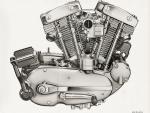
Harley did testing back in 2005/2006 before the EFI Sportsters where introduced to determine the best cylinder/head fin spacing and size for slow speed running.
Harley-Davidson Motor Co. Experimental Investigation into the Temperature and Heat Transfer Distribution around Air-Cooled Cylinders SAE paper 2006-32-0039 / 20066539 (2006)
It is similar to this one except at slower speeds (I believe the testing HD did was all less than 20 Km/Hr):
http://www.isca.in/IJES/Archive/v1/i...S-2012-040.pdf
I do not have a link for the actual HD testing, you can buy the paper from SAE
After a long ride at Interstate speeds where my head temp will normally be about 370 F, when I come to a stop and idle, the head temp normally will drop down to around 320-330 F.
(measured using a PowerVision monitoring the ET on a gauge)
So even with no air movement your engine will still cool down when stopped. You also have no load on the engine when stopped and idling.
It seems like the engine is hot because the air comes right up to you from the engine instead of blowing back under your legs when moving.
Harley did testing back in 2005/2006 before the EFI Sportsters where introduced to determine the best cylinder/head fin spacing and size for slow speed running.
Harley-Davidson Motor Co. Experimental Investigation into the Temperature and Heat Transfer Distribution around Air-Cooled Cylinders SAE paper 2006-32-0039 / 20066539 (2006)
It is similar to this one except at slower speeds (I believe the testing HD did was all less than 20 Km/Hr):
http://www.isca.in/IJES/Archive/v1/i...S-2012-040.pdf
I do not have a link for the actual HD testing, you can buy the paper from SAE
Last edited by shanneba; Aug 5, 2019 at 10:24 AM.
Trending Topics

Seasoned HDF Member


Joined: Sep 2017
Posts: 12,258
Likes: 4,947
From: England
I don't know from what year it is fitted but the rear cylinder has a temperature sensor. I haven't read what it does when it triggers for high temperature but it must do something to save the engine.
I have an oil temp gauge and it regularly shows over 100°C. The other day it got to 121°C but the bike still ticked over evenly at stops so I don't think there is much to wrooy about.
As shanneba got in before me, all you need to do is worry when the tick over goes a bit lumpy with the engine firing on just the one cylinder.
I have an oil temp gauge and it regularly shows over 100°C. The other day it got to 121°C but the bike still ticked over evenly at stops so I don't think there is much to wrooy about.
As shanneba got in before me, all you need to do is worry when the tick over goes a bit lumpy with the engine firing on just the one cylinder.
Last edited by Andy from Sandy; Aug 5, 2019 at 10:29 AM.
HD Forum Stories
The Best of Harley-Davidson for Lifelong Riders

7 Surprising Harley-Davidson Products that Are Not Motorcycles
Verdad Gallardo
8 Best Harley-Davidson Motorcycles Ever
Pouria Savadkouei
10 Worst Harley-Davidson Motorcycles Ever
Pouria Savadkouei
Killer Custom's Jail Break Is The Breakout That Refused to Blend In
Verdad Gallardo
Crazy Bunderbike Build Looks Amazing, But Is It Impossible to Ride?
Verdad Gallardo
Harley-Davidson Reveals Super Cool Cafe Racer Concept
Verdad Gallardo
Engraved Rebellion: Inside Bundnerbike's Glam Rock II
Verdad Gallardo
10 Motorcycles You Should Never Buy
Joe Kucinski
10 Things Harley-Davidson Needs to Fix in 2026
Verdad Gallardo
Grand HDF Member

Joined: Aug 2018
Posts: 4,126
Likes: 2,117
From: W. MI.
Still don't know the year of the bike? Shutting it down and restarting it every 5 minutes is not good for the motor at all. Wear and tear on the starting system alone isn't good. The bike may actually get hotter not circulating oil shut down.


Intermediate
Joined: Dec 2012
Posts: 30
Likes: 14
From: El Mirage, Az.
I live in Arizona and the temps have been 105 plus. When I ride on the highway my temp is 370 degrees. I use a Vance and Hines FP3. When I get off the highway my temp. goes down 20 degrees in a matter of minutes. Never has my temp gone above 370. The temp sensor is located on top of the rear cylinder. So your measuring head temps, which is higher the normal engine temp. Hope this helps.