



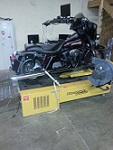



DYNO Numbers for Baggers???
Road Warrior
Joined: Aug 2010
Posts: 1,788
Likes: 5
From: Tennessee

Multiple degrees but hypothetical understanding wasnt one of them!
I can have a masters degree in culinary arts and 6 black belts in 6 differn't martial arts, that should definately qualify me as being an expert in physics, doesn't it? LMFAO

Elite HDF Member
Joined: Apr 2007
Posts: 3,766
Likes: 16
From: Roseville, CA
Made a phone call today to my first cousin who is an engineer with NASA. He's by far the smartest person I know so i put the question to him. His answer was basically the same as yours. He thought it was funny that harley riders would even be having this discussion! In plain easy to understand terms if the weight of vehicle A is not more than 50% of vehicle B, and all other factors being even, A and B will have essentially the same top speed . The difference can be measured, but not by any means available to us civilians!
Road Warrior
Joined: Aug 2010
Posts: 1,788
Likes: 5
From: Tennessee
I would bet the fairing bike is the best followed by windshield then naked. I know that when i ride 2 up my wife catches air that doesnt touch me. I've looked for wind tunnel tests before but didnt find any,
here's an interesting little article I fould that discusses alot of this "debate" we've been having latey.
http://www.nsxprime.com/FAQ/Miscella...queHPSpeed.htm
Here's a gearing calculator I found that has some HD's already in it, it shows what speed in what gear at what RPM's your bike should be. Keep in mind that it doesn't calculate for friction or drag. you can select your make and most models. It defaults to KPH but you can switch it to MPH. You can then change sprocket sizes etc, to see what effects it has on speed. Pretty cool!
http://www.gearingcommander.com/
http://www.nsxprime.com/FAQ/Miscella...queHPSpeed.htm
Here's a gearing calculator I found that has some HD's already in it, it shows what speed in what gear at what RPM's your bike should be. Keep in mind that it doesn't calculate for friction or drag. you can select your make and most models. It defaults to KPH but you can switch it to MPH. You can then change sprocket sizes etc, to see what effects it has on speed. Pretty cool!
http://www.gearingcommander.com/

Member
Joined: Jul 2009
Posts: 4,310
Likes: 1,079
I completely agree here. I have just been watching, and I don't have a college degree, and I have also been holding off on math and physics in my quest for my degree, but I know I have got to take it. The part that sucks is that that "simple" formula that you put up gave me a headache. I'm a common sense type of guy - don't know how got into working computer systems and networking to be honest with you.
Going off of what you have told us just recently, you stated that while my needle on my bike was buried below 120mph, I was in actuality going ~115mph, right? Well then you say weight plays a factor - even if a small one - on the top speed. So my common sense tells me that since I was on my Softy with windshield, me @ ~175lbs and woman @ ~150lbsand read 120 but was doing 115 (and pulling) if I dropped the windshield (Cd) and passenger (weight), I could not only reach a real 120, but pass it, right?
Going off of what you have told us just recently, you stated that while my needle on my bike was buried below 120mph, I was in actuality going ~115mph, right? Well then you say weight plays a factor - even if a small one - on the top speed. So my common sense tells me that since I was on my Softy with windshield, me @ ~175lbs and woman @ ~150lbsand read 120 but was doing 115 (and pulling) if I dropped the windshield (Cd) and passenger (weight), I could not only reach a real 120, but pass it, right?
In the example you raised there's only 150lb difference or maybe 17% of the vehicle's weight without your wife on it. That weight difference is likely to be a fraction of a mph which you'll probably never actually see on the speedo.
The removal of the windshield is an entirely different issue. I just don't know if the Cd of a softail with the windshield on is better or worse than if it's off. Probably is better when it's on but I really don't know. You'd need a wind tunnel to be sure.
Either way, signficantly changing the Cd of the bike would have a greater impact on the top end than the extra weight of 150lbs.
HD Forum Stories
The Best of Harley-Davidson for Lifelong Riders

7 Surprising Harley-Davidson Products that Are Not Motorcycles
Verdad Gallardo
8 Best Harley-Davidson Motorcycles Ever
Pouria Savadkouei
10 Worst Harley-Davidson Motorcycles Ever
Pouria Savadkouei
Killer Custom's Jail Break Is The Breakout That Refused to Blend In
Verdad Gallardo
Crazy Bunderbike Build Looks Amazing, But Is It Impossible to Ride?
Verdad Gallardo
Harley-Davidson Reveals Super Cool Cafe Racer Concept
Verdad Gallardo
Engraved Rebellion: Inside Bundnerbike's Glam Rock II
Verdad Gallardo
10 Motorcycles You Should Never Buy
Joe Kucinski
10 Things Harley-Davidson Needs to Fix in 2026
Verdad Gallardo
Member
Joined: Jul 2009
Posts: 4,310
Likes: 1,079
If you gave the dyna and the other bike the same Cd of the 2 bikes with the same gearing, then the top speed would be the same. hence me using my bike as an example for to differn't weight riders. Weight doesn't come into play. With all the factors at a certain RPM with the same gearing, wheel diameters, friction, ect, the speed is the same. The only differnce on top speed between your Dyna example and the 1000 Lb bike would be drag, wind resistence ect. NOT weight. Weight wold only effect the amount of time it takes to get to the top speed.
In simple terms, top speed of any moving object with wheels occurs when the force moving the object balances out against the air resistance + the rolling resistance.
The air resistance is related to the square of the velocity so overcoming air resistance becomes exponentially more difficult as the speed rises.
The second part of determining top speed is related to rolling resistance. Rolling resistance is additive. In other words its the same at 10mph as it is at 100mph. But if Bike A weighs more than bike B it will absolutely have a greater rolling resistance than Bike B and therefore a lower top speed. Its a simple mathematical fact that every HS physics student learns. The question is when is the difference in weight enough to be noticeable on a speedo.
I've shown several times that a bike/rider combination that weighs 2-3x more than a different bike/rider combination that has the same hp and gearing will have a noticeable 1-2mph difference in top end speed. This is irrefutable by anyone who doesn't think the world is flat. In the real world, the likelihood is that the heavier bik/rider combination will also have a higher Cd than the lighter bike and therefore the difference will be even greater at top end. More like 3-5 mph assuming the hp and gearing remain the same as the lighter bike.
Show me ANY top speed mathmatical formula that takes weight into play. I have yet to find any. Not that I have looked very much for it. lol. IOW what math estimates are you using here? Show your work please. All the top speed calculaors I have came across use tire size, friction, final drive gear, RPM, transmission gear ratio, drag. Not have used weight yet. Weight would effect friction but on a 2 wheeled MC it would be minimal. mass would effect drag, but you could possibly have more drag on a Dyna than on a touring bike if the Dyna rider was that much fatter. lol
The rolling resistance of a bike is the same all the way to its top speed but is very different for different bikes based on gearing, overall weight, bearing efficiency, belt efficiency, tire efficiency and any other moving parts associated with the bikes movement. Once a bike is built the only rolling resistance variable is the weight place on the bike, that's why its a variable in the forumla below:
F = 1/2*CdA*p*v^2 + CrW ,... where,
Cd = Coefficient of drag for the bike.
Cr = Coefficient of rolling resistance for bike.
p = Density of air,.. A = Cross sectional area of the bike,...W = Weight of the bike,...v = Velocity.
Only thing HP effects is the ability to reach top speed. Once you reach your rev limiter your top speed is done, all the factors have came into play. My 4000 RPM rev limit was the example. A stock bike in any gear at 4000 RPM would have the same speed as my bike in the same gear at 4000 RPM's, considering the gearing is the same. Doesn't matter if the bike has a 100 Lb wonam on it or a 300 Lb man (as far as weight go), the larger man obviouly would have more mass creating more friction and drag. Do a poll, ask touring people what RPM's they are at at 55 MPH in 5th gear. I bet you find the ones with a 6 speed bike with stock gearing will all give you the same answer, right around 2300 RPM's. No matter what size they are. I used 4000 RPM's to make a point about the HP, I know that a stock or near stock bike will not hit 6000 RPM's in 6th gear.
If the engine achieves its peak hp before the rev limiter, then the bike will achieve its top speed at the point it reaches its highest hp in the highest gearing available. If the engine doesn't achieve it's highest hp until after the rev limiter kicks in then the bike's top speed will be limited by the rev limiter.
Most engines achieve their peak hp for a given gear well before the revlimiter. For really strong motors, you will see dynos where the hp continues to increase all the way to 6200. This is an example of where a bike's top speed is actually limited by the rev limiter.
Last edited by Heatwave; Oct 6, 2011 at 11:21 AM.

Road Warrior
Joined: Feb 2007
Posts: 1,730
Likes: 199
From: Vancouver BC
all very entertaining in a scientific geeky sorta way i guess but it's kinda like comparing peak numbers on a dyno chart, doesn't tell the whole story and makes no difference in the real world.
yes on paper weight plays little to no part in top speed but in the real motorcycle world heavier means bigger which means more surface area which means lower top speed.
sorry but a built 140 hp streetglide won't come within 20 mph of a 140 hp R6. that's real world....
yes on paper weight plays little to no part in top speed but in the real motorcycle world heavier means bigger which means more surface area which means lower top speed.
sorry but a built 140 hp streetglide won't come within 20 mph of a 140 hp R6. that's real world....