




Bagger wobble solved!
Road Captain


Joined: May 2014
Posts: 674
Likes: 252
From: Alberta

Interesting discussion. I am back to Harley after 35 years and now read about this rather disconcerting tendency to instability! My new to me 2010 has only 26 K kms and has since I had it <1 K kms by me not shown any tendency towards wobble or weave and we have some poo roads where I am. However, I don't push it like a sport bike either. I think I shall invest in the true track device as I really don't want to experience any stability upset.
Just another reason to check the bike out--- 2nd owner of a 2003 electra glide classic with 60,000 kms and I'm sure the previous owner never serviced the rear fork. I'll take the swing off this fall to have a look and if necessary replace the bearings with Auroras but it sounds like a better job if you replace with Sta - Bo bushings as well, but looking at page 68 of the parts catalogue for my model I don't see this part! Is this part # 48487-02 and #48489-02 which the MoCo calls the inner and outer spacer and where is the "rear vibration isolators". Pardon my ignorance but I'm on a learning curve !

Club Member


Joined: Jun 2007
Posts: 45,429
Likes: 2,898
From: Bedford UK

Interesting discussion. I am back to Harley after 35 years and now read about this rather disconcerting tendency to instability! My new to me 2010 has only 26 K kms and has since I had it <1 K kms by me not shown any tendency towards wobble or weave and we have some poo roads where I am. However, I don't push it like a sport bike either. I think I shall invest in the true track device as I really don't want to experience any stability upset.

Banned
Joined: Apr 2014
Posts: 678
Likes: 1
From: LA
My bike's instability showed up more clearly crossing ridges on the hiways, e.g. where there were trucks or banding. Say I was to cross three lanes at speed (70 - 80) to exit or change routes, it would set into a rubbery, heavy *** tail weave that felt very disconcerting and required me to slow down. I've never had it on any other bikes.
I've never experienced the serious problem in the way that they are doing in the CHiPs video before I decided to strip it and rebuild it better ... and originally I really did so to change wheels and upgrade the brakes to 2014 quality ... but then I've never had the opportunity to really push the bike that much.
The problem does not seem to be a "tank slapper" caused at the handlebar end but be happening at the rear end around and connected to the rubber mounting so, yes, ensuring it is all up to spec avoids much of it.
It may be that different bikes have different preloads on the rubber isolator donuts and that this is part of the equation. By "preload", I mean when you bolt up the swing arm frame mounts the mounts squash the rubber donut a little holding it firm. Resonance also appears to be part of the issue and would involve a number of influence, e.g. load weight or lack of it, speed, poor dampening in shock absorbers etc.
There's someone working on an upgraded front rubber engine mount too which might add something.
I've never experienced the serious problem in the way that they are doing in the CHiPs video before I decided to strip it and rebuild it better ... and originally I really did so to change wheels and upgrade the brakes to 2014 quality ... but then I've never had the opportunity to really push the bike that much.
The problem does not seem to be a "tank slapper" caused at the handlebar end but be happening at the rear end around and connected to the rubber mounting so, yes, ensuring it is all up to spec avoids much of it.
It may be that different bikes have different preloads on the rubber isolator donuts and that this is part of the equation. By "preload", I mean when you bolt up the swing arm frame mounts the mounts squash the rubber donut a little holding it firm. Resonance also appears to be part of the issue and would involve a number of influence, e.g. load weight or lack of it, speed, poor dampening in shock absorbers etc.
There's someone working on an upgraded front rubber engine mount too which might add something.
Last edited by Dun Roamin; Jun 10, 2014 at 06:47 AM.

Outstanding HDF Member
Joined: Jan 2007
Posts: 2,598
Likes: 19
From: Naples FL / Pine TWP PA
Bagger wobble on my bike showed up at 26k miles. Scared the crap out of me. The number one thing to stop it seems to be fresh tires. The bagger brace helped but did not completely resolve the issue. The second thing that helped is Ohlins shocks. Now when I get into an oscillation situation the bike only seems to want to swing a couple of times then stops. I would say I have more controlled the problem than fixed the root cause. I keep reading threads similar to this one and wonder if I should go after the swing arm bushings.
Banned
Joined: Apr 2014
Posts: 678
Likes: 1
From: LA
I'm guessing, ... emphasizing guessing ... that the bigger part of the problem is that the rubber donuts allow side to side movement instead of just up and down and that the bottom end of the engine is basically swinging back and forward like a bell, and taking the rear wheel with it.
Technically, does it need to? Aren't the vibrations 'up and down'?
It's pinned at the front and top, so only the donut ... and axle to transmission contact ... remains.
I have a transmission brace, one of the Progressives which would seem to pin it at the rear ... therefore is not the only area left for there to be some movement between the parts of the swing arm axle assembly?
For example; the axle moving in the transmission block, the axle moving in the holes of the donuts, the bushes moving against the donuts etc.
I don't know this, I am just trying to approach it through a process of elimination. Of course, as Graham points out, the best end point is to aim for it to be sufficiently eliminated that it is no longer a problem for your riding style and conditions.
And don't expect it to be a Ducati.
Technically, does it need to? Aren't the vibrations 'up and down'?
It's pinned at the front and top, so only the donut ... and axle to transmission contact ... remains.
I have a transmission brace, one of the Progressives which would seem to pin it at the rear ... therefore is not the only area left for there to be some movement between the parts of the swing arm axle assembly?
For example; the axle moving in the transmission block, the axle moving in the holes of the donuts, the bushes moving against the donuts etc.
I don't know this, I am just trying to approach it through a process of elimination. Of course, as Graham points out, the best end point is to aim for it to be sufficiently eliminated that it is no longer a problem for your riding style and conditions.
And don't expect it to be a Ducati.
Club Member
Joined: Jun 2007
Posts: 45,429
Likes: 2,898
From: Bedford UK
No need to guess DR, I've given a full explanation at my link in post #2! Buell use the 'full' system, of three stabilizers, on all their bikes and in 2005 the Firebolt was voted best handling bike, over all others including Ducatis, in the UK 'Bike' magazine. That doesn't mean a Glide can chase Dukes, but demonstrates that the system as originally patented works bloody well.
Last edited by grbrown; Jun 10, 2014 at 10:51 AM.

HDF Community Team


Joined: Nov 2012
Posts: 6,189
Likes: 2,419
From: USA

That rubber donut is anything but soft and squashy. It's several steel plates stacked together and bonded with rubber. I played with mine in a 6" vise, it's wasn't impressed by the vise at all. I could measure some deflection with calipers, but to the eye, nothing was happening. Yes, I could have destroyed it, but that wasn't my objective.
Here's an image of a Buell isolator, which is very similar, cut so you can see inside it.
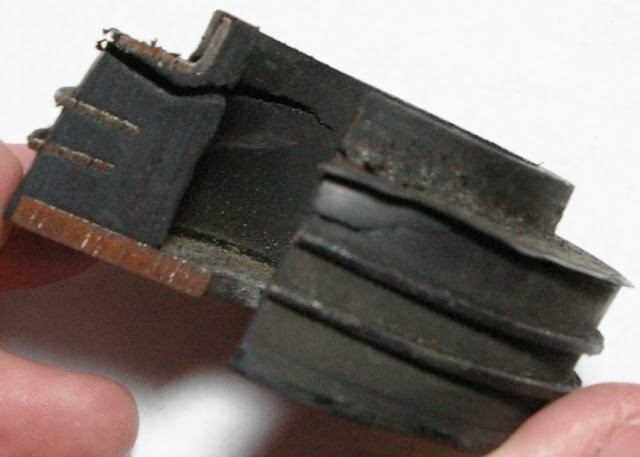
Again, just talking about my bike. That isolator sits down inside a pocket in the frame rather snugly. It's capped quite snugly with a bolted on cover. Unless it's delaminated (mine were not), I don't see how it's moving much at all. It will dampen vibration, but I just don't see it allowing the swing arm to wiggle much at all. I certainly couldn't detect play or wiggle in it mounted on the bike, or motion of the through bolt in relation to the frame when tugging on the swing arm.
HD Forum Stories
The Best of Harley-Davidson for Lifelong Riders

7 Surprising Harley-Davidson Products that Are Not Motorcycles
Verdad Gallardo
8 Best Harley-Davidson Motorcycles Ever
Pouria Savadkouei
10 Worst Harley-Davidson Motorcycles Ever
Pouria Savadkouei
Killer Custom's Jail Break Is The Breakout That Refused to Blend In
Verdad Gallardo
Crazy Bunderbike Build Looks Amazing, But Is It Impossible to Ride?
Verdad Gallardo
Harley-Davidson Reveals Super Cool Cafe Racer Concept
Verdad Gallardo
Engraved Rebellion: Inside Bundnerbike's Glam Rock II
Verdad Gallardo
10 Motorcycles You Should Never Buy
Joe Kucinski
10 Things Harley-Davidson Needs to Fix in 2026
Verdad Gallardo
Tourer
Joined: Aug 2011
Posts: 388
Likes: 36
From: USA
I have 1,000 miles on mine since putting in the Aurora bearings and replacing the rear tire. The difference is night and day. I have not done 80 mph sweepers yet, but it is rock solid cornering over bumpy roads at 65 and 70, that were wobble inducing before.
Outstanding HDF Member
Joined: Jan 2007
Posts: 2,598
Likes: 19
From: Naples FL / Pine TWP PA
My wobble has always been induced by 70+ MPH bump or dip in a sweeper. Talk about puckering your rear end. I did have it happen once down South on I26 with a bad section of pavement and lane change getting caught in the wind behind a big rig with my tire nearly worn out but I think that was just a case of everything coming together wrong.