




Power Vision Information Thread

Just some info on a observation I've had. I relocated my coil last week and couldn't use my stock plug wire on my #1 cylinder. So I used an old Chevy V6 wire I had laying around till I got my new wires in. I made about 3ea tuning runs, with terriable results after using the logs to make changes. The bike ran good till I made the log changes. So I went back to the begining and tried again, only with the same result. After about 2hrs of tinkering, I finally noticed that there were no hits on the #1 cylinder spark knock. There were hits on #2. So I'm thinking that the knock sensor wasn't working because of the wrong type plug wire (ion sensing). Now my BIG question IS will my new Taylor wires I have on order, Work?
Stellar HDF Member


Joined: Mar 2009
Posts: 2,454
Likes: 58
From: Graysville, AL
Has anyone eliminated their TBW throttle lag with the PV settings? Jamie tweeked my tune and adjusted the throttle blade settings which helped out but the lag is still there. I am ignorant on adjusting settings in the PV myself. Just curious what you adjusted and what the settings are? Thanks very much.
Tourer
Joined: Mar 2010
Posts: 383
Likes: 2
From: New Jersey
I am still having a hard time trying to pull the trigger on doing my own tune with my PV. I have read the posts on this thread and they are kinda helpful.
I think my problem is that I don't know the basics and principals of tuning to begin with.
It's kinda like a computer programmer trying to explain to a basic home computer user, how to write programming code, or an airplane mechanic trying to explain how to calibrate instruments to a plane passenger. If ya know what I mean.
I have been looking for info on the theory and basics of tuning and have found nothing noteworthy on the internet.
Dyno Jet doesn't sell books on how to tune to the general public as far as I know.
The only other thing I can think of is having to take a Dyno Tuning class from DynoJet which is totally impractical for me.
If any of you tuning guru's have any other tuning resources please feel free to chime in.
I recently found this book on Amazon.com and pre ordered it. It looks like what might help so I'm posting it for anyone else who is in my shoes.
http://www.amazon.com/gp/product/076...00_i00_details
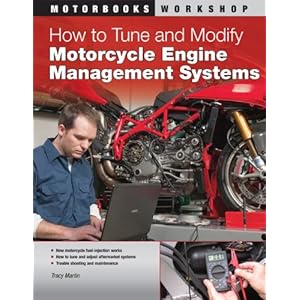
From electronic ignition to electronic fuel injection, slipper clutches to traction control, today’s motorcycles are made up of much more than an engine, frame, and two wheels. And, just as the bikes themselves have changed, so have the tools with which we tune them. How to Tune and Modify Motorcycle Engine Management Systems addresses all of a modern motorcycle’s engine-control systems and tells you how to get the most out of today’s bikes. Topics covered include:
How fuel injection works
Aftermarket fuel injection systems
Open-loop and closed-loop EFI systems
Fuel injection products and services
Tuning and troubleshooting
Getting more power from your motorcycle engine
Diagnostic tools
Electronic throttle control (ETC)
Knock control systems
Modern fuels
Interactive computer-controlled exhaust systems
I think my problem is that I don't know the basics and principals of tuning to begin with.
It's kinda like a computer programmer trying to explain to a basic home computer user, how to write programming code, or an airplane mechanic trying to explain how to calibrate instruments to a plane passenger. If ya know what I mean.
I have been looking for info on the theory and basics of tuning and have found nothing noteworthy on the internet.
Dyno Jet doesn't sell books on how to tune to the general public as far as I know.
The only other thing I can think of is having to take a Dyno Tuning class from DynoJet which is totally impractical for me.
If any of you tuning guru's have any other tuning resources please feel free to chime in.
I recently found this book on Amazon.com and pre ordered it. It looks like what might help so I'm posting it for anyone else who is in my shoes.
http://www.amazon.com/gp/product/076...00_i00_details
From electronic ignition to electronic fuel injection, slipper clutches to traction control, today’s motorcycles are made up of much more than an engine, frame, and two wheels. And, just as the bikes themselves have changed, so have the tools with which we tune them. How to Tune and Modify Motorcycle Engine Management Systems addresses all of a modern motorcycle’s engine-control systems and tells you how to get the most out of today’s bikes. Topics covered include:
How fuel injection works
Aftermarket fuel injection systems
Open-loop and closed-loop EFI systems
Fuel injection products and services
Tuning and troubleshooting
Getting more power from your motorcycle engine
Diagnostic tools
Electronic throttle control (ETC)
Knock control systems
Modern fuels
Interactive computer-controlled exhaust systems
Last edited by Jester750; Mar 19, 2012 at 09:52 AM.

Road Warrior

Joined: Aug 2005
Posts: 1,949
Likes: 288
The SERT tuner guide mentions putting all cells in a flat AFR for advanced tuning. That's what Dennis' original doc also said. At any rate, this doc is worth a reading and keep for reference. It may be for the SERT but it covers all the basics and advanced topics. There's some good info in there.
iClick, on your explanation, I think it covers it all. The only thing I think we need to solidify is the advanced tuning method. Like I mentioned above, I have 2 sources that say to use a flat AFR table to get the VEs mapped out for your engine combo. Then when finished, reset the AFR to whatever you want. Since the VEs will be accurate, it will calculate using MAP, ET, TP and VEs to try and get to the demanded AFR. I think the methodology behind going flat on the advanced tuning AFR table is for safety reasons. Invariably you tend to put the bike under heavy loads trying to hit all the cells to get the VEs set. There is a possibility to get real lean if using a table that is setup for good mileage. With it flat (at 13.2 for example) you'll be pretty well guaranteed not to get a real lean condition while tuning. I am open to correction, but that is my theory.
iClick, on your explanation, I think it covers it all. The only thing I think we need to solidify is the advanced tuning method. Like I mentioned above, I have 2 sources that say to use a flat AFR table to get the VEs mapped out for your engine combo. Then when finished, reset the AFR to whatever you want. Since the VEs will be accurate, it will calculate using MAP, ET, TP and VEs to try and get to the demanded AFR. I think the methodology behind going flat on the advanced tuning AFR table is for safety reasons. Invariably you tend to put the bike under heavy loads trying to hit all the cells to get the VEs set. There is a possibility to get real lean if using a table that is setup for good mileage. With it flat (at 13.2 for example) you'll be pretty well guaranteed not to get a real lean condition while tuning. I am open to correction, but that is my theory.
TedMan

Member
Joined: Jul 2009
Posts: 4,310
Likes: 1,079
Has anyone eliminated their TBW throttle lag with the PV settings? Jamie tweeked my tune and adjusted the throttle blade settings which helped out but the lag is still there. I am ignorant on adjusting settings in the PV myself. Just curious what you adjusted and what the settings are? Thanks very much.
You'll need to "turn on" the throttle blade function and then you can try raising all the settings to max and then try dialing back in 5-10% incrementals and see if you like a particular graduated setting for the throttle blade responsiveness.
Last edited by Heatwave; Mar 19, 2012 at 10:35 AM.
Stellar HDF Member
Joined: Mar 2009
Posts: 2,454
Likes: 58
From: Graysville, AL
I've tried making the throttle blade controls more "exact" and less "graduated" but to be honest it has generally resulted in an overly "touchy" throttle response that more often then not just feels "jerky". I ended up going back to the graduated settings of the original map. It's easy enough to try and see if you like it. You really can't cause any harm and if you don't like them just put it back to the original settings.

Thread Starter
|
Extreme HDF Member
Joined: Sep 2005
Posts: 11,615
Likes: 50
From: Baton Rouge, LA
Originally Posted by JustDennis
What you said! I agree. Once the VEs are set for your combination, then make the other changes you want or need. There is a lot of good discussion going on and a lot more folks are getting very knowledgeable about the PV. That helps us all.
I've always used the AT-100 to tune (Pro) and actually used the flat method in reverse. I created my normal tune using the AFRs I wanted to end up with, but for my cooling tune where AFRs are 13.0 across the board I took the first tune and just changed all the set AFR values to 13.0. When the rich tune is run I see very consistent Lambda readings of ~.89 in all operating areas, which is the way it should work.
I'm speaking from my experience with Pro tuning, as I haven't dealt with Basic at all, and I assume all this flat-AFR tuning discussion is only applicable to the wideband sensors (Pro). You obviously couldn't use this method with Basic since you can only tune in closed-loop, and their functional range is too narrow to work.
iClick, on your explanation, I think it covers it all. The only thing I think we need to solidify is the advanced tuning method.
Last edited by iclick; Mar 19, 2012 at 01:32 PM.
Thread Starter
|
Extreme HDF Member
Joined: Sep 2005
Posts: 11,615
Likes: 50
From: Baton Rouge, LA
I just got this explanation from Jamie that he sent someone recently:
"When using the WB Auto Tune using a single AFR value works best for most users as there are no switches in AFR over the calibration and you can watch a single AFR value on your display and in your logs which simply make it easier for reference, and because not everyone has a close map to start out with 13.2 is a pretty safe AFR to shoot for initially. Once you have the VE's syncd to a given AFR/Lambda the ECM can very accurately calculate fuel delivery if the AFR/Lambda table is then changed. If the spark tables are setup correctly you will generally have no issue going from a calibration with 13.2 and changing it to a closed loop calibration, however it should be rechecked. When I setup the final calibration for a given setup I finish up by going thru all of the tune areas, I check that the O2 integrator is working, there is no abnormal knock activity, and that the mixture is correct."
And later on after asking about VE values varying from 75-121 in my current tune...
"A VE spread is no problem, this is what the motor is telling us that it needs. On our calibrations with cams or our 107 kit it is common to have the idle area VE's in the 50's and near the high limit of 127.5 in the 3500RPM range at WOT."
"When using the WB Auto Tune using a single AFR value works best for most users as there are no switches in AFR over the calibration and you can watch a single AFR value on your display and in your logs which simply make it easier for reference, and because not everyone has a close map to start out with 13.2 is a pretty safe AFR to shoot for initially. Once you have the VE's syncd to a given AFR/Lambda the ECM can very accurately calculate fuel delivery if the AFR/Lambda table is then changed. If the spark tables are setup correctly you will generally have no issue going from a calibration with 13.2 and changing it to a closed loop calibration, however it should be rechecked. When I setup the final calibration for a given setup I finish up by going thru all of the tune areas, I check that the O2 integrator is working, there is no abnormal knock activity, and that the mixture is correct."
And later on after asking about VE values varying from 75-121 in my current tune...
"A VE spread is no problem, this is what the motor is telling us that it needs. On our calibrations with cams or our 107 kit it is common to have the idle area VE's in the 50's and near the high limit of 127.5 in the 3500RPM range at WOT."
HD Forum Stories
The Best of Harley-Davidson for Lifelong Riders

7 Times Harley-Davidson Chucked Tradition Out the Window
Verdad Gallardo
7 Surprising Harley-Davidson Products that Are Not Motorcycles
Verdad Gallardo
8 Best Harley-Davidson Motorcycles Ever
Pouria Savadkouei
10 Worst Harley-Davidson Motorcycles Ever
Pouria Savadkouei
Killer Custom's Jail Break Is The Breakout That Refused to Blend In
Verdad Gallardo
Crazy Bunderbike Build Looks Amazing, But Is It Impossible to Ride?
Verdad Gallardo
Harley-Davidson Reveals Super Cool Cafe Racer Concept
Verdad Gallardo
Engraved Rebellion: Inside Bundnerbike's Glam Rock II
Verdad Gallardo
10 Motorcycles You Should Never Buy
Joe Kucinski
Thread Starter
|
Extreme HDF Member
Joined: Sep 2005
Posts: 11,615
Likes: 50
From: Baton Rouge, LA
All this discussion of the flat-AFR method is apparently based on Pro tuning with wideband O2 sensors. With Basic you don't have the resources to dial-in most any AFR for any location in the operating range, and are locked in on .98-1.02 for tuning.

Advanced
Joined: Jan 2012
Posts: 98
Likes: 0
From: South Florida
Ok....I've run about ten logging runs now and have a tune that seems pretty good to me (but what do I know). Decent power, virtually no popping and sounds pretty good. So I saved that map as "GoodOne". Then, I did a couple more log runs and after adding them to my GoodOne as GoodOne2, the bike started popping a lot with a couple of back fires. Needless to say, I went back to my first GoodOne map. Question is, why would the tune get worse instead of better? I thought the logging runs would only improve things?
Which brings up another question, when the heck do I know I have a good tune exactly? Just by feel, or sound? How do we know we've finally hit the sweet spot for our particular ride?
Thanks for all you guys who know what you're doing!
Which brings up another question, when the heck do I know I have a good tune exactly? Just by feel, or sound? How do we know we've finally hit the sweet spot for our particular ride?
Thanks for all you guys who know what you're doing!