



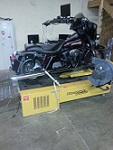

DYNO Numbers for Baggers???

I agree with everything you said. But here's my thinking. My comments about the need or lack of need for a dyno-tune starts from the premise of having a "close" map to start with. For example, in my case, with a 110", headwork, hi-lift cams (.650), 58mm TB, larger injectors, roller rockers etc., the only way to get started with tuning was to have a competent dyno-tune. There would be no other way to start with a map that was "close". Therefore auto-tuning (at least with today's software) would have just been too far a jump to make, even with WB O2 sensors.
OTOH, if you have a milder build and a map from another bike that's close in configuration, then I believe all of the available autotuning software will sharpen that existing base map as good or better than a dyno-tune can achieve.
IMO, it really comes down to how far (or close) your base operating map is from the optimal for your engine build. The closer it is to start with, the more likely the software will be to achieve "THE" optimal map.
My belief is that we're only a few years away from sensors, ECUs and software driven by ingenuity that will be able to achieve a user set "goal". After a few rides, the software will optimize the bike to achieve the "goal". Consumers will be able to set goals such as Performance without regard to fuel consumption. Optimized fuel consumption without regard to performance. Blends of both. Best performance on 89 octane fuel. Best fuel economy on 93 octane and so on.
You an change the timing on pretty much all the tuners. We were discussing the ablity of the Autotuners to make timing changes automatically.

Tourer
Joined: Apr 2007
Posts: 395
Likes: 11
From: Oklahoma
I just had my 04 FLHTCUI dyno tuned last week. SE HTCC Heads, SE HTCC 10.5:1 pistons, SE257 cams, stage II, true duals and sampson slip ons. What a difference!!! I have always just ran with the "canned map" but after the dyno, I finally found what I have been missing. I pulls like a train all the way through now. I wish I would have done that a long time ago.

Member
Joined: Jul 2009
Posts: 4,310
Likes: 1,079
That's pretty much where i'm at. As long as people are still doing motor work, there will be a demand for dyno tuning.
Pretty much where I stand on this as well. The autotune does OK on really mild (stage I) builds. In my experience, a good dyno tune can still improve on it though. again, MY OPINION from my experience.
this is true even on a starting point with a dyno tune. A BIG misconception is that a proper dyno tune should take xx amount of time. B.S., it all depends on how close of a MAP you start with. If I tune 2 identically built bikes, and use the tuned MAP from the first bike as my starting MAP for bike #2, tune time just got cut down tremendously. That's why we have all our MAPs catologed in the computer by year and build.
In a way, i hope you are right. Unfortunately, with as often as the MoCo changes their technology, it is getting harder and harder for teh aftermarket co's to keep up. As well as the dyno shops. If a person was dyno tuning back in '08 and quit and tried to get back into it today, they would basically be starting over. Things have changed that much. And it seams like ever year there is more changes, and more to learn. With todays fuel injection, a properly tuned bike should already have the best fuel economy with the best performance. Not like a crabed bike that would have to sacrifice one for the other. A new bike has the equivelant of hundreds of jets in it, from lean ones in cruising to rich ones for performance. and everything in between. I truely think the MoCo and the EPA will haev a tamperproof ECM in the future that will not be able to be written to. (At least the VE and AFR portion of the MAP.) The new Screaming Eagle Street tuner is just the start. Even PC had to develop an model (the EX) to be leagal in California. (You can't make adjustments to the Cruising area, that are under the control of the EPA). If they go to that, it would force us to do complete ECM swaps.
Pretty much where I stand on this as well. The autotune does OK on really mild (stage I) builds. In my experience, a good dyno tune can still improve on it though. again, MY OPINION from my experience.
this is true even on a starting point with a dyno tune. A BIG misconception is that a proper dyno tune should take xx amount of time. B.S., it all depends on how close of a MAP you start with. If I tune 2 identically built bikes, and use the tuned MAP from the first bike as my starting MAP for bike #2, tune time just got cut down tremendously. That's why we have all our MAPs catologed in the computer by year and build.
In a way, i hope you are right. Unfortunately, with as often as the MoCo changes their technology, it is getting harder and harder for teh aftermarket co's to keep up. As well as the dyno shops. If a person was dyno tuning back in '08 and quit and tried to get back into it today, they would basically be starting over. Things have changed that much. And it seams like ever year there is more changes, and more to learn. With todays fuel injection, a properly tuned bike should already have the best fuel economy with the best performance. Not like a crabed bike that would have to sacrifice one for the other. A new bike has the equivelant of hundreds of jets in it, from lean ones in cruising to rich ones for performance. and everything in between. I truely think the MoCo and the EPA will haev a tamperproof ECM in the future that will not be able to be written to. (At least the VE and AFR portion of the MAP.) The new Screaming Eagle Street tuner is just the start. Even PC had to develop an model (the EX) to be leagal in California. (You can't make adjustments to the Cruising area, that are under the control of the EPA). If they go to that, it would force us to do complete ECM swaps.
That's alot of jobs, companies and industries driven out of business, all for the sake of government control. God save us if that happens. Then again, we deserve it if we elect that type of socialist administration to control that level of detail in our lives.
I really don't think "they" will make the ECUs "tamperproof". If they do, they will essentially wipe out entire industries overnight. All piston, head, valve, jug, crank, injector, machine shops, service shops that upgrade engines, cam and aftermarket engine makers would be put out of business the day they lock an ECU to a bike and prevent any changes to the coding on the ECU.
That's alot of jobs, companies and industries driven out of business, all for the sake of government control. God save us if that happens. Then again, we deserve it if we elect that type of socialist administration to control that level of detail in our lives.
That's alot of jobs, companies and industries driven out of business, all for the sake of government control. God save us if that happens. Then again, we deserve it if we elect that type of socialist administration to control that level of detail in our lives.
Hopefully, but it would be big brother (EPA) mandating it. Newer emissions will force MoCo's to go leaner, that's why water cooled will be the future of HD. They have no other choice. They will not be able to go leaner without liquid cooling. I don't think a "tamperproof" ECM would put all others out of business, just slow them down a bit. Where there is a will there is a way, it would only take companies like Thundermax to make whole replacement ECM's. Like they already do. After the aftermarket companies got it all figured out they would only have to worry about MoCo changes, like when they went to TBW, or when they started using Kpa instead of TP's. And as for the last sentence of your reply, it already seams that our Govt. is getting more Socialist by the day. The more they can control Big or Small business the happy they seam to be. Actually, they seam to be happiest when they force business to go overseas or allow them to be under Govt. control. I.E. GM and Chrysler and the banks.

Seasoned HDF Member
Joined: Jul 2007
Posts: 6,336
Likes: 67
From: SW Minnesota
You guys have a real pissin' match going on here, and I for one am really enjoying it. I've learned more about tuning a Harley reading the last few pages of your posts than I could have ever learned on my own.
If either one of you (Harleytuner and Heatwave) get a chance to compare the new Cobra PowrPro to the Power Commander (and other tuners) I for one would be very interested in the results. Here's their "white paper" on this new tuner:
What follows is a pretty good overview of how this products work, and from this the following should be clear:
This unit does not have to measure air temp changes, altitude changes, load changes or the other bits of data that get tossed about in conversations. It’s concerned with the rate of acceleration and adjusting the air/fuel ratio to create the maximum power given the combination of products and environmental conditions.
It is not tuning to a preset air/fuel ratio. In fact, that air/fuel ratio read by the oxygen sensors is simply the downstream by product of the engine making the most power it can.
If a bike has oxygen sensors, we make use of those sensors to adjust cruise fuel. They are not engaged when the bike is under acceleration.
Make no mistake this is a very sophisticated product that takes fuel-injection tuning to an entirely new level.
In developing this product, we thought a truly intelligent system should be able to gather and analyze the information it needs to make adjustments as you ride with no extra equipment, no extra hassles. This was the goal of the PowrProFi2000 with CVT— Continuously Variable Tuning without the need for dynos.
You already own a highly accurate dyno—your engine’s crankshaft. We think of crankshafts as turning smoothly, but in fact when a cylinder fires, it accelerates the crankshaft slightly. Every engine has some kind of torsional shock absorberbetween crank and gearbox, which is there to accommodate this slight variation in crank speed. With the application of modern high-speed electronics, we can access this information and
time the rotation of the crank from one firing to the next, and analyze whether the next firing is slightly stronger or weaker than the previous one.
Now comes the clever part: using the measurement of how hard a cylinder accelerates the crankshaft as a way to correct fuel mixture. If the mixture is a bit lean and the CVT system adjusts it to be a bit richer at the next firing, more power will be produced and the piston will give the crank a slightly stronger kick. We can use this as a tool to move from whatever fuel mixture the engine is actually receiving,toward a more efficient mixture.
The next step is a way to time the rotations of the crank, so crank speed at one firing can be compared with crank speed at the next firing. Fortunately, bike manufacturers give us this info for free--as the time from the beginning of one fuel-injection squirt to the beginning of the next one, 720 crank degrees later. Yes, the engine’s other cylinder may be slowing the crank by being on its compression stroke, but all we need is comparative information.
We also need to experiment with fuel mixture, just as race tuners or EFI programmers do. If we make the mixture a little leaner and the next crank cycle takes a little bit longer than before, we know we¹re going the wrong way. This is just like what old time race tuners did by changing carburetor jets and then looking at the bike¹s quarter mile ET or lap time. However, in the case of the Fi2000 PowrPro, this process now occurs up to 80 times per second--it¹s literally Continuously VariableTuning.
The Fi2000 PowrPro conducts its fuel-mixture tuning by varying the mixture slightly. If the crank moves a tiny bit faster when the mixture leans out slightly, the PowrPro knows that¹s the right direction and the system leans the mixture again--or vice-versa. With a big twin cylinder engine turning
5000 rpm, one cylinder is giving us 42 of these opportunities to tune the fuel mixture every second. The result is that the Fi2000 PowrPro continuously and quickly drives fuel mixture to the value that gives best power. This process allows the system to adapt to any engine modifications you make. It¹s like going to the drag strip with a stopwatch and boxes of carburetor jets up to 80 times every second.
When this system was still in its initial planning stages, one option under consideration was to use this data to create a new conventional fuel map similar to the one programmed into the engine¹s stock EFI, and then to periodically update it. That turned out to be unnecessary because
Continuously Variable Tuning does the same job without the expense and complication of storing, updating and retrieving data to or from a fuel map.
CVT is a continuous mixture-correcting process, not a fixed set of values “in a can,” like that of the stock EFI system or previous EFI tuning systems. Instead, CVT operates continuously, detecting throttle movement that indicates significant acceleration, and there is a threshold below which it switches to one of two other modes. If the bike has an exhaust oxygen sensor, this data typically controls the mixture in steady cruise or during slow roll-ons, and the PowrPro system adjusts this to 14.2- to-1 air/fuel ratio, giving maximum-power operation. If the bike has no oxygen sensor, the system observes the range of variation of mixture over several cycles and sets the mixture to the rich end of that variation.
__________________
I tested this product as an "average Harley rider" for Phat Performance and posted results on this forum, including my dyno and video that I posted here. I am well aware of its limitations (it only adjusts fuel) but for a guy that still struggles with understanding gmail, it's plug and play simplicity was a godsend for me. I just returned from a 30 mile ride and marvel at the new found power hidden in my basicly stock TC88.
Two unanswered questions I have I hope one or both of you can tell me. On a non-ox-sensored bike, i.e., before 2007, if you do a Harley Stage One download, what A/F ratio is used in that download? The second question is, a stock TC has a redline of 5500, but the Stage One download raises that to around 6200 RPM. What is the actual safe red-line of a Harley Twin Cam?
Thank you, sincerely.
If either one of you (Harleytuner and Heatwave) get a chance to compare the new Cobra PowrPro to the Power Commander (and other tuners) I for one would be very interested in the results. Here's their "white paper" on this new tuner:
What follows is a pretty good overview of how this products work, and from this the following should be clear:
This unit does not have to measure air temp changes, altitude changes, load changes or the other bits of data that get tossed about in conversations. It’s concerned with the rate of acceleration and adjusting the air/fuel ratio to create the maximum power given the combination of products and environmental conditions.
It is not tuning to a preset air/fuel ratio. In fact, that air/fuel ratio read by the oxygen sensors is simply the downstream by product of the engine making the most power it can.
If a bike has oxygen sensors, we make use of those sensors to adjust cruise fuel. They are not engaged when the bike is under acceleration.
Make no mistake this is a very sophisticated product that takes fuel-injection tuning to an entirely new level.
In developing this product, we thought a truly intelligent system should be able to gather and analyze the information it needs to make adjustments as you ride with no extra equipment, no extra hassles. This was the goal of the PowrProFi2000 with CVT— Continuously Variable Tuning without the need for dynos.
You already own a highly accurate dyno—your engine’s crankshaft. We think of crankshafts as turning smoothly, but in fact when a cylinder fires, it accelerates the crankshaft slightly. Every engine has some kind of torsional shock absorberbetween crank and gearbox, which is there to accommodate this slight variation in crank speed. With the application of modern high-speed electronics, we can access this information and
time the rotation of the crank from one firing to the next, and analyze whether the next firing is slightly stronger or weaker than the previous one.
Now comes the clever part: using the measurement of how hard a cylinder accelerates the crankshaft as a way to correct fuel mixture. If the mixture is a bit lean and the CVT system adjusts it to be a bit richer at the next firing, more power will be produced and the piston will give the crank a slightly stronger kick. We can use this as a tool to move from whatever fuel mixture the engine is actually receiving,toward a more efficient mixture.
The next step is a way to time the rotations of the crank, so crank speed at one firing can be compared with crank speed at the next firing. Fortunately, bike manufacturers give us this info for free--as the time from the beginning of one fuel-injection squirt to the beginning of the next one, 720 crank degrees later. Yes, the engine’s other cylinder may be slowing the crank by being on its compression stroke, but all we need is comparative information.
We also need to experiment with fuel mixture, just as race tuners or EFI programmers do. If we make the mixture a little leaner and the next crank cycle takes a little bit longer than before, we know we¹re going the wrong way. This is just like what old time race tuners did by changing carburetor jets and then looking at the bike¹s quarter mile ET or lap time. However, in the case of the Fi2000 PowrPro, this process now occurs up to 80 times per second--it¹s literally Continuously VariableTuning.
The Fi2000 PowrPro conducts its fuel-mixture tuning by varying the mixture slightly. If the crank moves a tiny bit faster when the mixture leans out slightly, the PowrPro knows that¹s the right direction and the system leans the mixture again--or vice-versa. With a big twin cylinder engine turning
5000 rpm, one cylinder is giving us 42 of these opportunities to tune the fuel mixture every second. The result is that the Fi2000 PowrPro continuously and quickly drives fuel mixture to the value that gives best power. This process allows the system to adapt to any engine modifications you make. It¹s like going to the drag strip with a stopwatch and boxes of carburetor jets up to 80 times every second.
When this system was still in its initial planning stages, one option under consideration was to use this data to create a new conventional fuel map similar to the one programmed into the engine¹s stock EFI, and then to periodically update it. That turned out to be unnecessary because
Continuously Variable Tuning does the same job without the expense and complication of storing, updating and retrieving data to or from a fuel map.
CVT is a continuous mixture-correcting process, not a fixed set of values “in a can,” like that of the stock EFI system or previous EFI tuning systems. Instead, CVT operates continuously, detecting throttle movement that indicates significant acceleration, and there is a threshold below which it switches to one of two other modes. If the bike has an exhaust oxygen sensor, this data typically controls the mixture in steady cruise or during slow roll-ons, and the PowrPro system adjusts this to 14.2- to-1 air/fuel ratio, giving maximum-power operation. If the bike has no oxygen sensor, the system observes the range of variation of mixture over several cycles and sets the mixture to the rich end of that variation.
__________________
I tested this product as an "average Harley rider" for Phat Performance and posted results on this forum, including my dyno and video that I posted here. I am well aware of its limitations (it only adjusts fuel) but for a guy that still struggles with understanding gmail, it's plug and play simplicity was a godsend for me. I just returned from a 30 mile ride and marvel at the new found power hidden in my basicly stock TC88.
Two unanswered questions I have I hope one or both of you can tell me. On a non-ox-sensored bike, i.e., before 2007, if you do a Harley Stage One download, what A/F ratio is used in that download? The second question is, a stock TC has a redline of 5500, but the Stage One download raises that to around 6200 RPM. What is the actual safe red-line of a Harley Twin Cam?
Thank you, sincerely.
Member
Joined: Jul 2009
Posts: 4,310
Likes: 1,079
Hopefully, but it would be big brother (EPA) mandating it. Newer emissions will force MoCo's to go leaner, that's why water cooled will be the future of HD. They have no other choice. They will not be able to go leaner without liquid cooling. I don't think a "tamperproof" ECM would put all others out of business, just slow them down a bit. Where there is a will there is a way, it would only take companies like Thundermax to make whole replacement ECM's. Like they already do. After the aftermarket companies got it all figured out they would only have to worry about MoCo changes, like when they went to TBW, or when they started using Kpa instead of TP's. And as for the last sentence of your reply, it already seams that our Govt. is getting more Socialist by the day. The more they can control Big or Small business the happy they seam to be. Actually, they seam to be happiest when they force business to go overseas or allow them to be under Govt. control. I.E. GM and Chrysler and the banks.
Thought you might find this interesting. Of course the rumor du jour is will HD be coming out with a water-cooled engine "next year" or "the year after" or "the year after that"! Who knows? I agree that with the current administration in power, the EPA has "gone rogue" and if they could mandate we trade in our HDs for a Vespa made overseas because it pollutes less....they would.
But for the record, Harley could have had a water-cooled engine in 1976 and they were very close to launching it. I think you'll find the "NOVA" story interesting: http://www.bikerenews.com/AntiqueBikes/CodeNameNova.htm
Last edited by Heatwave; Oct 10, 2011 at 10:43 PM.
Seasoned HDF Member
Joined: Jul 2007
Posts: 6,336
Likes: 67
From: SW Minnesota
HD Forum Stories
The Best of Harley-Davidson for Lifelong Riders

7 Surprising Harley-Davidson Products that Are Not Motorcycles
Verdad Gallardo
8 Best Harley-Davidson Motorcycles Ever
Pouria Savadkouei
10 Worst Harley-Davidson Motorcycles Ever
Pouria Savadkouei
Killer Custom's Jail Break Is The Breakout That Refused to Blend In
Verdad Gallardo
Crazy Bunderbike Build Looks Amazing, But Is It Impossible to Ride?
Verdad Gallardo
Harley-Davidson Reveals Super Cool Cafe Racer Concept
Verdad Gallardo
Engraved Rebellion: Inside Bundnerbike's Glam Rock II
Verdad Gallardo
10 Motorcycles You Should Never Buy
Joe Kucinski
10 Things Harley-Davidson Needs to Fix in 2026
Verdad Gallardo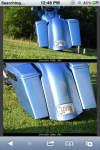
Road Warrior
Joined: Aug 2010
Posts: 1,788
Likes: 5
From: Tennessee
I just had my 04 FLHTCUI dyno tuned last week. SE HTCC Heads, SE HTCC 10.5:1 pistons, SE257 cams, stage II, true duals and sampson slip ons. What a difference!!! I have always just ran with the "canned map" but after the dyno, I finally found what I have been missing. I pulls like a train all the way through now. I wish I would have done that a long time ago.
Cruiser

Joined: Jul 2011
Posts: 130
Likes: 9
From: NorCal
The backfire you are hearing sounds like you decel enleanment need to be adjusted, it's not that hard to do. I can walk you through it it you'd like. I can PM you my phone number id it would be easier. I can't quit make out the deatails in your sheet. Up in the top right corner, you should see some letter and then smoothing, (like SAE cmoothing 5). What does your say? Kind've looks like it might be set to smoothing 3? Smoothing basically just averages between readings on the dyno and makes the lines look nicer. Some shops keep them low because they show higher numbers, but the line doesn't look as nice. If your bike runs good with the MAP that is on it (except for your backfire issues) you can download that MAP from your bike to your computer and make the changes to it. And if you'd like ot learn and tinker with it, you can do some V-tune recording runs and see how far off the tune is.