



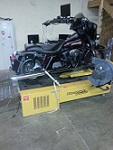

DYNO Numbers for Baggers???
Outstanding HDF Member
Joined: Oct 2007
Posts: 3,437
Likes: 15

Seems like you're always looking to pick an argument. I stated that it would be helpful to see the dyno chart results from 2-3000rpms. Obviously its at WOT but understanding whether the engine is optimized to deliver strong performance between 2000-3000rpms at WOT is just as important and I would suggest far more important that the absolute peak #s at WOT.
Being able to pass a truck on a highway (WOT from cruising speed) is a whole lot more convenient when you don't have to drop a gear or at worst, you only need to drop a single gear.
A WOT dyno chart will absolutely show the owner if the tuning has been optimized in the ranges the rider is in most often. In fact after years of reading dyno charts, I have never read one that only started at 3000 rpms...NEVER. Why a tuner would find that useful is beyond me and of no real value to the owner without the WOT performance between 2-3000. And I made no references to wanting to know the performance below 3000rpms because that's where we "cruise". In fact I didn't make any reference other than suggesting it would be good to see the performance between 2-3000rpms. And it would be, which is why every chart on this entire thread starts somewhere below 3000rpms.
Of course the dyno's posted are peak #s at WOT. But wouldn't you want to know if you bike was well tuned so that you could "whack" the throttle from a cruisng speed and not have it stumble or leave ponies on the table? A good tuner should provide the customer with charts at varying operationing levels such as cruising and WOT. And newer bikes (throttle-by-wire) will show the performance in KPa, not TP.
Any time you want to "walk back" your view about Dyno charts is fine by me, but there's no legitimate reason for deleting off the 2-3000rpm range from a peak performance dyno chart. None...which is why no one else does it!
Being able to pass a truck on a highway (WOT from cruising speed) is a whole lot more convenient when you don't have to drop a gear or at worst, you only need to drop a single gear.
A WOT dyno chart will absolutely show the owner if the tuning has been optimized in the ranges the rider is in most often. In fact after years of reading dyno charts, I have never read one that only started at 3000 rpms...NEVER. Why a tuner would find that useful is beyond me and of no real value to the owner without the WOT performance between 2-3000. And I made no references to wanting to know the performance below 3000rpms because that's where we "cruise". In fact I didn't make any reference other than suggesting it would be good to see the performance between 2-3000rpms. And it would be, which is why every chart on this entire thread starts somewhere below 3000rpms.
Of course the dyno's posted are peak #s at WOT. But wouldn't you want to know if you bike was well tuned so that you could "whack" the throttle from a cruisng speed and not have it stumble or leave ponies on the table? A good tuner should provide the customer with charts at varying operationing levels such as cruising and WOT. And newer bikes (throttle-by-wire) will show the performance in KPa, not TP.
Any time you want to "walk back" your view about Dyno charts is fine by me, but there's no legitimate reason for deleting off the 2-3000rpm range from a peak performance dyno chart. None...which is why no one else does it!
Cruiser

Joined: Jul 2011
Posts: 130
Likes: 9
From: NorCal
review my dyno tune
Scoot: 2011 Road Glide 103
At 1043 miles i got my bike dyno tuned with the Mastertune TTS with Thunderheaders 2-1 and LA Chopper air kit.
The bike pulls like a diesel throughout the range. I love the torque. For the most part i'm happy with it except there's a pop/backfire every once in a while when upshifting and or staying constant on the throttle and letting off for a split second. Looking at the chart the lines are zig zagged up/down throughout the range. What does that mean? All dyno charts i see dont look like that.
Talked with the tuner and he emailed me another map and sent me some cables but i have no clue where to begin. Anybody highly knowledgeable with the Mastertune?
At 1043 miles i got my bike dyno tuned with the Mastertune TTS with Thunderheaders 2-1 and LA Chopper air kit.
The bike pulls like a diesel throughout the range. I love the torque. For the most part i'm happy with it except there's a pop/backfire every once in a while when upshifting and or staying constant on the throttle and letting off for a split second. Looking at the chart the lines are zig zagged up/down throughout the range. What does that mean? All dyno charts i see dont look like that.
Talked with the tuner and he emailed me another map and sent me some cables but i have no clue where to begin. Anybody highly knowledgeable with the Mastertune?

Stellar HDF Member


Joined: Sep 2007
Posts: 2,459
Likes: 674
From: Vancouver Island B.C.
I stated that it would be helpful to see the dyno chart results from 2-3000rpms. Obviously its at WOT but understanding whether the engine is optimized to deliver strong performance between 2000-3000rpms at WOT is just as important and I would suggest far more important that the absolute peak #s at WOT.
Stellar HDF Member
Joined: Sep 2007
Posts: 2,459
Likes: 674
From: Vancouver Island B.C.
Just has it set on smoothing 2 instead of 5. Nothing to worry about.
Cruiser
Joined: Jul 2011
Posts: 130
Likes: 9
From: NorCal
How do i do that? Is there a tutorial on the Mastertune TTS somewhere?

Member
Joined: Jul 2009
Posts: 4,310
Likes: 1,079
You must have some pretty thin skin. I'm not the one looking to pick an arguement. I guess I misread your post the same as you misread mine. No biggie. you posted that it was more important to see a bikes performance between 2 and 3,000 RPM's, since that's where most people spend the majority riding. I took that as you were saying that the 2 - 3,000 RPM range of the dyno sheet was representing cruising. My bad.
And i've never posted one that starts at 3,000 RPM's. I start my runs at 2,000 RPM's. I have no idea why the one in question was started at 3,000. I don't see where you are thinking that a WOT runshow how good the other ranges were tuned. that makes NO sence to me. You can tune WOT all you want, that doesn't mean the rest of the TP's are tuned. It would show you what the bike would do if you were, say, cruising at a certain speed and went wide open. But most people don't go 100% to pass, they might roll to 80% or whatever. I agree that it is good to see 2000 RPM's, like I said, that's how I run them and that's how I post them.
I would agree with all this. There really isn't a chart we can post that shows cruising, we could show you TP's through the RPM range, like I said, bikes cruise at around 7 - 15% throttle position. I'll supply the sheets when customers request them, but other than the a/f printe, there's not much to look at.
Again, I don't run them starting at 3k, so I don't know why you would say this to me, but what ever trips your fancy. I really could care less about what you think, you label me as trying to start arguments, maybe you should take a long hard look at yourself before making these statments. I don't mind a good healthy debate, but I couldn't give 2 ***** about getting into a pissing match with you.
And i've never posted one that starts at 3,000 RPM's. I start my runs at 2,000 RPM's. I have no idea why the one in question was started at 3,000. I don't see where you are thinking that a WOT runshow how good the other ranges were tuned. that makes NO sence to me. You can tune WOT all you want, that doesn't mean the rest of the TP's are tuned. It would show you what the bike would do if you were, say, cruising at a certain speed and went wide open. But most people don't go 100% to pass, they might roll to 80% or whatever. I agree that it is good to see 2000 RPM's, like I said, that's how I run them and that's how I post them.
I would agree with all this. There really isn't a chart we can post that shows cruising, we could show you TP's through the RPM range, like I said, bikes cruise at around 7 - 15% throttle position. I'll supply the sheets when customers request them, but other than the a/f printe, there's not much to look at.
Again, I don't run them starting at 3k, so I don't know why you would say this to me, but what ever trips your fancy. I really could care less about what you think, you label me as trying to start arguments, maybe you should take a long hard look at yourself before making these statments. I don't mind a good healthy debate, but I couldn't give 2 ***** about getting into a pissing match with you.
I agree about the cruise charts but they are still worth it for a customer to view. Ensruring the bike has a relatively flat and lean AF (14) for the front cylinder and a slightly richer chart for the rear cylinder is good to know and probably just as important as the bragging sheet. For cruise, the only thing you're capturing is the AFR to ensure the bike will get reasonably good fuel economy but not so lean that it threatens the bike.
Last edited by Heatwave; Oct 10, 2011 at 06:07 AM.
Scoot: 2011 Road Glide 103
At 1043 miles i got my bike dyno tuned with the Mastertune TTS with Thunderheaders 2-1 and LA Chopper air kit.
The bike pulls like a diesel throughout the range. I love the torque. For the most part i'm happy with it except there's a pop/backfire every once in a while when upshifting and or staying constant on the throttle and letting off for a split second. Looking at the chart the lines are zig zagged up/down throughout the range. What does that mean? All dyno charts i see dont look like that.
Talked with the tuner and he emailed me another map and sent me some cables but i have no clue where to begin. Anybody highly knowledgeable with the Mastertune?
At 1043 miles i got my bike dyno tuned with the Mastertune TTS with Thunderheaders 2-1 and LA Chopper air kit.
The bike pulls like a diesel throughout the range. I love the torque. For the most part i'm happy with it except there's a pop/backfire every once in a while when upshifting and or staying constant on the throttle and letting off for a split second. Looking at the chart the lines are zig zagged up/down throughout the range. What does that mean? All dyno charts i see dont look like that.
Talked with the tuner and he emailed me another map and sent me some cables but i have no clue where to begin. Anybody highly knowledgeable with the Mastertune?
It's sounds like his is a decel enleanment issue to me, more so that decel popping. When he said his bike pops when he's shifting gears or when he's cruising and kust lets off the throttle. That can be taken care of bu lowering your decel enleanment.
HD Forum Stories
The Best of Harley-Davidson for Lifelong Riders

7 Surprising Harley-Davidson Products that Are Not Motorcycles
Verdad Gallardo
8 Best Harley-Davidson Motorcycles Ever
Pouria Savadkouei
10 Worst Harley-Davidson Motorcycles Ever
Pouria Savadkouei
Killer Custom's Jail Break Is The Breakout That Refused to Blend In
Verdad Gallardo
Crazy Bunderbike Build Looks Amazing, But Is It Impossible to Ride?
Verdad Gallardo
Harley-Davidson Reveals Super Cool Cafe Racer Concept
Verdad Gallardo
Engraved Rebellion: Inside Bundnerbike's Glam Rock II
Verdad Gallardo
10 Motorcycles You Should Never Buy
Joe Kucinski
10 Things Harley-Davidson Needs to Fix in 2026
Verdad Gallardo
Member
Joined: Jul 2009
Posts: 4,310
Likes: 1,079
go back and read lonewolf's post on why it was done (started at 3K). He did my throttleblade cals and unbelievable difference in throttle response. I have seen a fair amount of dyno sheets starting at 3K lately right wrong or indifferent. as far as picking an arguement hmmm...........................
I agree about the cruise charts but they are still worth it for a customer to view. Ensruring the bike has a relatively flat and lean AF (14) for the front cylinder and a slightly richer chart for the rear cylinder is good to know and probably just as important as the bragging sheet. For cruise, the only thing you're capturing is the AFR to ensure the bike will get reasonably good fuel economy but not so lean that it threatens the bike.