

DYNO Numbers for Baggers???

Stellar HDF Member


Joined: Sep 2007
Posts: 2,459
Likes: 674
From: Vancouver Island B.C.

I forgot to say which table.
I figured as much from your responce, when you said to lower the cells, I just wanted to clear in which table for him. If he would try to lower the values in teh VE tables he would be bringing on a whole new set of problems (probably decel popping).

Member
Joined: Jul 2009
Posts: 4,310
Likes: 1,079
Yeah, I agree. It's not my practice, but it's this guys business and if it works for him then so be it. Like I said, I misunderstood your original reply. Again, I was pointing out that the dyno sheet isn't showing cruising. (Apparently you know that). Alot of people don't. I havce read numerous posts from people that will look at a dyno sheet and say things like "man, you are way to rich, your fuel mileage must be terrible" and stuff like that.
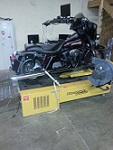
the only way to get a real accurate idea of what a bike is doing at cruising is to bring a customer into the dyno room while their bike is on it and run it at cruising speeds. When I am finished tuning a bike, I load the final MAP in and run the bike for a few miles on the dyno at all differn't speeds to verify the tune. I'll check it with differn't loads on the brake to simulate solo, 2 up and 2 up with lugguage etc. The way I set up my AFR when I am done, it gets richer as the Kpa (load) and the RPM's get higher. So if I was to do a run (say a 15% TP run) the AFR line wouldn't be flat, when you twist the grip to 20% the load (demand) goes high (so it would be richer) then the load decreases but the RPM's are going up. It wouldn't really balance out untill you let off the throttle and get to a steady speed. Kind've hard to explain. have you ever sat in on a dyno run? If you are ever up my way drop me a line and you'd be more than welcome to come in and sit in on one with me. It's quit a bit differn't than tuning with Data Runs with a vision, v-tune, smarttune etc.
the only way to get a real accurate idea of what a bike is doing at cruising is to bring a customer into the dyno room while their bike is on it and run it at cruising speeds. When I am finished tuning a bike, I load the final MAP in and run the bike for a few miles on the dyno at all differn't speeds to verify the tune. I'll check it with differn't loads on the brake to simulate solo, 2 up and 2 up with lugguage etc. The way I set up my AFR when I am done, it gets richer as the Kpa (load) and the RPM's get higher. So if I was to do a run (say a 15% TP run) the AFR line wouldn't be flat, when you twist the grip to 20% the load (demand) goes high (so it would be richer) then the load decreases but the RPM's are going up. It wouldn't really balance out untill you let off the throttle and get to a steady speed. Kind've hard to explain. have you ever sat in on a dyno run? If you are ever up my way drop me a line and you'd be more than welcome to come in and sit in on one with me. It's quit a bit differn't than tuning with Data Runs with a vision, v-tune, smarttune etc.
I've actually been in the dyno room for tuning on my last 2 bikes more than a couple times (unfortunately). 3 different shops over the years. And I absolutely agree that its far different from a data run needed to make automated tuning adjustments (Smarttune, TTS or PV). It's also very dependent on the skill of the tuner.
I could be wrong in the following view but its my opinion that dyno tuning is really just compensating for the fact that HDs have narrow-band O2 sensors. IF (and that's a big if), a bike has a fuel map that's relatively optimised for the bike's engine as a starting point, then tuning with WB sensors and the algorithyms in the latest tuning software, will generate as good if not a better tuning outcome that a dyno-tune.
So long as the owner has access and knows how to edit key performance tables such AFR, timing etc to override factory settings that are designed to save fuel and reduce pollution and instead have them optimized to deliver performance, then automated software will be able to tune a bike better than a dyno. But not unless there are WB sensors making the measurements to feed into the software.
Last edited by Heatwave; Oct 10, 2011 at 11:39 AM.
Member
Joined: Jul 2009
Posts: 4,310
Likes: 1,079
We are at the early stages but it won't be long before software will easily outdo the outcome of hrs on a dyno even in the in the hands of a talented dyno tuner.
Last edited by Heatwave; Oct 10, 2011 at 12:46 PM.
I've actually been in the dyno room for tuning on my last 2 bikes more than a couple times (unfortunately). 3 different shops over the years. And I absolutely agree that its far different from a data run needed to make automated tuning adjustments (Smarttune, TTS or PV). It's also very dependent on the skill of the tuner.
I could be wrong in the following view but its my opinion that dyno tuning is really just compensating for the fact that HDs have narrow-band O2 sensors. IF (and that's a big if), a bike has a fuel map that's relatively optimised for the bike's engine as a starting point, then tuning with WB sensors and the algorithyms in the latest tuning software, will generate as good if not a better tuning outcome that a dyno-tune.
So long as the owner has access and knows how to edit key performance tables such AFR, timing etc to override factory settings that are designed to save fuel and reduce pollution and instead have them optimized to deliver performance, then automated software will be able to tune a bike better than a dyno. But not unless there are WB sensors making the measurements to feed into the software.
I could be wrong in the following view but its my opinion that dyno tuning is really just compensating for the fact that HDs have narrow-band O2 sensors. IF (and that's a big if), a bike has a fuel map that's relatively optimised for the bike's engine as a starting point, then tuning with WB sensors and the algorithyms in the latest tuning software, will generate as good if not a better tuning outcome that a dyno-tune.
So long as the owner has access and knows how to edit key performance tables such AFR, timing etc to override factory settings that are designed to save fuel and reduce pollution and instead have them optimized to deliver performance, then automated software will be able to tune a bike better than a dyno. But not unless there are WB sensors making the measurements to feed into the software.
This is all my experience and my opinion. But when I tune a bike I set the whole air fuel MAP to 13.0:1, then I do my data runs (TP pulls, or on newer bike, MAP load pulls). Then I calibrate the VE tables to meet my 13.0:1 goal. When I am satified with my results, and the tune is complete, I will then set the AFR tables to where I want them. I.E. a little leaner in cruiing, richer as the demand and the RPM's get higher yadda yadda yadda. The scope of the factory NB sensors is limited, so IMO the tune is very important. Since the autotune systems use wide band o2 sensors, the have the ability to read a larger range, BUT, they are still at the mercy of placement and other variables. It is my experience (I can't speak for any other tuners), but my experience that they get somewhat close, but not always optimal. I have cleaned up more than one tune on more than 1 bike that has been "autotuned". Even if you call DynoJets tech support, they will recomend that you have the bike dyno tuned before running the autotune. The autotune is good for keeping a bike somewhat close to tune after it's been properly tuned. It will halp with differn't grades/ qualities of fuel, and make adjustments as your air filter gets dirty, etc. One of the big drawbacks (again, my opinion) with the autotune is when they are set up to allow them to make too big of an adjustments. lie if you leave them set to make a 20% adjustment. They might make a correction for a problem you didn't know you had. Say an intake seal leak, the autotune might correct beyond the leak, and the user might not know that he has a problem. I beleive that the term "autotune" can be very misleading. Not to mention that if the MAP you start with isn't pretty close to begin with, how many miles are you riding with your bike, potentially, way out of tune while you are doing data runs? Autotuners don't have the capability, yet, to make any ignition timing adjustments. Hopefully in the future they will.
Again, it has never been MY experience that any software has tuned better than what I cando on the dyno. I'd even go so far as to say autotune untill your hearts content, bring me the bike. Save your autotuned MAP and let me tune it my way, if it's not better when you leave i'll put your autotuned MAP back in and I would eat the cost of the dyno tune.
I absolutely agree with you on Carb bikes. No other way than dyno-tuning. But with an FI bike you're essentially dyno-tuning by using the bike's ECM to collect real-world data from riding the bike and then having software modify the data from those runs to make improvements that better meet the desired objectives of AFR , spark etc.
We are at the early stages but it won't be long before software will easily outdo the outcome of hrs on a dyno even in the in the hands of a talented dyno tuner.
We are at the early stages but it won't be long before software will easily outdo the outcome of hrs on a dyno even in the in the hands of a talented dyno tuner.
Member
Joined: Jul 2009
Posts: 4,310
Likes: 1,079
This is all my experience and my opinion. But when I tune a bike I set the whole air fuel MAP to 13.0:1, then I do my data runs (TP pulls, or on newer bike, MAP load pulls). Then I calibrate the VE tables to meet my 13.0:1 goal. When I am satified with my results, and the tune is complete, I will then set the AFR tables to where I want them. I.E. a little leaner in cruiing, richer as the demand and the RPM's get higher yadda yadda yadda. The scope of the factory NB sensors is limited, so IMO the tune is very important. Since the autotune systems use wide band o2 sensors, the have the ability to read a larger range, BUT, they are still at the mercy of placement and other variables. It is my experience (I can't speak for any other tuners), but my experience that they get somewhat close, but not always optimal. I have cleaned up more than one tune on more than 1 bike that has been "autotuned". Even if you call DynoJets tech support, they will recomend that you have the bike dyno tuned before running the autotune. The autotune is good for keeping a bike somewhat close to tune after it's been properly tuned. It will halp with differn't grades/ qualities of fuel, and make adjustments as your air filter gets dirty, etc. One of the big drawbacks (again, my opinion) with the autotune is when they are set up to allow them to make too big of an adjustments. lie if you leave them set to make a 20% adjustment. They might make a correction for a problem you didn't know you had. Say an intake seal leak, the autotune might correct beyond the leak, and the user might not know that he has a problem. I beleive that the term "autotune" can be very misleading. Not to mention that if the MAP you start with isn't pretty close to begin with, how many miles are you riding with your bike, potentially, way out of tune while you are doing data runs? Autotuners don't have the capability, yet, to make any ignition timing adjustments. Hopefully in the future they will.
Again, it has never been MY experience that any software has tuned better than what I cando on the dyno. I'd even go so far as to say autotune untill your hearts content, bring me the bike. Save your autotuned MAP and let me tune it my way, if it's not better when you leave i'll put your autotuned MAP back in and I would eat the cost of the dyno tune.
Again, it has never been MY experience that any software has tuned better than what I cando on the dyno. I'd even go so far as to say autotune untill your hearts content, bring me the bike. Save your autotuned MAP and let me tune it my way, if it's not better when you leave i'll put your autotuned MAP back in and I would eat the cost of the dyno tune.
I agree with everything you said. But here's my thinking. My comments about the need or lack of need for a dyno-tune starts from the premise of having a "close" map to start with. For example, in my case, with a 110", headwork, hi-lift cams (.650), 58mm TB, larger injectors, roller rockers etc., the only way to get started with tuning was to have a competent dyno-tune. There would be no other way to start with a map that was "close". Therefore auto-tuning (at least with today's software) would have just been too far a jump to make, even with WB O2 sensors.
OTOH, if you have a milder build and a map from another bike that's close in configuration, then I believe all of the available autotuning software will sharpen that existing base map as good or better than a dyno-tune can achieve.
IMO, it really comes down to how far (or close) your base operating map is from the optimal for your engine build. The closer it is to start with, the more likely the software will be to achieve "THE" optimal map.
Even a well done dyno-tune map can be improved upon by auto-tuning with WB sensors, but the opposite is not true. A base map that is far off the mark from optimal will be better off getting a dyno tune since the software is unlikely to be able to accomodate the many variables that need to be adjusted.
My belief is that we're only a few years away from sensors, ECUs and software driven by ingenuity that will be able to achieve a user set "goal". After a few rides, the software will optimize the bike to achieve the "goal". Consumers will be able to set goals such as Performance without regard to fuel consumption. Optimized fuel consumption without regard to performance. Blends of both. Best performance on 89 octane fuel. Best fuel economy on 93 octane and so on.
Trying to achieve these customers goals will simply be too costly, inconvenient and too "hard" on customer's bikes through dyno-tuning.
Devices like the PV and software like TTS and SEPST are in their infancy. New devices will hit the market and the one's currently available will surely improve. As they do, I believe dyno's will become useful only for tuning non-computerized engines or very exotic engines.
Last edited by Heatwave; Oct 10, 2011 at 03:18 PM.
HD Forum Stories
The Best of Harley-Davidson for Lifelong Riders

7 Surprising Harley-Davidson Products that Are Not Motorcycles
Verdad Gallardo
8 Best Harley-Davidson Motorcycles Ever
Pouria Savadkouei
10 Worst Harley-Davidson Motorcycles Ever
Pouria Savadkouei
Killer Custom's Jail Break Is The Breakout That Refused to Blend In
Verdad Gallardo
Crazy Bunderbike Build Looks Amazing, But Is It Impossible to Ride?
Verdad Gallardo
Harley-Davidson Reveals Super Cool Cafe Racer Concept
Verdad Gallardo
Engraved Rebellion: Inside Bundnerbike's Glam Rock II
Verdad Gallardo
10 Motorcycles You Should Never Buy
Joe Kucinski
10 Things Harley-Davidson Needs to Fix in 2026
Verdad Gallardo
Member
Joined: Jul 2009
Posts: 4,310
Likes: 1,079
I beleive you are talking about autotune using the bikes ECM to collect real world data? Correct? If so, it's only using airfuel data to make adjustments. Not spark timing or anything else. Autotune might be fine for stage I builds that can get away with using the factory timing setings, but when you start getting into differn't cams then IMO the autotune lacks. Maybe someday they will get it to control ignition timing etc. But I don't know of any that do so just yet. I'm sure they are working on it. Maybe someday
Last edited by Heatwave; Oct 10, 2011 at 03:57 PM.

Elite HDF Member
Joined: Nov 2006
Posts: 3,909
Likes: 6
From: Livingston, Texas
Don't claim to be a Dyno Tuner, but with the Thunder-Max you can change the timing,
I would want it to be on a dyno and watch to see if changing the timing did anything.
A adverage person like me jackin with timing can burn a bike up.
I would want it to be on a dyno and watch to see if changing the timing did anything.
A adverage person like me jackin with timing can burn a bike up.