




Bagger wobble exposed!
Stellar HDF Member
Joined: Jan 2013
Posts: 2,721
Likes: 103
From: St. Louis, MO

I don't know the science, but I can say for sure, when I installed a Tru-Track stabilizer on my 95 Road King it tightened up the handling of the bike a lot...it was wonderful. Like installing a rear stabilizer bar on a car that doesn't have one, it made the handling that much better and was a cheap price for the satisfaction it gave me.

Thread Starter
|
Club Member


Joined: Jun 2007
Posts: 45,429
Likes: 2,897
From: Bedford UK

Joe, the science is explained in post #1, which is why this thread started out life. Recent discussion is a distraction......
Last edited by grbrown; Aug 20, 2014 at 09:02 AM.
Stellar HDF Member
Joined: Jan 2013
Posts: 2,721
Likes: 103
From: St. Louis, MO
Yea, I was thinking along those lines and wanted to offer my practical thoughts on the matter...the brace works and makes the bike handle a lot better. It's a wonderful mod, one of the best bang for the buck mods I have put on a bike.

Banned
Joined: Apr 2014
Posts: 678
Likes: 1
From: LA
It still amazes me to think half of the bike's weight and almost all of of the rider and passenger sits on that inner washer and is held by four bolts ... and an up to 103 ci engine dances on top of it. I'll admit it must have taken a lot of confidence, or some very definite engineering calculations to design. But I find the bike feels so uncertain at 80 mph + that I just don't go there.
BTW, just to add to this conversation if I have not said so already. After about a year or 8,000 miles, I check the Heim/Rose joint on the Progressive stabilizer and found it to be very worn ... I'm talking about 1mm or so wobble. Therefore, if you have one, don't presume that that is it and it is fixed forever. The joints are consumables.
Progressive uses normal 'hard' rod end bearings (Teflon?), without any facilites to lubricate them, unlike the limited travel and sealed rubber joints that H-D uses for the engine mounts. I don't know what they are called nor where they come from but they are different. I presume H-D uses them because they don't need maintenance. Or do they absorb micro-vibrations?
I've replaced mine with a heavy duty set from a company that specializes in racing automobiles. They are cheap enough to do so. I have no idea if they will make a difference.
And, guys, you can buy them anodised in black too ...
Interestingly, they are now making rod end bearings in plastics - or combined steel and plastic - which are said to absorb vibrations and outlast metal ones, however, I have not studied up on their relative load capacities as I write this, so I am unable to comment intelligently about them (web says tensile loads of up to 15kN/3372lbf ?). This might be worth looking into as they are corrosion free ... technology outstripping our relics from an industrial age?
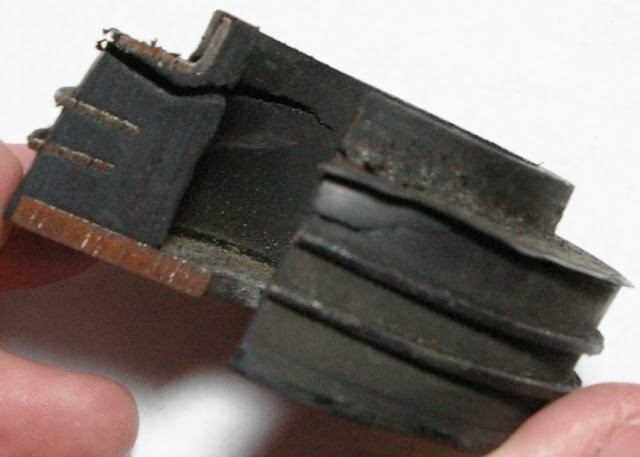
As I ride in the wet and winter, I put rubber boots on mine. Although I have been warned they degrade fairly quickly due to UV. Not a lot of sunlight and UV under an H-D transmission, methinks.
Thread Starter
|
Club Member
Joined: Jun 2007
Posts: 45,429
Likes: 2,897
From: Bedford UK
DR, we have at least one HDF member who is successfully running a 155" engine in his ole bagger, with complete success, from what I can make out! As I said in my opening post, this is an elegant and sound design, in principle. Those reinforced rear rubber mounts are what holds the rear end together, along with the sandwich of supporting components. As for speed, my ole lady has been close to the ton, fully laden - on German autobahns of course guv!
As for your Progressive link, the action of that is off-set from the centre-line of the bike, unlike the other two on your bike; it is also shorter. The beauty of the True-Track is that it is true to the original concept, uses equal length links and the engine end of each is on the vehicle's central plane, where they kinematically belong.
As for your Progressive link, the action of that is off-set from the centre-line of the bike, unlike the other two on your bike; it is also shorter. The beauty of the True-Track is that it is true to the original concept, uses equal length links and the engine end of each is on the vehicle's central plane, where they kinematically belong.
Seasoned HDF Member


Joined: Sep 2008
Posts: 14,068
Likes: 11,086
From: San Diego, CA
True "track" enough.....!

I totally agree, but sorry, I'm not an engineer, that's all I got to add....


Tourer
Joined: Apr 2014
Posts: 288
Likes: 3
From: UK
I must admit I could never figure out how they managed to patent it, after all the system already exists and was patented by Buell. Judging by the number of similar systems out there I guess its not a robust patent, maybe just for marketing purposes.
Thread Starter
|
Club Member
Joined: Jun 2007
Posts: 45,429
Likes: 2,897
From: Bedford UK

I agree that the T-T patent seems odd, following in the footsteps of the original Harley ones, however there is only one variety of patent and they have one, so they have a proper 'robust' one! All patents have a limited lifespan of just a few years, they don't last forever, so the protection it provides will evaporate before too long. If they have the funds and inclination, they could close down some of the copies, IMHO.
HD Forum Stories
The Best of Harley-Davidson for Lifelong Riders

8 Best Harley-Davidson Motorcycles Ever
Pouria Savadkouei
10 Worst Harley-Davidson Motorcycles Ever
Pouria Savadkouei
Killer Custom's Jail Break Is The Breakout That Refused to Blend In
Verdad Gallardo
Crazy Bunderbike Build Looks Amazing, But Is It Impossible to Ride?
Verdad Gallardo
Harley-Davidson Reveals Super Cool Cafe Racer Concept
Verdad Gallardo
Engraved Rebellion: Inside Bundnerbike's Glam Rock II
Verdad Gallardo
10 Motorcycles You Should Never Buy
Joe Kucinski
10 Things Harley-Davidson Needs to Fix in 2026
Verdad Gallardo
Southpaw Super Glide: A Left-Hand-Drive 1979 Harley FXE Built to Fit the Rider
Verdad Gallardo
Banned
Joined: Apr 2014
Posts: 678
Likes: 1
From: LA
I appreciate why True-Track is bolt on ... but presumably I could get the same effect by welding a bracket onto the center of the cross plate and mounting it to there?
Anything I would have to look out for ... a longer rod end bearing set ... ground clearance? Has to be doable.
Sadly, the previous owner of my bike was a cheapskate who went for a Progressive.
Anything I would have to look out for ... a longer rod end bearing set ... ground clearance? Has to be doable.
Sadly, the previous owner of my bike was a cheapskate who went for a Progressive.

Outstanding HDF Member
Joined: Jan 2010
Posts: 2,916
Likes: 31
From: earth
I appreciate why True-Track is bolt on ... but presumably I could get the same effect by welding a bracket onto the center of the cross plate and mounting it to there?
Anything I would have to look out for ... a longer rod end bearing set ... ground clearance? Has to be doable.
Sadly, the previous owner of my bike was a cheapskate who went for a Progressive.
Anything I would have to look out for ... a longer rod end bearing set ... ground clearance? Has to be doable.
Sadly, the previous owner of my bike was a cheapskate who went for a Progressive.