




Power Vision Information Thread
Outstanding HDF Member


Joined: Aug 2009
Posts: 2,858
Likes: 217
From: Puyallup Wa.

You can find one just about anywhere google "ram mounts" and or "Tech mounts" on line you will see motorcycle mounts. Its a standard "Amps hole pattern" I made mine out of bearing split collar and a piece of scrap metal at work. But I am going to change to this set up. Scroll down towards bottom of page you will see tech mount and quick release visor.
http://www.dynojet.com/Powervision/p...cessories.aspx
I have been wanting something that I can more easily remove from bike so thats what I am looking at.
It is only the value for 2500 rpm. Example, if you have 14.6 (closed loop) at 2500 and 14.3 at 2750 the bike will not be in closed loop at 2501. A quick test is to leave the afr table in open loop above 2500 and collect some some data. You should see no ve corrections above 2500. This only applies if you are using the narrow bands. Looking at the timing table data just makes the interpolation easier to see. If you have 32 at 2500 and 36 at 2750 you will see 34 at 2625, 33 at 2562. The reference to the CDE adjustments is that the ve tables also interpolate between cells. The closer the values in the cells the more accurate the interpolated value.
__________________

Jamie Long / Fuel Moto USA
The USA's Leader V-Twin EFI & Performance www.fuelmotousa.com
Contact 920-423-3309
Email jamie@fuelmotousa.com
Jamie Long / Fuel Moto USA
The USA's Leader V-Twin EFI & Performance www.fuelmotousa.com
Contact 920-423-3309
Email jamie@fuelmotousa.com

Cruiser
Joined: Aug 2011
Posts: 229
Likes: 11
From: East Iowa
This TechMount available from FuelMoto is a bit spendy, but it works slick as hell.
I have not found a need for a visor yet, with the angle adjusted correctly the only time seeing the PV screen is an issue is when the sun is low and directly behind you, in which case the visor wouldn't work anyway.
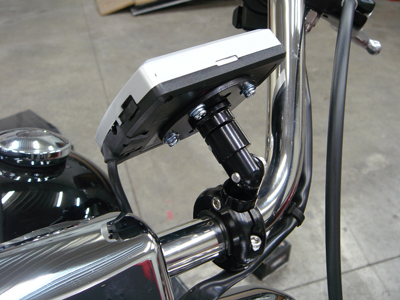
I have not found a need for a visor yet, with the angle adjusted correctly the only time seeing the PV screen is an issue is when the sun is low and directly behind you, in which case the visor wouldn't work anyway.

Road Warrior


Joined: Nov 2011
Posts: 1,397
Likes: 403
From: Australia
I will never mount long term, so i didnt see the need for a $$$ chrome mount.
I got this off ebay: http://www.ebay.com.au/itm/Arkon-GN0...item53e9f0d09d
US $12.95
works perfectly for my needs.
Cruiser
Joined: Jul 2008
Posts: 207
Likes: 0
From: Illinois
Like the Idea of PV, Want to Set and Forget!!
I purchased a CVO Breakout about a month ago and I want the best tune possible without going to the shop to pay dyno guy a bunch of $$, if a unit I can put in/use will do the job just as well (current set up will be entirely stock with some Rush 2" baffle slip ons, but will want to get Vance and Hines 2 into 1 big radius at some point). But that is the question of course. I had a PCV on my 05 Deluxe for 3 years and loved it-used the map put in by Fuel Moto and it seemed to run great (Jamie at Fuel Moto did say that the PCV unit probably wouldn't work for my Breakout due to the small amount of space under the seat, but my local Indy guy said he has installed many of them behind the rear fender). I like the idea of having a device that will allow me to adjust settings as I mod the bike. That being said, I don't understand anything about the "settings"- all those tables and values look like Japanese to me, I suppose I could learn, but I really don't want to if I don't have to. I just want a pre-made map installed and ride. So, my question is basically should I go with a Power Vision, PCV, or something else, trying to get the most bang for the buck at the same time? I do like the ability to gain an extra license to tune another bike- wouldn't mind adjusting my wife's just a bit (has screaming eagle slip ons and everything else is stock). Looking for any recommendations. Thanks.

Cruiser
Joined: Jun 2006
Posts: 129
Likes: 0
From: Houston, Texas
I purchased a CVO Breakout about a month ago and I want the best tune possible without going to the shop to pay dyno guy a bunch of $$, if a unit I can put in/use will do the job just as well (current set up will be entirely stock with some Rush 2" baffle slip ons, but will want to get Vance and Hines 2 into 1 big radius at some point). But that is the question of course. I had a PCV on my 05 Deluxe for 3 years and loved it-used the map put in by Fuel Moto and it seemed to run great (Jamie at Fuel Moto did say that the PCV unit probably wouldn't work for my Breakout due to the small amount of space under the seat, but my local Indy guy said he has installed many of them behind the rear fender). I like the idea of having a device that will allow me to adjust settings as I mod the bike. That being said, I don't understand anything about the "settings"- all those tables and values look like Japanese to me, I suppose I could learn, but I really don't want to if I don't have to. I just want a pre-made map installed and ride. So, my question is basically should I go with a Power Vision, PCV, or something else, trying to get the most bang for the buck at the same time? I do like the ability to gain an extra license to tune another bike- wouldn't mind adjusting my wife's just a bit (has screaming eagle slip ons and everything else is stock). Looking for any recommendations. Thanks.
Outstanding HDF Member
Joined: Apr 2009
Posts: 2,582
Likes: 2
From: Central Jersey
I have read many post here... I may have just overlooked what Im looking for. Can someone explain how to setup the gauges? I would like to view engine temp, rpm, speed, gear indicator or any of the ones you all suggest to view. Is there a step by step instructions somewhere? Thanks for any help.
HD Forum Stories
The Best of Harley-Davidson for Lifelong Riders

7 Times Harley-Davidson Chucked Tradition Out the Window
Verdad Gallardo
7 Surprising Harley-Davidson Products that Are Not Motorcycles
Verdad Gallardo
8 Best Harley-Davidson Motorcycles Ever
Pouria Savadkouei
10 Worst Harley-Davidson Motorcycles Ever
Pouria Savadkouei
Killer Custom's Jail Break Is The Breakout That Refused to Blend In
Verdad Gallardo
Crazy Bunderbike Build Looks Amazing, But Is It Impossible to Ride?
Verdad Gallardo
Harley-Davidson Reveals Super Cool Cafe Racer Concept
Verdad Gallardo
Engraved Rebellion: Inside Bundnerbike's Glam Rock II
Verdad Gallardo
10 Motorcycles You Should Never Buy
Joe Kucinski
Road Captain
Joined: Nov 2012
Posts: 569
Likes: 0
From: USA
interpolation is between fixed values. at 2500 if you have say 14.6 then that is what it is. if at 2250 you have 13.6 the difference of 1.0 is stepped (interpolated) between the two vertically. of course it goes beyond that because the Map is also stepped ie: 20 to 30 another change of 10.
if at 2500, 20 map AFR is 14 and 2500, 30 map is 15.0 another adjustment. At 2500 & map 25, AFR would be 14.5 for instance.
at 2350 rpm, 22.56 map, AFR would be ...... ? so you set 3000 at closed say 14.6 and the next line 3500? to 14 it will interpolate 0.6 and you could still be closed loop at 3200 at 14.4~
if at 2500, 20 map AFR is 14 and 2500, 30 map is 15.0 another adjustment. At 2500 & map 25, AFR would be 14.5 for instance.
at 2350 rpm, 22.56 map, AFR would be ...... ? so you set 3000 at closed say 14.6 and the next line 3500? to 14 it will interpolate 0.6 and you could still be closed loop at 3200 at 14.4~