




Power Vision Information Thread

Road Warrior


Joined: Jan 2008
Posts: 1,549
Likes: 18
From: Upstate SC

Steve is going to hype his product and does, but I still don't see how you can tune beyond the closed-loop area when there is no feedback (sampling). It just seems like smoke and mirrors, and any efforts along those lines would appear to be guesswork. There's nothing wrong with that as long as it is represented as such, not as a way to get a truly accurate tune. With the AT-100 Basic, using the same stock sensors, it is represented as a way to tune 2/3 of the range, which is realistic, and at least the PV has the Pro version that can sample throughout the operating range. Just my 2¢.
Have you run tuning logs with both the Autotune wideband sensors and the stock O2 sensors? The Vision tuning manual leads me to believe the narrow band stock O2 sensors tune at idle and low load and the wideband at higher loads.... quoting
"*Special Feature*
Log Tuner Pro can also use the factory narrow band sensors to create the corrections needed to properly calibrate your ECM at idle and light load ranges; then utilizes the Dynojet Auto Tune module that uses wide band oxygen sensors to tune for best power and torque. Since Auto Tune Pro can use data that’s natively on board and Dynojet wideband technology you get the best of both features."
I was wondering if you should tune with one the the other?
A question or two about closed loop Bias values.
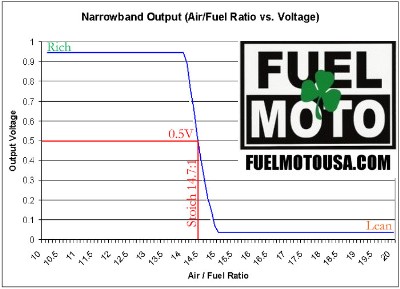
Jamie, you are currently setting the bias in closed loop to 700mv. The works out to an AFR of: 14.63 assuming 14.6 on the AFR map is really 14.68. On another map I have (TC96) you have the the bias voltage set to 778 which works out to 14.45, assuming the AFR 14.6 is really 14.68. So my question is can I increase the bias voltage a bit more to get the running temperature down some. Currently sitting in traffic, stop and go I'm building a lot of heat fairly quick. With an out side air temp of about 72F, five minutes at a stop light yielded an engine temp of 302. I'm thinking on a hot day this is going to be a bugger. Also my running temp down the Interstate is running between 260 and 280F.
Jamie, you are currently setting the bias in closed loop to 700mv. The works out to an AFR of: 14.63 assuming 14.6 on the AFR map is really 14.68. On another map I have (TC96) you have the the bias voltage set to 778 which works out to 14.45, assuming the AFR 14.6 is really 14.68. So my question is can I increase the bias voltage a bit more to get the running temperature down some. Currently sitting in traffic, stop and go I'm building a lot of heat fairly quick. With an out side air temp of about 72F, five minutes at a stop light yielded an engine temp of 302. I'm thinking on a hot day this is going to be a bugger. Also my running temp down the Interstate is running between 260 and 280F.
Here is a chart that may help
__________________

Jamie Long / Fuel Moto USA
The USA's Leader V-Twin EFI & Performance www.fuelmotousa.com
Contact 920-423-3309
Email jamie@fuelmotousa.com
Jamie Long / Fuel Moto USA
The USA's Leader V-Twin EFI & Performance www.fuelmotousa.com
Contact 920-423-3309
Email jamie@fuelmotousa.com
iclick
Have you run tuning logs with both the Autotune wideband sensors and the stock O2 sensors? The Vision tuning manual leads me to believe the narrow band stock O2 sensors tune at idle and low load and the wideband at higher loads.... quoting
"*Special Feature*
Log Tuner Pro can also use the factory narrow band sensors to create the corrections needed to properly calibrate your ECM at idle and light load ranges; then utilizes the Dynojet Auto Tune module that uses wide band oxygen sensors to tune for best power and torque. Since Auto Tune Pro can use data that’s natively on board and Dynojet wideband technology you get the best of both features."
I was wondering if you should tune with one the the other?
Have you run tuning logs with both the Autotune wideband sensors and the stock O2 sensors? The Vision tuning manual leads me to believe the narrow band stock O2 sensors tune at idle and low load and the wideband at higher loads.... quoting
"*Special Feature*
Log Tuner Pro can also use the factory narrow band sensors to create the corrections needed to properly calibrate your ECM at idle and light load ranges; then utilizes the Dynojet Auto Tune module that uses wide band oxygen sensors to tune for best power and torque. Since Auto Tune Pro can use data that’s natively on board and Dynojet wideband technology you get the best of both features."
I was wondering if you should tune with one the the other?

Outstanding HDF Member
Joined: Jan 2007
Posts: 2,598
Likes: 19
From: Naples FL / Pine TWP PA
The bias tables in most OE calibrations are in the 400-550 range however we generally like to see them in the 700-780 range. Increasing the closed loop bias values will richen the mixture by setting the voltage the ECM looks for as it toggles from rich/lean as the O2 integrator rolls. On Lambda based calibrations you control this directly
Here is a chart that may help
Here is a chart that may help

Stellar HDF Member


Joined: Sep 2007
Posts: 2,467
Likes: 677
From: Vancouver Island B.C.
With the setting of 798 you will have to watch for sensor degradation. As the sensor wears the operating window becomes narrower. Another option is once your ve's are calibrated you can pull your idle area out of closed loop and run a little richer afr.
Outstanding HDF Member
Joined: Jan 2007
Posts: 2,598
Likes: 19
From: Naples FL / Pine TWP PA
My understanding is up to 800 is safe for sensor degradation. The Vtune maxes out at 798. However I think you are correct, pulling idle out of closed loop is probably the best idea.
Advanced
Joined: May 2010
Posts: 73
Likes: 0
From: Alberta, Canada
You do not need to reset the fuel trims as PV Log Tuner is using data that is already being used natively by the ECM to correct the VE tables during normal closed loop operation. When using this application you are essentially applying the corrections that the ECM has learned and stored, but rather than store them in the background as adaptive fuel values it is applying them directly to your VE table. This will allow the O2 integrator to roll more efficiently and since the system constantly switches from lean/rich it will deliver a more accurate mixture
I ran the tune a number of times and only during the first two runs had any adjustments and these were to spark advance table for the front cylinder. 3 more runs did not make any changes. I did start with the tune provided by Fuelmoto and have been pleased with the results so far. I will give the PV a better test as I am off on a 4000 km trip to South Dakota and back. Yahoo can't wait.

6th Gear
Joined: Apr 2011
Posts: 10
Likes: 1
From: Rapid City, SD
I think I am messing up
I keep running new log file and then doing the calculation and My VE tables keep getting smaller and smaller I am under the stock settings in allot of the rows. In fact I am down to a 66 at 1000 RPM and 35 KPA Stock was 74.
This is for the front Cyl.
It just don't seem right?
This is for the front Cyl.
It just don't seem right?
HD Forum Stories
The Best of Harley-Davidson for Lifelong Riders

6 Weirdest Harley-Davidsons Ever Sold to the Public
Verdad Gallardo
7 Times Harley-Davidson Chucked Tradition Out the Window
Verdad Gallardo
7 Surprising Harley-Davidson Products that Are Not Motorcycles
Verdad Gallardo
8 Best Harley-Davidson Motorcycles Ever
Pouria Savadkouei
10 Worst Harley-Davidson Motorcycles Ever
Pouria Savadkouei
Killer Custom's Jail Break Is The Breakout That Refused to Blend In
Verdad Gallardo
Crazy Bunderbike Build Looks Amazing, But Is It Impossible to Ride?
Verdad Gallardo
Harley-Davidson Reveals Super Cool Cafe Racer Concept
Verdad Gallardo
Engraved Rebellion: Inside Bundnerbike's Glam Rock II
Verdad Gallardo
Outstanding HDF Member
Joined: Jan 2007
Posts: 2,598
Likes: 19
From: Naples FL / Pine TWP PA
I keep running new log file and then doing the calculation and My VE tables keep getting smaller and smaller I am under the stock settings in allot of the rows. In fact I am down to a 66 at 1000 RPM and 35 KPA Stock was 74.
This is for the front Cyl.
It just don't seem right?
This is for the front Cyl.
It just don't seem right?
Last edited by FX4; Jun 2, 2011 at 10:24 PM.
6th Gear
Joined: Apr 2011
Posts: 10
Likes: 1
From: Rapid City, SD
Well I thought with the SE/Air Cleaner and the S & S Power Duals. With the S & S SPO Mufflers that the Air flow would be more. I did 10 runs tonight and the just keep getting lower and lower. I just think it is strange that some fields are less than stock.