


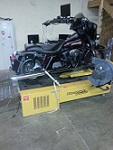


"DYNO" Numbers For SOFTAILS

Torque is figured from a mathematical formula using HP and RPM's. The torque and HP should cross at 5250 RPM's, meaning you will always have the same HP number and torque number at 5250 RPM's. Since your sheet was printed out of scale your torque line is skewed. Just have him print it correctly and it will be good for comparison. If your not worried about it just let it go, it won't change anything it will just be more accurate. If you do have him change it ask him to go ahead and print it in SAE correction and not in STD. SAE is the standard correction factor used in the US. Alot of tuners like to print in STD because it shows slightly higher numbers than SAE. But like I said, SAE is the industry standard. SAE (society of automotive engineeres) corrects the atmoshperic run conditions (mathematically) to 29.23 InHg (99 kPa) of dry air and 77 F (25°C) whereas STD corrects the atmoshperic conditions to 29.92 InHg (103.3 kPa) of dry air and 60 F (15.5°C). Basically the system was developed so a person could compare HP in one area (say New York) to the HP a run in another area (Say Arizona).

Thread Starter
|
Club Member


Joined: May 2007
Posts: 145,895
Likes: 821
From: 40 miles Northeast of Indy..
Torque is figured from a mathematical formula using HP and RPM's. The torque and HP should cross at 5250 RPM's, meaning you will always have the same HP number and torque number at 5250 RPM's. Since your sheet was printed out of scale your torque line is skewed. Just have him print it correctly and it will be good for comparison. If your not worried about it just let it go, it won't change anything it will just be more accurate. If you do have him change it ask him to go ahead and print it in SAE correction and not in STD. SAE is the standard correction factor used in the US. Alot of tuners like to print in STD because it shows slightly higher numbers than SAE. But like I said, SAE is the industry standard. SAE (society of automotive engineeres) corrects the atmoshperic run conditions (mathematically) to 29.23 InHg (99 kPa) of dry air and 77 F (25°C) whereas STD corrects the atmoshperic conditions to 29.92 InHg (103.3 kPa) of dry air and 60 F (15.5°C). Basically the system was developed so a person could compare HP in one area (say New York) to the HP a run in another area (Say Arizona).
Thanks HT'er. I've put that info in here several times cause it seems a bunch of tuner's likes to use STD just to get the Higher numbers, but U explained it better and faster.
Same as why some tuners use 5th instead of 4th gear.
One dealer's tuner here uses 5th to tune and the other tuner at the other dealer uses 4th,
Talking on the 6 speed tranny's. I've read that will also bump it up a little.
[/b]
Thanks HT'er. I've put that info in here several times cause it seems a bunch of tuner's likes to use STD just to get the Higher numbers, but U explained it better and faster.
Same as why some tuners use 5th instead of 4th gear.
One dealer's tuner here uses 5th to tune and the other tuner at the other dealer uses 4th,
Talking on the 6 speed tranny's. I've read that will also bump it up a little.
Thanks HT'er. I've put that info in here several times cause it seems a bunch of tuner's likes to use STD just to get the Higher numbers, but U explained it better and faster.
Same as why some tuners use 5th instead of 4th gear.
One dealer's tuner here uses 5th to tune and the other tuner at the other dealer uses 4th,
Talking on the 6 speed tranny's. I've read that will also bump it up a little.
It's printed in SAE that's good. But the scale is still off, it's even more off now than before. Look at the numbers up the sides, they should be the same on both the left side and the right side.
Thread Starter
|
Club Member
Joined: May 2007
Posts: 145,895
Likes: 821
From: 40 miles Northeast of Indy..
Ok I looked closer, the 100 HP line is pretty close at the 100TQ line.
Last edited by oct1949; Mar 19, 2012 at 04:14 PM.
HD Forum Stories
The Best of Harley-Davidson for Lifelong Riders

7 Surprising Harley-Davidson Products that Are Not Motorcycles
Verdad Gallardo
8 Best Harley-Davidson Motorcycles Ever
Pouria Savadkouei
10 Worst Harley-Davidson Motorcycles Ever
Pouria Savadkouei
Killer Custom's Jail Break Is The Breakout That Refused to Blend In
Verdad Gallardo
Crazy Bunderbike Build Looks Amazing, But Is It Impossible to Ride?
Verdad Gallardo
Harley-Davidson Reveals Super Cool Cafe Racer Concept
Verdad Gallardo
Engraved Rebellion: Inside Bundnerbike's Glam Rock II
Verdad Gallardo
10 Motorcycles You Should Never Buy
Joe Kucinski
10 Things Harley-Davidson Needs to Fix in 2026
Verdad Gallardo
Road Captain
Joined: May 2010
Posts: 542
Likes: 5
From: New York
So here is my old Dyno Sheet from when I bought the bike last year on 2011 Fatboy
This is with the Stage 1 and the V&H Big Shots Stagger'd and the 96 Motor.
67 HP and 77 TQ
 Click this bar to view the full image.
This was the build.
Click this bar to view the full image.
Here she is with the Stage 4 Build 103 upgrade, SE Heavy Breather and V&H Big Shots Stagger'd
105 HP and 109 TQ
This image has been resized. Click this bar to view the full image. The original image is sized 768x1024.
This is with the Stage 1 and the V&H Big Shots Stagger'd and the 96 Motor.
67 HP and 77 TQ
Click this bar to view the full image.This was the build.
Click this bar to view the full image.Here she is with the Stage 4 Build 103 upgrade, SE Heavy Breather and V&H Big Shots Stagger'd
105 HP and 109 TQ
This image has been resized. Click this bar to view the full image. The original image is sized 768x1024.
Last edited by Totally Bored; Mar 10, 2012 at 05:32 PM.