





 Feb 13, 2015, 01:41 PM
Last edit by: IB Advertising
Everything Breakout! Find out everything you need to know! Some topics include:
• Customizing you bike
• Seats
• Risers
• And much more!
For more information check out these threads:More Threads
• Customizing you bike
• Seats
• Risers
• And much more!
For more information check out these threads:More Threads

The Everything Breakout Thread

Stellar HDF Member


Joined: Feb 2014
Posts: 2,710
Likes: 529
From: Lethbridge, Alberta Canada

here's some info I found posted. best answer I've come across so far. (i did clean it up a bit so it made more sense / shorter)
Here is a response from Dakota Digital ....
The ECM is programmed to see a certain rpm for the speed being indicated on the VSS. If you mess with this rpm-to-speed ratio the ECM will NOT see the programmed parameters and 6th gear light (or cruise) will not work. (the rpm parameters are hard coded in the ECM)
You changed that when you altered your speed via motor or clutch sprockets. If the speed is off by 6%, you have a window of +/-3% for the 6th gear and cruise to work.
You can fix it if you make your speedometer off a bit but not as much as it was before. As long as it is within a certain rpm-to-speed ratio window the ECM needs to see, it will work.
Again keep in mind this is not solely rpm based or solely speed based, it is "ratio" based e.g. the ratio of rpm to speed. It is a pre-programmed ratio window in the ECM.
Here is a response from Dakota Digital ....
The ECM is programmed to see a certain rpm for the speed being indicated on the VSS. If you mess with this rpm-to-speed ratio the ECM will NOT see the programmed parameters and 6th gear light (or cruise) will not work. (the rpm parameters are hard coded in the ECM)
You changed that when you altered your speed via motor or clutch sprockets. If the speed is off by 6%, you have a window of +/-3% for the 6th gear and cruise to work.
You can fix it if you make your speedometer off a bit but not as much as it was before. As long as it is within a certain rpm-to-speed ratio window the ECM needs to see, it will work.
Again keep in mind this is not solely rpm based or solely speed based, it is "ratio" based e.g. the ratio of rpm to speed. It is a pre-programmed ratio window in the ECM.
Jim G

Outstanding HDF Member
Joined: Jun 2014
Posts: 3,185
Likes: 189
From: 90210
LOL. We'll I'm hoping that HD at least wrote in some logic that actually looks at the gear ratios table as part of the 'ratio window' determination. there is really not enough data out there to find on this. most of the forum solutions have centered on messing with the VSS and pulse settings as a means of correction. No one has tried altering the gear ratio tables.
I would suspect that may actually work since it is obvious the touring bike and non touring bike strategy ecm files are universal across their respective models. The ecm would have to take into consideration model specific variables such as injector size, engine size, gear ratios, etc to make any sort of accurate determinations.
We won't know until we try, eh?
I would suspect that may actually work since it is obvious the touring bike and non touring bike strategy ecm files are universal across their respective models. The ecm would have to take into consideration model specific variables such as injector size, engine size, gear ratios, etc to make any sort of accurate determinations.
We won't know until we try, eh?
Outstanding HDF Member
Joined: Jun 2014
Posts: 3,185
Likes: 189
From: 90210
This note from Dakota Digital apparently assumes you don't have PowerVision or any other tool to change the "factor" stored in the ECM. But, if you have PowerVision or another software tool that can change the factor, there should be no problem because you don't get outside the +/- 3% error range - you can instead make the new "factor" exactly correct.
Jim G
Jim G
Stellar HDF Member
Joined: Feb 2014
Posts: 2,710
Likes: 529
From: Lethbridge, Alberta Canada
It is entirely correct that only ONE field needs to be altered, because while HD alters both prim ary and final drives from year to year and model to model, they do NOT normally alter internal gearbox physical ratios. So, once you have determined the "new" overall driveline ratio created via physical items you have changed, you can multiply the existing factory "factor" by the ratio of new versus old, and everything, including speedometer, gear lights or digits, and ABS logic, should be correct.
On cars, this is exactly how it is done. When in 2006 I changed the physical rear axle ratio on my Chevrolet SSR ("retro convertible pickup") from 3.73 to 4.54 (22% change!), sure enough the ABS system AND speedometer were both wrong and complained. Changing just one factor field in the software tool that we used to program for the supercharger tune, corrected the problem instantly and completely.
I also did something similar for the 2010 Mustang I supercharged. The gearing change there was more modest, but with the combination of gearing and supercharger, the car still made it through 1st gear so fast that anyone who was not used to it bumped the rev limiter before they could react. Laid rubber ALL the way through 1st, even with 3 men in the car.

Jim G
Last edited by JimGnitecki; Jan 13, 2016 at 10:19 AM.
Outstanding HDF Member
Joined: Jun 2014
Posts: 3,185
Likes: 189
From: 90210
Sure- I agree and hope it is that way. Oh how I wish that our HD Delphi was the same, un-adulterated and full featured automotive Delphi. there are so many tables and options missing that would be of benefit.
I'm looking in my WinPV and the only related tables are "gear ratios" (1st through 6th ratios) and "speedometer" (VSS pulse per mile). Well if I lose my 6th light after the 70t rear pulley swap then you can bet dimes to donuts I'll find out what works to fix it and what does not -
-
But I suspect that I'd only see the issue after changing the primary drive ratios, not the secondary. When I swapped from 32/66 to 30/68 I still had my 6th light even though my actual displayed speed was wrong, before I updated the VSS setting.
I'm looking in my WinPV and the only related tables are "gear ratios" (1st through 6th ratios) and "speedometer" (VSS pulse per mile). Well if I lose my 6th light after the 70t rear pulley swap then you can bet dimes to donuts I'll find out what works to fix it and what does not
- But I suspect that I'd only see the issue after changing the primary drive ratios, not the secondary. When I swapped from 32/66 to 30/68 I still had my 6th light even though my actual displayed speed was wrong, before I updated the VSS setting.
Outstanding HDF Member
Joined: Jun 2014
Posts: 3,185
Likes: 189
From: 90210
FYI- I asked the site owner at GearingCommander (http://www.gearingcommander.com/) to add the Breakout to his bike database-
You can go there and load the default gearing / tire data for Harley>Softail>FXSB and then see changes easily by altering front / rear pulleys, tire size, primary drive ratio, etc. - there are graphs for rpm, mph, comparatives based on different pulley sizes, etc.
Its a fairly handy online gear calculator tool to use for HD bikes and probably the easiest one I've found- If you like the site consider a small donation to the owner (I have no affiliation).
You can go there and load the default gearing / tire data for Harley>Softail>FXSB and then see changes easily by altering front / rear pulleys, tire size, primary drive ratio, etc. - there are graphs for rpm, mph, comparatives based on different pulley sizes, etc.
Its a fairly handy online gear calculator tool to use for HD bikes and probably the easiest one I've found- If you like the site consider a small donation to the owner (I have no affiliation).
Outstanding HDF Member
Joined: Jun 2014
Posts: 3,185
Likes: 189
From: 90210
Update on the Breakout 70t rear pulley swap
So I have my test pulley, 1/4" pulley offset spacer and 1-3/4" grade 10 pulley bolts. final measurement checking shows that the Arlan Ness pulley with the 1/4" spacer is within 1/32" of the stock pulley offset. that should be close enough. the wheel bolt length was determined based on the thickness of the pulley bolt seat (1/4") and spacer (1/4"), and the need to have 1.25" of bolt thread into the wheel. I took some pics of parts and the measurement process I used to determine my offset spacer thickness. Note that if I were using a stock HD pulley like from a 2006 Street Bob or other dyna (also a 70t pulley, 1.125" wide), I would not need the offset spacer since HD molds the spacer into their pulleys. This is why the 2011 68T sportster XL1200 pulley is a direct bolt on. I suspect the 2006 Dyna pulleys will bolt on directly as well without need for spacers.
Now all I have to do is see if I have the extra 0.31" of belt adjustment to put this sucker on. It looks like I have just under 1/2" of slot left so it's gonna be close!
Nine large PICS below so let them load:
Arlan Ness pulley #16-531 for a 2004-2006 FLHT (70t, 1.125" wide), Drag Specialties 1/4" pulley spacer, industrial Grade 10 round head socket cap screws 7/16" 14 x 1-3/4"
(you need at least grade 8 for pulley bolts)
Order pulley bolts from American Integrated, phone number is on the 2nd photo (bag of bolts). Best price you'll find and ultra high quality. They have all lengths / sizes.


DS spacer placed onto backside of Ness pulley:

New round head 7/16" socket cap bolts for pulley - should sit nicely in there.

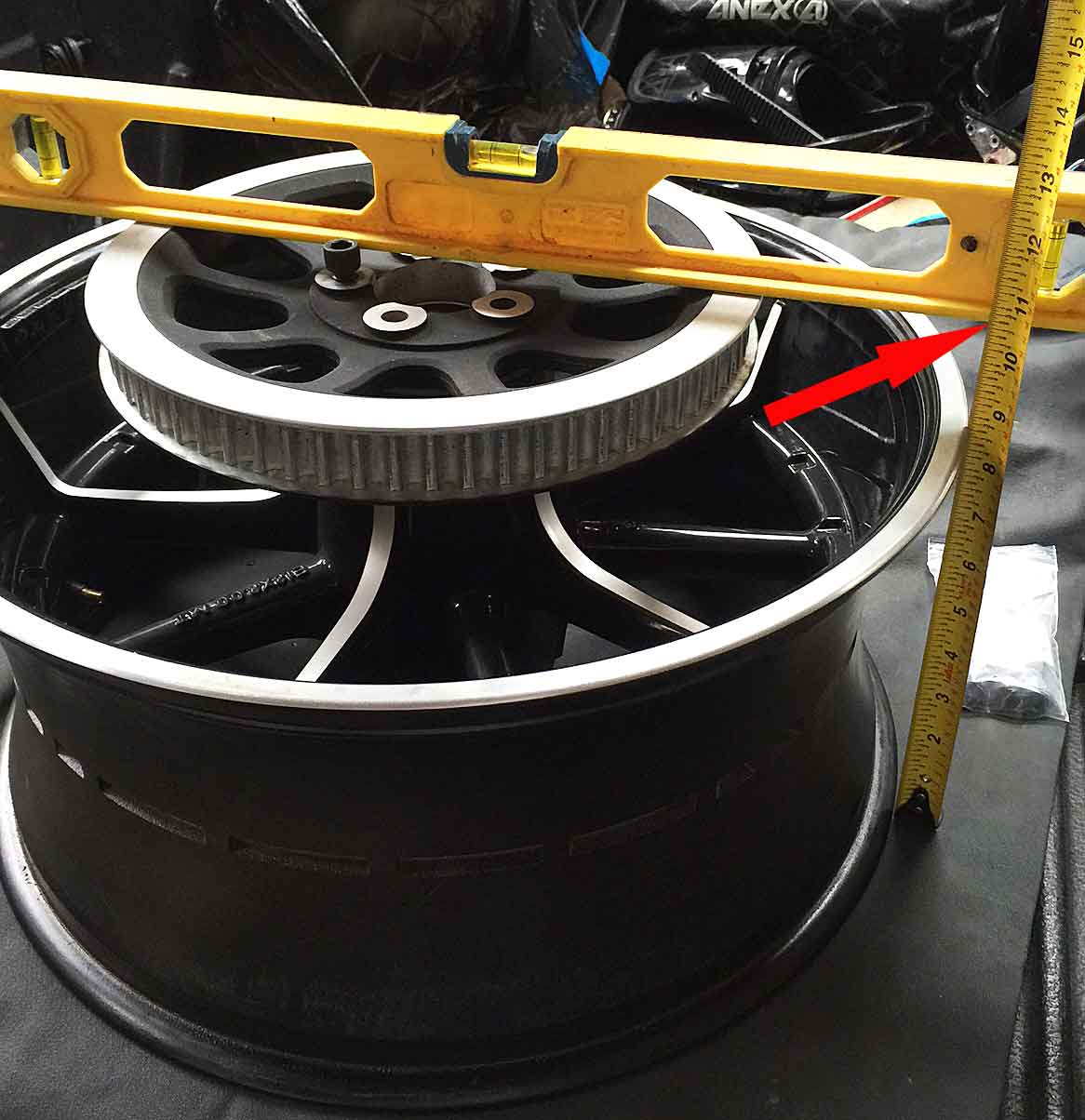
Measuring and checking pulley offset - stock pulley on stock wheel. lay straight edge across pulley face and measure from ground up to top outside edge of pulley.
your new pulley must sit at that same height so you would get the appropriate thickness spacer to push it outward.
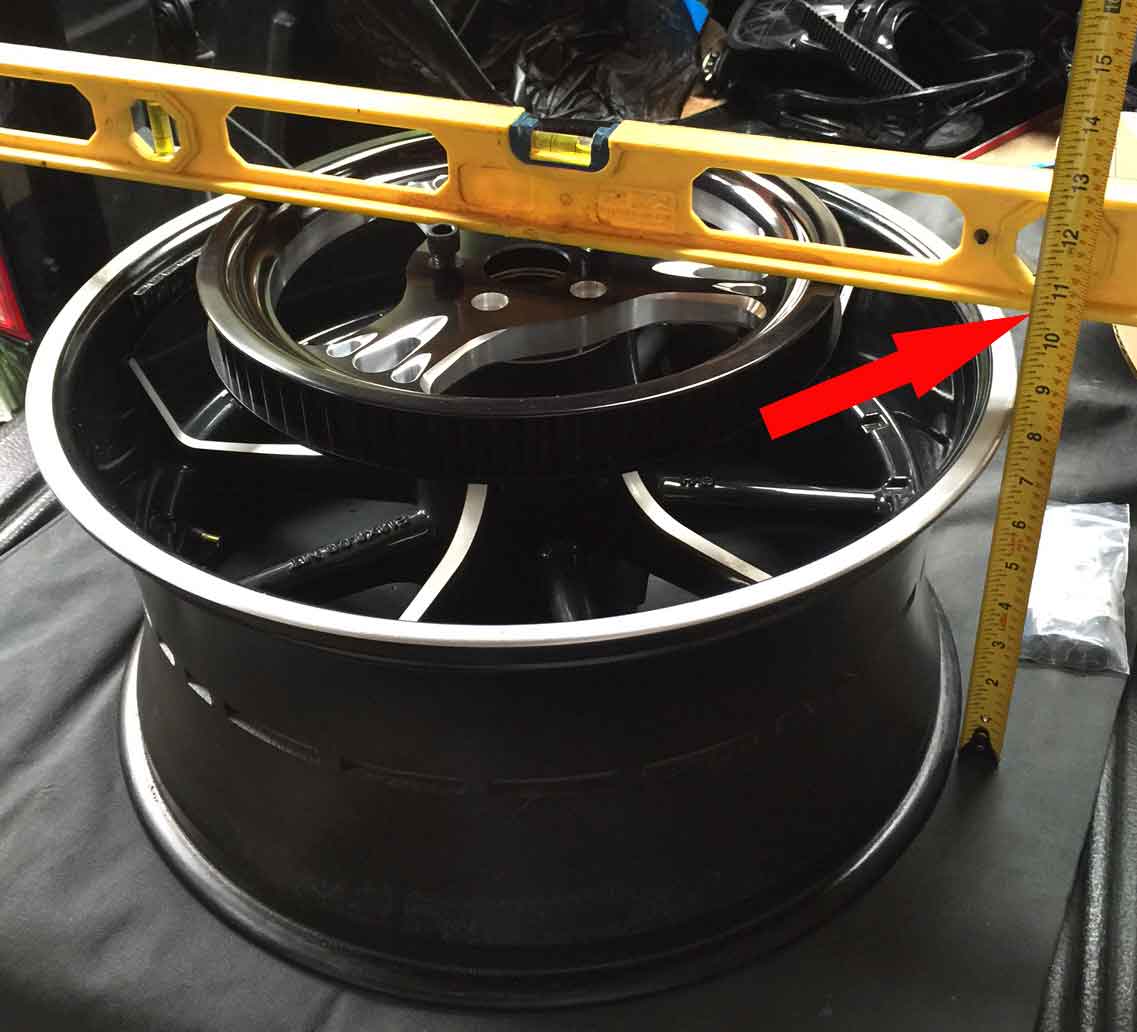
in this case I needed 1/4" and the DS .250" spacer was $9.95
remove stock pulley, place spacer onto wheel hub

place Ness pulley onto wheel, on top of spacer. hold with a couple of bolts.

side view of DS spacer between pulley and wheel hub

checking offset measurement of new pulley and spacer- in this case I am within 1/32" of the stock pulley outward measurement. not bad.
Part 2 coming hopefully this week, and hopefully with positive results!
Now all I have to do is see if I have the extra 0.31" of belt adjustment to put this sucker on. It looks like I have just under 1/2" of slot left so it's gonna be close!
Nine large PICS below so let them load:
Arlan Ness pulley #16-531 for a 2004-2006 FLHT (70t, 1.125" wide), Drag Specialties 1/4" pulley spacer, industrial Grade 10 round head socket cap screws 7/16" 14 x 1-3/4"
(you need at least grade 8 for pulley bolts)
Order pulley bolts from American Integrated, phone number is on the 2nd photo (bag of bolts). Best price you'll find and ultra high quality. They have all lengths / sizes.
DS spacer placed onto backside of Ness pulley:
New round head 7/16" socket cap bolts for pulley - should sit nicely in there.
Measuring and checking pulley offset - stock pulley on stock wheel. lay straight edge across pulley face and measure from ground up to top outside edge of pulley.
your new pulley must sit at that same height so you would get the appropriate thickness spacer to push it outward.
in this case I needed 1/4" and the DS .250" spacer was $9.95
remove stock pulley, place spacer onto wheel hub
place Ness pulley onto wheel, on top of spacer. hold with a couple of bolts.
side view of DS spacer between pulley and wheel hub
checking offset measurement of new pulley and spacer- in this case I am within 1/32" of the stock pulley outward measurement. not bad.
Part 2 coming hopefully this week, and hopefully with positive results!
Last edited by LA_Dog; Jan 18, 2016 at 09:31 PM.
anxious to see how you like the performance of the new gear change...been following your journey to gearing perfection
HD Forum Stories
The Best of Harley-Davidson for Lifelong Riders

7 Surprising Harley-Davidson Products that Are Not Motorcycles
Verdad Gallardo
8 Best Harley-Davidson Motorcycles Ever
Pouria Savadkouei
10 Worst Harley-Davidson Motorcycles Ever
Pouria Savadkouei
Killer Custom's Jail Break Is The Breakout That Refused to Blend In
Verdad Gallardo
Crazy Bunderbike Build Looks Amazing, But Is It Impossible to Ride?
Verdad Gallardo
Harley-Davidson Reveals Super Cool Cafe Racer Concept
Verdad Gallardo
Engraved Rebellion: Inside Bundnerbike's Glam Rock II
Verdad Gallardo
10 Motorcycles You Should Never Buy
Joe Kucinski
10 Things Harley-Davidson Needs to Fix in 2026
Verdad Gallardo
Outstanding HDF Member
Joined: Jun 2014
Posts: 3,185
Likes: 189
From: 90210
Jim- everyone- it FITS!! no problemo- Woot!! Belt just barely slides right over and there is plenty of belt adjustment. About 3.5 turns out on the adjusters and then aligned with my micrometer.
Pics coming later - I can't test ride it today due to rain and wet roads. but I've run the bike on the lift and it tracks true.
Offset is right on the money with the sportster sprocket and stock sprocket. this is with the 1/4" spacer of course, since this fancy billet pulley didn't come with enough offset for a 240 tire- but good thing is, spacers are cheap and plentiful in all sizes.
I wasn't too overly worried based on the math- calcs said I needed 0.31 of added belt adjustment and I had about 1/2". but heck you never know 100% until you bolt it up.
So Jim- no reason you can't buy one of the chrome design HD or aftermarket (RSD, PM, BDL Ness etc) 70t pulleys for a 2004-2006 FLHT or 2006 Dyna - something that will match with your CVO wheels. As long as the pulley has the 2.20 hub hole for 2001-up FXS/FXD bikes without IDS (cush drive) and is 1" to 1.125" wide you're good to go. the five hole bolt pattern is same and the axle size or axle spacers do not matter. Once you have the pulley, you would only need to determine the appropriate hub offset spacer and length of bolts- which is not hard to do. Once you have the parts this is no more difficult than replacing a rear pulley.
Pics coming later - I can't test ride it today due to rain and wet roads. but I've run the bike on the lift and it tracks true.
Offset is right on the money with the sportster sprocket and stock sprocket. this is with the 1/4" spacer of course, since this fancy billet pulley didn't come with enough offset for a 240 tire- but good thing is, spacers are cheap and plentiful in all sizes.
I wasn't too overly worried based on the math- calcs said I needed 0.31 of added belt adjustment and I had about 1/2". but heck you never know 100% until you bolt it up.
So Jim- no reason you can't buy one of the chrome design HD or aftermarket (RSD, PM, BDL Ness etc) 70t pulleys for a 2004-2006 FLHT or 2006 Dyna - something that will match with your CVO wheels. As long as the pulley has the 2.20 hub hole for 2001-up FXS/FXD bikes without IDS (cush drive) and is 1" to 1.125" wide you're good to go. the five hole bolt pattern is same and the axle size or axle spacers do not matter. Once you have the pulley, you would only need to determine the appropriate hub offset spacer and length of bolts- which is not hard to do. Once you have the parts this is no more difficult than replacing a rear pulley.
Last edited by LA_Dog; Jan 19, 2016 at 03:37 PM.